
Race with Buffalo
A story of the Cheyenne of the Great Plains
There was a time when all the animals lived in peace, when no one ate anyone else. All the animals were the same color, because they had not yet painted their faces.
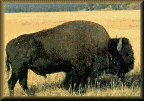
Buffalo was the largest and strongest of the animals, and he was getting hungry, He wanted to be the chief of all the animals.
He wanted to draw strength from all the other animals by eating their flesh. Buffalo wanted to become the eater of all the animals.
The Human People also said that they should become the chief of all the animals. People wanted to draw strength from all the other animals by eating their flesh. People wanted to become the eaters of all the other animals.
Buffalo challenged the Human People to a race, the winner of the race would become the chief of all the animals. The People said that they would accept such a challenge, but since buffaloes have four legs and people have only two, the People claimed the right to have another animal run the race in the People's place.
The buffaloes consented.
The People chose the Bird People to represent them in the race. They chose Hummingbird, Meadowlark, Hawk, and Magpie.
All the other animals and birds wanted to join the race, too, each of them thinking that just maybe they too had a chance to become chief of all the animals. All the animals took paint and painted their faces for the race, each according to his or her spiritual vision. Skunk painted a white strip on himself and his symbol for the race. Antelope painted himself the color of the earth for the race. Raccoon painted black circles around his eyes and around his tail. Robin painted herself brown with a red breast-plate.
The race was to be held at the edge of the Black Hills at the place known as Buffalo Gap.
The competitors would race from the starting line sticks to the turn around stick and then back to the starting line. All the animals, painted according to their vision,lined up between the sticks. Among the animals were the Bird People, who would run the race with their wings for the Human People, and Runs Slender Buffalo, the fastest runner of all the buffaloes.
The cry was given to begin and all the animals and birds set out on the race. Hummingbird took the lead, ahead of Runs Slender Buffalo, but his wings were so small that he soon fell behind. As the animals neared the turn around stick, Runs Slender Buffalo took the lead. Then Meadowlark came up beside Runs Slender Buffalo, and the two went along side by side right into the turn.
Runs Slender Buffalo wheeled around the stick, her hooves thundering, and she pulled away from Meadowlark, who went wide to make the turn.
The animals in the lead passed the late runners who were still headed for the stick. Meadowlark fell behind and cheered on Hawk as he passed her. Hawk gained on Run Slender Buffalo, and it looked like he might pass her. Her heart was pounding and her legs were tiring. But Hawk's wings were tiring also, and he soon fell behind.
Runs Slender Buffalo was nearing the finish line as the winner. It looked like the Buffalo People would become the eaters of all the animals!
Then, behind the buffalo woman, wings beating steadily, came Magpie. She was not a quick starter, but her wingbeats were hard and true. Her heart was strong. Her eyes did not wander from the finish line. She never looked back. Her wings were wide and she drove herself forward with beat after beat after beat. All the other animals had fallen behind. Runs Slender Buffalo looked over at the magpie, but the magpie never looked away from the starting sticks. With each beat of her wings she moved past Runs Slender Buffalo by no more than the length of her bill.
At the starting sticks, many animals began to line up to watch the finish. Raccoon, who had fallen out of the race early, had returned to the starting sticks. Now he stood up between the sticks and put out his little hands for the runners to touch as they passed. He would feel the touch of whoever was in the lead, and turn toward the winner.
Closer and closer came Runs Slender Buffalo, and some of the animals feared Raccoon would be trampled. Magpie gradually flew nearer to the ground so she could brush Raccoon's little hands as she flew past. Raccoon did not move, but stared straight at the onrushing pair. Magpie seemed to be pulling ahead. Runs Slender Buffalo leaned forward as she ran to touch Raccoon's hand with her great nose. Magpie's wingtip touched Raccoon's little hand and he turned toward her an instant before Runs Slender Buffalo thundered past and he was surrounded by a great cloud of dust. All the animals waited breathlessly for the dust to settle. At last, there stood Raccoon with his little hand raised toward the path of Magpie.
The Human People had won the race!
The Buffalo wandered the great plains and ate grass and the people became the great hunters, the chief of all animals.
WHERE THE GIRL SAVED HER BROTHER
[CHEYENNE]
In the summer of i876, the two greatest battles between soldiers and Indians were fought on the plains of Montana. The first fight was called the Battle of the Rosebud. The second, which was fought a week later, was called the Battle of the Little Bighorn, where General Custer was defeated and killed. The Cheyenne call the Battle of the Rosebud the Fight Where the Girl Saved Her Brother. Let me tell you why.
Well, a hundred years ago, the white men wanted the Indians to go into prisons called "reservations," to give up their freedom to roam and hunt buffalo, to give up being Indians. Some tamely settled down behind the barbed wire of the agencies, but others did not. Those who went to the reservations to live like white men were called "friendlies." Those who would not go were called "hostiles." They weren't hostile, really. They didn't want to fight; all they wanted was to be left alone to live the Indian way, which was a good way. But the soldiers would not leave them alone. They decided to have a great roundup and catch all "hostiles," kill those who resisted, and bring the others back to the agencies as prisoners.
Three columns of soldiers entered the last stretch of land left to the red man. They were led by Generals Crook, Terry, and Custer. Crook had the most men with him, about two thousand. He also had cannon and Indian scouts to guide him. At the Rosebud he met the united Sioux and Cheyenne warriors.
The Indians had danced the sacred sun dance. The great Sioux chief and holy man, Sitting Bull, had been granted a vision telling him that the soldiers would be defeated. The warriors were in high spirits. Some men belonging to famous warrior societies had vowed to fight until they were killed, singing their death songs, throwing their lives away, as it was called. They painted their faces for war. They put on their finest outfits so that if they were killed, their enemies would say: "This must have been a great chief. See how nobly he lies there."
The old chiefs instructed the young men how to act. The medicine
men prepared protective charms for the fighters, putting gopher dust on their hair or painting their horses with hailstone designs. This was to render them invisible to their foes, or to make them bullet-proof. Brave Wolf had the most admired medicine-a mounted hawk that he fastened to the back of his head. He always rode into battle blowing his eagle-bone whistle-and once the fight started, the hawk came alive and whistled too.
Many proud tribes were there besides the Cheyenne: the Hunkpapa, the Minniconjou, the Oglala, the Burned Thighs and the Two Kettles. Many brave chiefs and warriors came, including Two Moons, White Bull, Dirty Moccasins, Little Hawk, Yellow Eagle, and Lame White Man. Among the Sioux was the great Crazy Horse, and Sitting Bull - tbeir holy man, still weak from his flesh offerings made at the sun dance-and the fierce Rain-in-the-Face. Who can count them all! What a fine sight they were!
Those who had earned the right to wear warbonnets were singing,
lifting them up. Three times they stopped in their singing, and the fourth time they put the bonnets on their heads, letting the streamers fly and trail behind them. How good it must have been to see this!
Crazy Horse of the Oglala shouted his famous war cry: "A good day to die, and a good day to fight! Cowards to the rear, brave hearts - follow me!!!!"
The fight started. Many brave deeds were done, many coups counted. The battle swayed to and fro. More than anybody else's, this was the Cheyenne's fight. This was their day. Among them was a brave young girl, Buffalo-Calf-Road-Woman, who rode proudly beside her husband, Black Coyote. Her brother, Chief Comes-In-Sight, was in the battle too. She looked for him and at last saw him surrounded, his horse killed
from under him. Soldiers were aiming their rifles at him, while their Crow scouts circled around him and waited for an opportunity to count coups. But he fought them off with courage and skill.
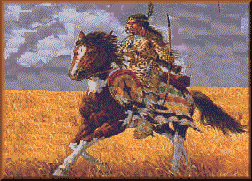
Buffalo-Calf-Road-Woman uttered a shrill, high-pitched war cry. She raced her pony into the midst of the battle, into the midst of the enemy. She made the spine-chilling, trilling, trembling sound of the Indian woman encouraging her man during a fight. Chief Comes-in-Sight jumped up on her horse behind her. Buffalo-Calf-Road-Woman laughed with joy and the excitement of battle, and all the while she sang. The soldiers were firing at her, and their Crow scouts were shooting arrows
at her horse, but it moved too fast for her and her brother to be hit. Then she turned her horse and raced up the hill from which the old chiefs and the medicine men were watching the battle.
The Sioux and Cheyenne saw what she was doing, and then the white
soldiers saw it too. They all stopped fighting and watched the brave girl saving her brother's life. The warriors raised their arms and set up a mighty shout - a long undulating war cry that made one's hair stand up on end. And even some of the soldiers threw their caps in the air and shouted "Hurrah!" in honor of Buffalo-Calf-Road-Woman.
The battle was still young. Not many men had been killed on either side, but the white general was thinking: "If their women fight like t his, what will their warriors be like? Even if I win, I will lose half my men." And so General Crook retreated a hundred miles or so. He was to have
joined up with Custer, Old Yellow Hair; but when Custer had to fight the same Cheyenne and Sioux a week later, Crook was far away and Custer's regiment was wiped out. So in a way, Buffalo-Calf-Road-Woman contributed to that battle too! Many who saw what she had done thought that she had counted the biggest coup of all-not taking life, but giving it. That's why the Indians call the Battle of the Rosebud the "Fight Where the Girl Saved Her Brother."
The spot where Buffalo-Calf-Road-Woman counted her coup has long
since been plowed under. A ranch now covers it. But the memory of her deed will last as long as there are Indians. This is not a fairy tale, but it sure is a legend.
-Told by Rachel Strange Owl, Birney, Montana,
with the assistance of two or three others. Recorded by
Richard Erdoes.
SUN TEACHES VEEHO A LESSON
[CHEYENNE]
Sun had beautiful, wonder-working leggings which could set the prairie on fire and drive the game toward the hunter's bow. Veeho, the clever trickster, greatly admired them, and one day when he came to visit, he sneaked off with them when Sun was not looking. Chuckling, Veeho said to himself, "Now I can work many miracles and be the world's greatest hunter."
Toward evening he was tired from running so fast and far. "Sun can't catch up with me now," he decided. Rolling up the magic-leggings and placing them under his head for a pillow, he lay down to sleep. He slept well, but in the morning he found himself back inside Sun's tipi. Veeho is so stupid he didn't know that all the world is contained within Sun's lodge. But though he was surprised to wake up there after having run so far and fast, he is hard to embarrass. Sun smiled and said: "What are you doing with my leggings?"
Veeho may be stupid, but he is never at a loss for an answer. He said, "I just put my head on them to sleep softly. I knew you wouldn't mind." "I don't mind," said Sun. "You can use therp as a pillow if you want to." Sun knew very well that Veeho was lying, as usual, and meant to steal the wonder-working leggings again. But he only said, "Well, I must go walk my daily path."
"Don't hurry back," said Veeho. "I'll keep an eye on your lodge." Once he could no longer see Sun, Veeho ran off with the leggings again, this time twice as fast and twice as far. Again he went to sleep, and again woke to find himself back inside Sun's tipi.
Sun laughed and told Veeho, "If you're that fond of my leggings, you can keep them. Let's pretend that I'm holding a giveaway feast and that you got these as a present." Veeho was overjoyed. "I never meant to steal these beautiful leggings, friend Sun. You know me-I'm always up to some trick; I was only fooling. But now that you've given them to me of your own free will, I gladly accept."
Veeho could hardly wait to get away from Sun's lodge and p ut on the leggings. Wearing them, he ran over the prairie and ignited the grass to drive the buffalo toward him. But Veeho did not have Sun's power; he couldn't handle such a big fire, and it scorched his soles and blistered his feet. "Friend Sun, come and help me!" he cried. "Help your poor friend! Where are you, Sun? Come put the fire out!" But Sun pretended not to hear, and soon Veeho's leggings were on fire. Crying from pain, he plunged into the nearest stream. By then it was too late; the leggings were ruined and Veeho's legs blistered. When Veeho begged Sun to make him a new pair of leggings, Sun said, "Even I can't make magic leggings but once. I'm sorry, friend. Be more careful in the future." Sun could easily have made another pair, of course, but then Veeho wouldn't have learned a lesson.
-Told by Strange Owl in Birney, Montana, and recorded by Richard Erdoes.
Veeho is a prototype trickster, and the word is used today to mean white man.In a Blackfoot variation of this tale, Sun visits the same retribution on Old Man, who has stolen his porcupine-quill leggings.
The Strange Owl family are traditional Cheyenne who live in Birney, Montana, on the Lame Deer Cheyenne Reservation, and in other Western states. Many members of this family are known for their fine beadwork and knowledge of Indian crafts.
GO TO "Cheyenne 3 (Legends 2)"
Return to Main Menu
A story of the Cheyenne of the Great Plains
There was a time when all the animals lived in peace, when no one ate anyone else. All the animals were the same color, because they had not yet painted their faces.
Buffalo was the largest and strongest of the animals, and he was getting hungry, He wanted to be the chief of all the animals.
He wanted to draw strength from all the other animals by eating their flesh. Buffalo wanted to become the eater of all the animals.
The Human People also said that they should become the chief of all the animals. People wanted to draw strength from all the other animals by eating their flesh. People wanted to become the eaters of all the other animals.
Buffalo challenged the Human People to a race, the winner of the race would become the chief of all the animals. The People said that they would accept such a challenge, but since buffaloes have four legs and people have only two, the People claimed the right to have another animal run the race in the People's place.
The People chose the Bird People to represent them in the race. They chose Hummingbird, Meadowlark, Hawk, and Magpie.
All the other animals and birds wanted to join the race, too, each of them thinking that just maybe they too had a chance to become chief of all the animals. All the animals took paint and painted their faces for the race, each according to his or her spiritual vision. Skunk painted a white strip on himself and his symbol for the race. Antelope painted himself the color of the earth for the race. Raccoon painted black circles around his eyes and around his tail. Robin painted herself brown with a red breast-plate.
The race was to be held at the edge of the Black Hills at the place known as Buffalo Gap.
The competitors would race from the starting line sticks to the turn around stick and then back to the starting line. All the animals, painted according to their vision,lined up between the sticks. Among the animals were the Bird People, who would run the race with their wings for the Human People, and Runs Slender Buffalo, the fastest runner of all the buffaloes.
The cry was given to begin and all the animals and birds set out on the race. Hummingbird took the lead, ahead of Runs Slender Buffalo, but his wings were so small that he soon fell behind. As the animals neared the turn around stick, Runs Slender Buffalo took the lead. Then Meadowlark came up beside Runs Slender Buffalo, and the two went along side by side right into the turn.
Runs Slender Buffalo wheeled around the stick, her hooves thundering, and she pulled away from Meadowlark, who went wide to make the turn.
The animals in the lead passed the late runners who were still headed for the stick. Meadowlark fell behind and cheered on Hawk as he passed her. Hawk gained on Run Slender Buffalo, and it looked like he might pass her. Her heart was pounding and her legs were tiring. But Hawk's wings were tiring also, and he soon fell behind.
Runs Slender Buffalo was nearing the finish line as the winner. It looked like the Buffalo People would become the eaters of all the animals!
Then, behind the buffalo woman, wings beating steadily, came Magpie. She was not a quick starter, but her wingbeats were hard and true. Her heart was strong. Her eyes did not wander from the finish line. She never looked back. Her wings were wide and she drove herself forward with beat after beat after beat. All the other animals had fallen behind. Runs Slender Buffalo looked over at the magpie, but the magpie never looked away from the starting sticks. With each beat of her wings she moved past Runs Slender Buffalo by no more than the length of her bill.
At the starting sticks, many animals began to line up to watch the finish. Raccoon, who had fallen out of the race early, had returned to the starting sticks. Now he stood up between the sticks and put out his little hands for the runners to touch as they passed. He would feel the touch of whoever was in the lead, and turn toward the winner.
Closer and closer came Runs Slender Buffalo, and some of the animals feared Raccoon would be trampled. Magpie gradually flew nearer to the ground so she could brush Raccoon's little hands as she flew past. Raccoon did not move, but stared straight at the onrushing pair. Magpie seemed to be pulling ahead. Runs Slender Buffalo leaned forward as she ran to touch Raccoon's hand with her great nose. Magpie's wingtip touched Raccoon's little hand and he turned toward her an instant before Runs Slender Buffalo thundered past and he was surrounded by a great cloud of dust. All the animals waited breathlessly for the dust to settle. At last, there stood Raccoon with his little hand raised toward the path of Magpie.
The Buffalo wandered the great plains and ate grass and the people became the great hunters, the chief of all animals.
In the summer of i876, the two greatest battles between soldiers and Indians were fought on the plains of Montana. The first fight was called the Battle of the Rosebud. The second, which was fought a week later, was called the Battle of the Little Bighorn, where General Custer was defeated and killed. The Cheyenne call the Battle of the Rosebud the Fight Where the Girl Saved Her Brother. Let me tell you why.
Well, a hundred years ago, the white men wanted the Indians to go into prisons called "reservations," to give up their freedom to roam and hunt buffalo, to give up being Indians. Some tamely settled down behind the barbed wire of the agencies, but others did not. Those who went to the reservations to live like white men were called "friendlies." Those who would not go were called "hostiles." They weren't hostile, really. They didn't want to fight; all they wanted was to be left alone to live the Indian way, which was a good way. But the soldiers would not leave them alone. They decided to have a great roundup and catch all "hostiles," kill those who resisted, and bring the others back to the agencies as prisoners.
Three columns of soldiers entered the last stretch of land left to the red man. They were led by Generals Crook, Terry, and Custer. Crook had the most men with him, about two thousand. He also had cannon and Indian scouts to guide him. At the Rosebud he met the united Sioux and Cheyenne warriors.
The Indians had danced the sacred sun dance. The great Sioux chief and holy man, Sitting Bull, had been granted a vision telling him that the soldiers would be defeated. The warriors were in high spirits. Some men belonging to famous warrior societies had vowed to fight until they were killed, singing their death songs, throwing their lives away, as it was called. They painted their faces for war. They put on their finest outfits so that if they were killed, their enemies would say: "This must have been a great chief. See how nobly he lies there."
The old chiefs instructed the young men how to act. The medicine
men prepared protective charms for the fighters, putting gopher dust on their hair or painting their horses with hailstone designs. This was to render them invisible to their foes, or to make them bullet-proof. Brave Wolf had the most admired medicine-a mounted hawk that he fastened to the back of his head. He always rode into battle blowing his eagle-bone whistle-and once the fight started, the hawk came alive and whistled too.
Many proud tribes were there besides the Cheyenne: the Hunkpapa, the Minniconjou, the Oglala, the Burned Thighs and the Two Kettles. Many brave chiefs and warriors came, including Two Moons, White Bull, Dirty Moccasins, Little Hawk, Yellow Eagle, and Lame White Man. Among the Sioux was the great Crazy Horse, and Sitting Bull - tbeir holy man, still weak from his flesh offerings made at the sun dance-and the fierce Rain-in-the-Face. Who can count them all! What a fine sight they were!
Those who had earned the right to wear warbonnets were singing,
lifting them up. Three times they stopped in their singing, and the fourth time they put the bonnets on their heads, letting the streamers fly and trail behind them. How good it must have been to see this!
Crazy Horse of the Oglala shouted his famous war cry: "A good day to die, and a good day to fight! Cowards to the rear, brave hearts - follow me!!!!"
The fight started. Many brave deeds were done, many coups counted. The battle swayed to and fro. More than anybody else's, this was the Cheyenne's fight. This was their day. Among them was a brave young girl, Buffalo-Calf-Road-Woman, who rode proudly beside her husband, Black Coyote. Her brother, Chief Comes-In-Sight, was in the battle too. She looked for him and at last saw him surrounded, his horse killed
from under him. Soldiers were aiming their rifles at him, while their Crow scouts circled around him and waited for an opportunity to count coups. But he fought them off with courage and skill.
Buffalo-Calf-Road-Woman uttered a shrill, high-pitched war cry. She raced her pony into the midst of the battle, into the midst of the enemy. She made the spine-chilling, trilling, trembling sound of the Indian woman encouraging her man during a fight. Chief Comes-in-Sight jumped up on her horse behind her. Buffalo-Calf-Road-Woman laughed with joy and the excitement of battle, and all the while she sang. The soldiers were firing at her, and their Crow scouts were shooting arrows
at her horse, but it moved too fast for her and her brother to be hit. Then she turned her horse and raced up the hill from which the old chiefs and the medicine men were watching the battle.
The Sioux and Cheyenne saw what she was doing, and then the white
soldiers saw it too. They all stopped fighting and watched the brave girl saving her brother's life. The warriors raised their arms and set up a mighty shout - a long undulating war cry that made one's hair stand up on end. And even some of the soldiers threw their caps in the air and shouted "Hurrah!" in honor of Buffalo-Calf-Road-Woman.
The battle was still young. Not many men had been killed on either side, but the white general was thinking: "If their women fight like t his, what will their warriors be like? Even if I win, I will lose half my men." And so General Crook retreated a hundred miles or so. He was to have
joined up with Custer, Old Yellow Hair; but when Custer had to fight the same Cheyenne and Sioux a week later, Crook was far away and Custer's regiment was wiped out. So in a way, Buffalo-Calf-Road-Woman contributed to that battle too! Many who saw what she had done thought that she had counted the biggest coup of all-not taking life, but giving it. That's why the Indians call the Battle of the Rosebud the "Fight Where the Girl Saved Her Brother."
The spot where Buffalo-Calf-Road-Woman counted her coup has long
since been plowed under. A ranch now covers it. But the memory of her deed will last as long as there are Indians. This is not a fairy tale, but it sure is a legend.
-Told by Rachel Strange Owl, Birney, Montana,
with the assistance of two or three others. Recorded by
Richard Erdoes.
Sun had beautiful, wonder-working leggings which could set the prairie on fire and drive the game toward the hunter's bow. Veeho, the clever trickster, greatly admired them, and one day when he came to visit, he sneaked off with them when Sun was not looking. Chuckling, Veeho said to himself, "Now I can work many miracles and be the world's greatest hunter."
Toward evening he was tired from running so fast and far. "Sun can't catch up with me now," he decided. Rolling up the magic-leggings and placing them under his head for a pillow, he lay down to sleep. He slept well, but in the morning he found himself back inside Sun's tipi. Veeho is so stupid he didn't know that all the world is contained within Sun's lodge. But though he was surprised to wake up there after having run so far and fast, he is hard to embarrass. Sun smiled and said: "What are you doing with my leggings?"
Veeho may be stupid, but he is never at a loss for an answer. He said, "I just put my head on them to sleep softly. I knew you wouldn't mind." "I don't mind," said Sun. "You can use therp as a pillow if you want to." Sun knew very well that Veeho was lying, as usual, and meant to steal the wonder-working leggings again. But he only said, "Well, I must go walk my daily path."
"Don't hurry back," said Veeho. "I'll keep an eye on your lodge." Once he could no longer see Sun, Veeho ran off with the leggings again, this time twice as fast and twice as far. Again he went to sleep, and again woke to find himself back inside Sun's tipi.
Sun laughed and told Veeho, "If you're that fond of my leggings, you can keep them. Let's pretend that I'm holding a giveaway feast and that you got these as a present." Veeho was overjoyed. "I never meant to steal these beautiful leggings, friend Sun. You know me-I'm always up to some trick; I was only fooling. But now that you've given them to me of your own free will, I gladly accept."
Veeho could hardly wait to get away from Sun's lodge and p ut on the leggings. Wearing them, he ran over the prairie and ignited the grass to drive the buffalo toward him. But Veeho did not have Sun's power; he couldn't handle such a big fire, and it scorched his soles and blistered his feet. "Friend Sun, come and help me!" he cried. "Help your poor friend! Where are you, Sun? Come put the fire out!" But Sun pretended not to hear, and soon Veeho's leggings were on fire. Crying from pain, he plunged into the nearest stream. By then it was too late; the leggings were ruined and Veeho's legs blistered. When Veeho begged Sun to make him a new pair of leggings, Sun said, "Even I can't make magic leggings but once. I'm sorry, friend. Be more careful in the future." Sun could easily have made another pair, of course, but then Veeho wouldn't have learned a lesson.
-Told by Strange Owl in Birney, Montana, and recorded by Richard Erdoes.
Veeho is a prototype trickster, and the word is used today to mean white man.In a Blackfoot variation of this tale, Sun visits the same retribution on Old Man, who has stolen his porcupine-quill leggings.
The Strange Owl family are traditional Cheyenne who live in Birney, Montana, on the Lame Deer Cheyenne Reservation, and in other Western states. Many members of this family are known for their fine beadwork and knowledge of Indian crafts.
Main Menu