
For many tribes of Plains Indians whose bison-hunting culture flourished during the 18th and 19th centuries, the sun dance was the major communal religious ceremony. Generally held in late spring or early summer, the rite celebrates renewal the spiritual rebirth of participants and their relatives a; well as the regeneration of the living earth with all its components. The eagle, a highly important sacred animal in Plains belief, plays a major role in the sun dance. Most obviously, the bird partakes of the ritual by having his nest represented at the fork of the lodge. In Arapaho mythology, this nest symbolizes the thunderbird, or eagle, who built his nest in a cottonwood tree. "Just as [these] birds fly about overlooking the earth, so does the Father. It is the buffalo, however, as the very source of life for the Plains tribes, who occupies the central role in the sun dance. From that animal, Plains people once derived not only meat for sustenance, but skins for tipis, fur for robes, and virtually all materials for the tools and objects necessary for everyday living. Crows still commemorate the buffalo's fulfillment of their needs in former times. "Even today, Crows view the buffalo as a provider of good things for living. 'It represents plenty to eat, plenty to wear, and a peaceful wholesome life.'" The buffalo symbolizes the "necessities without which life would be hazardous and wearisome," and "also bestows gr ea t curing powers." In the contemporary sun dance, it still "radiates power" (Vogel, 1984, pp. 307, 312 ). As the Cheyenne sun dance progresses, buffalo songs change in tempo. "The rattle beat becomes slow and ponderous, as if a great herd of buffalo was moving across the prairie." A Cheyenne who was present the first time these buffalo songs were sung in the sun dance lodge related that "as they were chanted, a herd of buffalo bulls ran over the hill and down into the camp" (Powell, 1969, vol. 2, p. 658)."" Formerly the Hidatsas, Arikaras, and Shoshones prepared the head of a buffalo killed in a special hunt so that it looked alive during the sun dance. Today the Shoshones and Crows use a mounted head that is kept from year to year for that purpose. The stuffed buffalo head is tied near the fork of the center pole during the ceremony. Representing the great herds upon which the tribes once depended, it remains as a symbol of abundance (Frey, 1987, p. 105; Laubin, 1977, pp. 313-14). In earlier times, some form of a buffalo calf or its hide was placed at the top of the center pole. The initiator of a Sisseton Sioux sun dance would prepare a life-like stuffed calf or yearling for this purpose which in later years was replaced by a small rawhide buffalo effigy (Skinner, 1919:383). While placing the skin of a young buffalo at the top of the tree, the Oglala pledger would say: In some tribal sun dances, a pair of rawhide effigies, one in the shape of a buffalo and one in the shape of a man, were suspended from the center pole under its fork. The Oglala offered these figures to the six directions with a prayer stating that the buffalo which had been provided is "the chief of all the four-leggeds upon our sacred Mother; from him the people live, and with him they walk the sacred path. Behold, too, this two-legged, who represents all the people.,' Wakan-Tanka was asked to bestow upon "these two chiefs ... all the favours that they ask for" (Brown, 1967, p. 79). In the ceremony the buffalo represents the people and the universe and should always be treated with respect, for was he not here before the two-legged peoples, and is he not generous in that he gives us our homes and our food? The buffalo is wise in many things, and, thus, we should learn from him and should always be as a relative with him. (Brown, 1967, p. 72)
The sun dance reflects relationships with nature that are characteristic of the Plains ethos, and includes symbolic representations of various animal species, particularly the eagle and the buffalo, that once played vital roles in the lives of the people and are still endowed with sacredness and special powers. The ritual, involving sacrifice and supplication to insure harmony between all living beings, continues to be practiced by many contemporary native Americans.
For many tribes of Plains Indians whose buffalo-hunting culture flowered during the 18th and 19th centuries, the sun dance was
the major communal religious ceremony. Although details of the event differed in various groups, certain elements were common to most tribal traditions. Generally, the annual ceremony was held in late spring or early summer when people from different bands gathered together again following the dispersal that customarily took place in winter.
The sun dance, a ritual of sacrifice performed by virtually all of the High Plains peoples, has been described among the Arapaho, Arikara, Assiniboin,Bannock, Blackfeet, Blood, Cheyenne, Plains Cree, Crow, Gros Ventre, Hidatsa, Kiowa, Mandans, Ojibway, Omaha, Ponca,Sarsi, Shoshone, Sioux (Dakota), and Ute (Spier, 1921, p. 459; Liberty, 1980, pp. 165-66). Today many of these tribes still carry out the sun dance, sometimes in altered form.
The overall significance of the sun dance involves renewal the spiritual renewal of participants and their relatives as well as the renewal of the living earth and all its components. In its broadest aspects, kinships within both the social and natural realms are reaffirmed.
This regenerative theme is evidenced by the Cheyenne, for example, through naming the structure in which the ritual takes place the New-Life-Lodge. This term expresses the idea that the sun dance is supposed to "re-create, to re-form, to reanimate the earth, vegetation, [and] animal life" and hence is a "ceremony of rebirth or renaissance" (Dorsey, 1905a, p. 57).
Specific reasons for participation vary among individuals and tribes. Motivations for the sacrifice include thankfulness for
blessings received, the fulfillment of a vow previously made in return for the beneficial outcome of a certain crisis, and the desire to insure the safety of a person in the armed forces or to obtain a cure for a sick relative.
Less specifically, the ordeal may be undertaken to promote the general welfare of the dancers people. Historically, Crows held the dance to seek aid in obtaining vengeance for kin killed in warfare (Lowie, 1935, p. 297). Some tribal traditions include the transfer of sacred medicine bundles in the context of the ceremony.
Generally, each sun dance has a sponsor or pledger, usually the main dancer, who bears the expenses of the ceremony. The event ordinarily involves about a week or more of activity consisting of an early private period, during which preparations are made and instruction and prayer take place, followed by the public phase of dancing.
Dancers fast and abstain from drinking during the three or four days of dancing. While special songs are chanted by drummers near the lodge entrance, each participant moves rhythmically back and forth from the periphery of the lodge to the center pole. Dancers continuously blow on eagle- bone whistles, fixing their eyes on the crotch in the center pole that is typically known as the Thunderbirds Nest or eagles nest.
Periods of rest alternate with intervals of dancing. At the end of the sun dance, purification rites are held and the participants may drink water and break their fast.
The lodge is then abandoned, its components remaining briefly as a reminder of the ceremony before returning to the elements.
In former times, voluntary torture was part of the climax of the sun dance in certain tribes such as the Sioux and Cheyenne. In
those cases, the dancers were pierced through the breast or shoulder muscles by skewers which were tied to the center pole,
and they danced by pulling back until their flesh tore away.
Sometimes the thongs inserted in the sufferers bodies were attached to a varying number of buffalo skulls rather than to the center pole (Spier, 1921, pp. 474-75; Walker, 1917, pp. 116-19; Laubin, 1977, pp. 291- 92).
Sun dance participants strive to obtain supernatural aid and personal power through their sacrifice which will not only assure the accomplishment of desired outcomes but which will bring them a richer and more meaningful life as a member of their society.
The sacred ritual reaffirms tribal membership and cultural identity and ensures that the people will prosper for another year. Following the sun dance, there is a renewed feeling of social harmony. And because of a world view that includes nature and all living beings within the realm of kinship, that sense of harmony extends beyond human relationships to include the entire creation.
As one contemporary native American explains, the sun dance "is the ritual reenactment of the relationship the Plains people see between consecration of the human spirit and Wakan Tanka [God] as manifested as Sun, or Light, and Life-Bestower. Through purification, participation, sacrifice, and supplication, the participants act as instruments or transmitters of increased power and wholeness . . . from Wakan Tanka." The purpose of the ceremony is "to integrate: to fuse the individual with his or her fellows, the community of people with that of the other kingdoms, and this larger communal group with the worlds beyond this one. . . The person sheds the isolated, individual personality and is restored to conscious harmony with the universe." The community "is the bedrock of tribal life" and it "necessarily includes all beings that inhabit the tribe's universe"
(Allen, 1986, pp. 61-63).
Although many in-depth studies of the sun dance have been made by anthropologists, the inclusion of symbolic animals in the
ceremony has received only passing mention. I first became interested in the role of animals in the ritual when attending a Crow Indian sun dance during my field research on the Crow Reservation in June 1980. During that ceremony, everyone in
attendance was requested not to kill any animals or birds on or near the grounds where the sun lodge had been erected for the
duration of the sun dance.
This prohibition was part of the effort to maintain a sense of harmony between people and nature essential to the promotion of healing and regeneration of life that is the central focus of the ceremony.
Integration with the rest of creation is expressed throughout the sun dance by symbolic objects that represent attributes of
various animal kin. For example, Sioux participants may wear the skins of rabbits on their arms and legs, for "the rabbit
represents humility, because he is quiet and soft and not self-asserting a quality we must all possess when we go to the center of the world" (Brown, 1967, p. 85).
The wearing of strips of rabbit fur by the Cheyennes who build the sun dance lodge may refer back to the time when the tribe lived in the north and subsisted chiefly on rabbits (Grinnell, 1923, vol. 2, p. 218).
The Arapaho sun dance involves a rabbit-tip), whose name originated from the myth in which rabbits conducted the secret
ceremonies of the sun dance lodge. Those who still perform the rites are called Rabbit-men (Dorsey, 1903, p. 37). Weasel and
otter hides, because they come from "tough little animals", are linked to the Crow sun dance (Vogel, 1984, p. 253), probably
conferring endurance. For the Lakota, these two animals are especially "wakan"' meaning akin to sacred (Walker, 1980, pp.
101, 168).
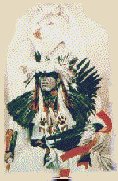
He is in the form of a bird" (Dorsey, 1903, p. 114). Some tribes, notably the Crow and Shoshone, fasten an actual mounted golden eagle to the rafter over the entrance or near the nest. Considered "chief of all the creatures of the air," and "powerful in battle," the bird acts as "guardian protecting the people from evil." The eagle is admired for courage, swiftness, and strength.
Sometimes identified as the thunderbird, he is distinguished by his extraordinarily high flight, bringing him nearer to the
sun and in closer proximity to the Great Mystery than any other creature (Laubin, 1977,pp.279,315;Grinnell,1923,vol. 1, p.
188).
The eagle is associated with success, for "prosperity and wealth follow the eagle, who may bestow the gift of curing" (Vogel, 1984, p. 312).
Eagles "have sharp eyes and know everything" (Brown, 1967, p. 77). As expressed by a contemporary Sioux medicine man,
"in an eagle there is all the wisdom of the world" (Lame Deer and Erdoes, 1972, p. 136).
A Crow who is dancing intensely may focus on the eagle at the top of the pole. The eagle may "finally move and show itself to
the person," and "may begin to dance alongside one as he 'charges' and dances back from the center pole."
The eagle may then accompany that person in a vision, dancing beside him and instructing him about the medicine acquired through the vision. On the second day of the dance, a participant may see the eagle soaring above the lodge. "The eagle is alive with a beauty and strength unmatched anywhere, having been endowed with keen eyesight as well as foresight."
The bird carries the Creator's messages and symbolizes forthcoming blessings (Frey, 1987, pp. 108-109, 118). In unison, each dancer constantly blows upon a whistle fashioned from an eagle's wing bone, making sounds like the cry of an eagle, keeping time with the drum.
This activity symbolizes the force of prayers which rise high like eagles to reach the Great Mystery. According to Black Elk, the sound made by the whistle "is the voice of the Spotted Eagle; our Grandfather, Wakan-Tanka, always hears this, for ... it is really His own voice" (Brown, 1967, p. 71).
The whistle is painted with colored dots and lines to represent the remarkable perception of the eagle. The fluffy down feather at the end of the whistle is blown back and forth, representing breath and life (Mails, 1972, pp. 165, 167; Laubin, 1977, p. 279).
The plume is "taken from the breast of the eagle, for this is the place which is nearest to the heart and center of the sacred bird" (Brown, 1967, p. 71). Under certain conditions, when a dancer suffers greatly from thirst, water may come to the eagle-bone whistle (Frey, 1987, p. 140).
Because of the eagle's special capacities, his feathers have supernatural and curative functions. An observer recorded that once when the thirst of some Arapaho dancers became intense, a participant used an eagle feather to bring a refreshing rain
(Shimkin, 1953, pp. 449-50).
During the sun dance, a medicine man may direct his eagle-feather fan toward the bodies of people who seek healing. The feathers are first touched to the center pole and then to the patient, transmitting power from the pole to the sufferer. The sun dance leader brushes away illness with a feather. Fanning motions directed to the body may withdraw and whip away causes of sickness.
Feathers are held upward toward the sky to reach the eagle so that the bird maybear the prayers for curing upward to the Creator (Frey, 1987, p. 134; Shimkin, 1953, p. 448; Voget, 1984, p. 240).
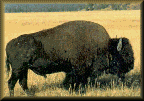
Proximity of buffalo herds as influenced by their migrations indeed determined the time and locality chosen for the great
ceremonial (Roe, 1970, p. 664). The preeminent status of the buffalo is illustrated by the fact that in certain tribes, the origin of the sun dance is traced to the buffalo. The inception of the ceremonial involves a visionary encounter between a person and a buffalo emissary with supernatural power. Ute and Shoshone myths, for example, reveal that the buffalo helped the individual who began the tradition, giving him instructions as to how to carry out the dance and revealing the benefits that would follow from proper performance of the ritual (Jorgensen, 1972, p. 26). For the Lakota, it was a deity in the form of a White Buffalo, who brought the Sacred Pipe through which all ceremonies and rituals are empowered (Allen, 1986, p. 16).
The Cheyenne sun dance was taught by the Creator to a medicine man, later known as Erect-Horns because of the buffalo horn cap he wore. He journeyed to a high peak in the company of a woman and when the couple came forth from the mountain to return home, "the whole earth seemed to become new, and there came forth buffalo that followed them" (Dorsey, 1905, p. 48).
Themes relating to the buffalo consistently occur throughout the sun dance. Historically, various ceremonies relating to the
animal have taken place as a preliminary to the climactic dancing. A sacred song of the Oglala Sioux that followed certain rituals pertaining to the buffalo skull expresses the participants' desire for blessings and its association with the buffalo's power:
Buffalo ceremonies, buffalo dances, and feasts of buffalo flesh were sometimes included as preliminaries to prayers that the
Great Mystery would "heed the words of the Buffalo which He will speak that night in commendation of the people." A Sioux shaman dedicated food to "the God of generosity, the Buffalo God." In buffalo dances, participants "imitate the pawing of a buffalo bull in rage or defiance and ... manifest a defiant bravery of the dancers equal to that of the buffalo bull." While dancing, they "gaze continually at the ornamented buffalo head." Those who complete "four periods of this dance become buffalo men" (Walker, 1917, pp. 104, 115). After the tree to be used as the center pole had been chosen, Sioux Buffalo Cult members carried out a ceremony to honor the buffalo and bring his spirit to the dance (Laubin, 1977, p. 279).
Flesh of the animal was utilized in various ways. Prior to inserting the center pole into the ground, the Sioux placed buffalo fat into the hole. Before the dancing began, the sacred sun dance pipe was filled and sealed with fat from a buffalo's heart. A buckskin bag containing a piece of buffalo hump, the choicest of all parts, was suspended from the bundle of branches above the pole. A feast of buffalo flesh often followed the termination of the sun dance. Buffalo tongues, as "the most sacred part of the most sacred animal"' were an important feature of the sun dance in many tribes. In preparation for the Blackfoot sun dance, one-hundred tongues were gathered and prepared according to proscribed rituals and consumed as sacramental food during the ceremony. The tongues were "prayed and sung over" and were consecrated to the sun. A feast of buffalo tongues preceded the onset of the dancers fasting among the Lakota and Blackfoot (Laubin, 1977, pp. 278, 282, 283; Frey, 1987, p. 121; Melody, 1976; Harrod, 1987, p. 125; Wissler, 1918, pp. 235-39; McClintock, 1910, p. 305).
"It is from this buffalo person that our people live; he gives to us our homes, our clothing, our food, everything we need. O buffalo calf, I now give to you a sacred place upon the tip of the tree. This tree will hold you in his hand and will raise you up to Wakan-Tanka. Behold what I am about to do! Through this, all things that move and fly upon the earth and in the heavens will be happy!" (Brown, 1967, pp. 78-79)
Charles Eastman, a Sioux, states that the man was painted red and the buffalo black. "The paint indicated that the man who was about to give thanks publicly had been potentially dead, but was allowed to live by the mysterious favor and interference of the Giver of Life. The buffalo hung opposite the image of his own body in death, because it was the support of his physical self' (1970, pp. 59-60). In J. R. Walker's account, both the buffalo bull and the man were painted black and were depicted with exaggerated genitals. Incantations were made to impart potency to the figures (1917, p. 108). Formerly, as a preliminary to the Teton Sioux sun dance, warriors shot at the rawhide effigies to represent "the overcoming of enemies and the success of many buffalo hunts" (Laubin, 1977, p. 283).
Various parts and products of the buffalo are incorporated into the sun dance. The officiating Sioux priest wore buffalo horns
upon his head. He might attach bands of buffalo skin with loosening hair to his ankles and wrists, and his robe came from a
buffalo who was shedding. Special power was attributed to the shed hair of the all- important animal (Laubin, 1977, p. 286).
The thongs used by the Sioux in the self-torture ritual were made of buffalo rawhide (Brown, 1967, p. 95). Among the Cheyenne "in earlier times, the buffalo rawhide was used as the drum throughout the ceremonies, thus continuing the principle that all essential sacred items in the sun dance are related to the buffalo" (Powell, 1969, vol. 2, p. 660). At a certain point in the Lakota ritual, a dried buffalo penis was placed against the center pole. This was done to "give increased virility to the dancers," so "they could get more children" (Walker, 1917, p. 110; 1980, p. 36). The center pole is viewed as a conductor of life, and therefore leaning the buffalo phallus against it confirms the pole's association with fertility and reinforces the symbolic meaning of the ceremony as a celebration of the generative power of the sun. The cottonwood pole, as "the conduit of life for the dancers and for the people" could be "understood to be the sun's phallus" (Melody, 1976, pp. 454-55). A rattle made of buffalo scrotum once played a role in the Shoshone sun dance ritual (Shimkin, 1953, p. 444). Sioux dancers undergoing the self-torture phase of the ceremony were given buffalo tails for use as fly brushes and fans (Laubin, 1977, p. 291).
Ritual burning of buffalo chips was also practiced. After the site for the sun dance lodge had been chosen, buffalo chips were
lighted on the sacred spot where the holy tree was to be erected (Laubin, 1977, p. 280). Lakota belief held that smoke from the buffalo chips was "an incense to propitiate the Buffalo God." Pieces of dry buffalo excrement "have a wakanla, or spirit-like of themselves" and this spirit-like is released by burning, as the smoke, and this ascended to the Buffalo God as an
intermediary." Prior to the dancing, a fire of buffalo chips on the altar (with sweetgrass incense) insures that "all will be
harmonized with the potency of the Buffalo God that should prevail during the ceremony" (Walker, 1980, p. 37; 1917, pp.
101, 113-14).
Even objects that are sacred in themselves are molded into the image of the buffalo. On the second day of dancing, Sioux
participants sometimes added to the wreathes of sage they wore on their heads "two eagle primary feathers inserted straight up
in the wreathes, one on each side of the head." These looked "much like long horns, symbolizing the plenty of Buffaloes and
buffalo power" (Laubin, 1977, p. 289). Horns made from the sacred sage adorned the head of a dancer who had vowed to drag four buffalo skulls, and the form of the buffalo was worn on his chest (Brown, 1967, p. 93).
The most dramatic representation of the buffalo in the sun dance is the animal's skull. Painted and decorated in various symbolic ways and resting on a bed of sage generally facing toward the east, it becomes a sacred altar during the ceremony. The Oglala directed prayers to Wakan-Tanka indicating the chief of all the four-leggeds is tatanka, the buffalo. Behold his dried skull here; by this we know that we, too, shall become skull and bones, and thus, together we shall all walk the sacred path back to Wakan-Tanka. Here on earth we live together with the buffalo, and we are grateful to him, for it is he who gives us our food, and who makes the people happy. For this reason I now give grass to our relative the buffalo. (Brown, 1967, p. 90)
Offerings were then presented: balls of sacred sage were placed in the eye sockets, a bag of tobacco was tied on to one hoary, and a piece of deer hide attached to the other horn to represent a robe for the buffalo. The skull was painted with red lines, signifying "You, O buffalo, are the earth!" (Brown, 1967, pp. 90-91). Oglala belief held that the Buffalo God, or Relative God, resided in the skull (Walker, 1917, pp. 130-31).
 Main Menu