
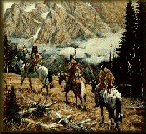
Cheyenne Language Oddities
The Cheyenne or Tsitsistas (own ethnic name), is an Algonquian group, traditional of the Prairie. There are about 2,000 speakers out of 5,000 population divided between Northern Cheyenne, who live in the Northern Cheyenne Reservation in southeastern Montana; and the Southern Cheyenne, who live associated with the Arapaho in western Oklahoma.
Tsitsistas
Cheyenne edo Tsitsistas herria:- hori da beren jatorrizko izen etnikoa, lautadetako talde ezagun bat dira. Beren hizkuntza talde Algonkinarrekoa da, eta 2.000 hiztun inguru daude, 5.000 laguneko talde etnikoan. Bi taldetan zatitu zituzten estatubatuarrek: iparraldekoak Montanan bizi dira erreserba batean, eta hegoaldekoak, Arapaho herriarekin bat eginik Oklahoman.

The Indian Convert
An Indian who lived at Muskingum, remote, was teased by the priest to join his dear flock, to throw off his blanket and put on a coat, and of grace and religion that lay in stock. The indian long slighted an offer so fair, preferring his hunting and fowling to preaching. A sermon to him was a heart full of care, and singing, but little superior to howling, but at last, by persuasion and constant harassing, our indian was brought to consent to be good.
He saw that the malice of Satan was pressing and the means to repel him not yet understood, of heaven one day when the parson was speaking and painting the beautiful things of the place.
The convert, who something substantial was seeking, rose up, and confessed he had doubts in the case, said he, "Mister minister, this place that you talk of things for the stomach, pray what has it got? Has it liquors a plenty? If so, I'll soon walk off and put myself down in this Heavenly spot!" "You fool," said the preacher, "no liquors are there! The place I'm describing is most like our meeting; good people, all singing, with preaching and prayer; they live upon these without eating or drinking. But the doors are all locked against folks that are wicked and you, I am fearful, will never get there. A life of repentance must purchase the ticket and few of you Indians can buy it, I fear."
"Farewell," said the indian, "I'm none of your mess, on victuals, so airy, I faintish should feel, I cannot consent to be lodged in a place where there's nothing to eat and but little to steal!"
Philip Freneau
The Whiteman and the Indian

1) vé'ho'e naa xaevo'êstane é'éenéšeohtsésesto
Whiteman and Indian were going along together.
2) naa hetóéva éxhonótovôsesto šè'xo ho'êstáva
And in the evening they roasted a duck in the fire
3) naa tsé'éšeéxâho'hetsêse é'áhto'hohnóvôsesto páéva
and when it was done cooking they buried it in the
ashes
4) naa mósto'seovêšenâhevóhe
And they were going to lie down.
5) naa nêhe'še vé'ho'e éhnêhetósesto tsé'tóhe
xaevo'êstanóho
and then the white man told this indian,
tsépêhéveováxêstse hétsetseha taa'eva tsetamèvo
tsé'tóhe šè'xo
"he who dreams well now at night will eat this duck"
éxhesêstse
he said.
6) naa tsé'tóhe xaevo'êstane é'amâhtovósesto tsé'tóhe
vé'hó'e
And this Indian agreed with this whiteman.
7) naa nêhe'še é'ovêšenásesto
And then they lay down.
8) naa tséhvóona'otse vé'ho'e é'oseeméoto'esêstse
And when it was morning the whiteman got up really
early.
9) naa tsé'tóhe xaevo'êstaneé'éšeáahtse'to
tóešenasêstse
And this Indian was already lying with his eyes
open.
And the whiteman really wanted to tell his story.
He told this Indian,"Let me be first to tell
naováxestôtse éxhetósesto
my dream!" he told him.
And this Indian thought well of that.
And that whiteman started telling his story.
He told this Indian,
"When I dreamed white women who had wings were
coming down.
"And here where they were a ladder came down,"
éxhesêstse
he said.
"And then I started to go up,"
that's how he told the story, this whiteman.
And there when he got to that point in the story
this
xaevo'êstane éhnêhetósesto tsé'tóhe vé'hó'e
Indian told this whiteman,
"Hee, likewise I dreamed about the same
the way I dreamed," he said.
"And likewise then at exactly the same time
mónáováxenâhéhe éxhesêstse tsé'tóhe xaevo'êstane
I must have dreamed," said this Indian.
"There I saw you on the ladder.
You were going up," he told him.
"And he won't come back down,' I mistakenly thought
about you,"
éxhetósesto
he told him.
"This duck I took it, I ate it," he told him.
That's it.
Leonard Yelloweagle
The Absent-minded Indian
hé'tóhe na'êstse máto hová'éhe ta'se tsééemaehéne'enátanó'tomo
This is just one more (of), like, what you want to know,
// vá'nêhóhta'heonôtse // vo'êstane tsé'éveó'ôsetanôse // heva
the regular stories, a person who was not very observant, like,
tséstaéveó'ôsenétâhévo'eetaese // na'êstse ma'háhkése tâháóhe évaveto //.
when he did something stupid, one old man, long ago.
nánêxhéne'enövo // ôhméseestse é'ôhkêhestohe //. vétanovéo'hé'e
I knew him, Eater he was called. At Tongue River
éhvo'êstanéheve //.
he lived.
nêhe'xóvéva é'ôhkeosée'évêhoháeméoto'eo'o // tsééšêhátaa'éhahese.
At that time they used to get up very early, the older people.
mósto'seméoasêto'eohtsêhevóhe // tsé'ôhkêsó'hoxomevôse //
They were going to go very early in the morning to go after rations
tsêhéóhe méave'ho'eno //vó'aehéo'hé'e //.
here at the agency in Lame Deer (lit. antelope-creek).
ta'méo'éxaneneo'o, nâhtsenêxhého'eoha'ovoo'o mo'éhno'häme //,
"Get ready early, I'm going after the horses,"
éxhetósesto he'óho tséá'enose2 //.
he told his wife.
mó'osáaneotá'méoto'éotsêhéhe tsésto'seéševó'neotsetse //.
He got up early when it was almost daylight.
móstâho'eohtsé'tovôhevóhe hestotseho tséhnéetsêse //.
He came to his horses where they (obv.) were standing.
na'êstse móhnâha'enôhevóhe. mó'osáanetáxevonêhnêhnotóhe //.
One he caught. He got on it.
móstaosáaneasêhoemôhevóhe tséhestôxetsêse //
He started counting them, how many there were of
hestotseho. éxaeno'tšêhováneehésesto3 na'êstse //.
his animals. It was simply gone one (of them).
tséstaéšetšêšêhóvo'ooha'ovôse // éstasenôhtséoohé'tovósesto
After he rounded them up he started looking for
néhe // né=tsétáhoese. éhvóhpe'xoénêsesto //.
it (the missing horse), the one which he was riding. It was grayfaced.
tâháóhe tséstamé'a'xêse // tsésta'óma'o'etse //
There when he came over the hill where it had been obscured
éssáavóomóhesesto //. nêhe'še mó'asetá'hasó'hehéhe //
he didn't see it (the horse). Then he started loping his horse.
nonó'hónó'e háá'êše éstâhešenôhtsé'ovósesto //. nêhe'še nonó'hónó'e
On and on quite a ways he went looking for it. Then more and more
móstanêšenó'nêševeohtsêhéhe //. nêhe'še tséhne'éšemé'êhnetsêse éše'hóho
he was galloping his horse. Then after the sun had come up
éhnéhnetameotsesêstse //. nêhe'še móhnêšêhóohta'ovo'hamêhéhe //.
he gave up. Then he drove his horses home.
éstâho'a'ovo'hamesêstse hevenôtse tséxho'tatse. he'óho tséá'enose
He drove his animals to where his tepee was. His wife
anósema é'amóeóesesesto. móhnêhnôhtsevóomaehevóhe //.
outside was standing. She was looking for him.
éstâho'etáhoeotsé'tovósesto //. éxaeno'kêhovánee'e na'êstse
He rode up to her. "It’s just missing one
mo'éhno'ha //. ta'se éxamae'éstsêhévoeotse4 // vóhpe'xoénéhe,
horse. It's just like it went under water, Grayface "
éxhetósesto //.
he told her.
naa néváéso né=tsétáhoeto? éxhetaesesto.
"And who is this one you're riding?" she (obv.) said to him.
éstamónêhéne'enánôse //. né=tséno'kêhováneehétsese
He came to his senses. The one that was missing
móstáhoehénotóhe //. éstatšêšeánôhetsêheta'éotsesêstse. tsêhéóhe
he was riding. He lowered his head down. Here
hemé'kóne he'ama // tsêhéóhe néhmâsóoomêstse!
on his head on the top (he indicated), "Here hit me hard!"
éxhetósesto hestse'emo //.
he told his wife.
hená'hanehe né=ma'háhkése tséhešeó'ôsetänôse //
That's the way that old man was not observant.
FOOTNOTES:
Croft's double slash (//) pause notation has been retained, but omitted his single slash (/) notation which appears simply to indicate a word boundary. We found Croft's interlinear English
glosses to be very helpful. Punctuation and paragraphing guesses are by the editor (W. Leman).
Croft's title of this section of his fieldnotes was "Absent-Minded Indians" Croft did not note the name of the Cheyenne narrator, but it would appear to be a Montana Cheyenne, quite possibly John Stands In Timber who enjoyed telling such stories, as can be seen from accounts which appear in Stands In Timber and Liberty (1967).
Notation2:-Literally, 'the woman (obv.) that he owns', which used to be a common way to designate a wife. It is not used as commonly today, perhaps due to its paternalistic connotation. Similarly, the common term hestse'èmo 'his woman' for 'his wife' has fallen into disuse. A neutral substitute for both terms has been tsévéstoemose 'his/her spouse', literally, 'the one he/she sits with'.
Narrator3:-The narrator occasionally palatalizes Cheyenne k before e, a mark of an old style of male speech. Today a few male speakers pronounce palatalized forms, and then not always consistently.
Others pronounce this word in the unpalatalized form, éxaeno'kêhováneehésesto.
That is 4:- it's just as if he vanished.
Fieldnotes5:-In Croft's fieldnotes the transcription continues from this point with an account of another episode of absent-mindedness, and with no indication of a major break. This next episode is about when a man called Squint Eye got irritated because he kept finding a gate open.
He, of course, was the one who kept leaving the gate open. Following that text is yet another episode, again with no major break indicated, about forgetfulness on the part of Squint Eye. Croft was able to collect many interesting texts, many are humorous, others are of historical importance.
His entire collection deserves to be re -transcribed and made available to the public.
This text was first published in Náévâhóo'ôhtséme / We are going back home: Cheyenne history and stories told by James Shoulderblade and others, edited by:- Wayne Leman. Memoir 4. Winnipeg: Algonquian and Iroquoian Linguistics. Copyright 1987. Used by permission. The text presentation here has been adjusted so that English translations align better with the Cheyenne words; this includes adjustment of some of the English word order.
Cheyenne Warrior

Surely every ethnic group appreciates humor. Cheyenne are no exception. Because both Cheyenne and English have been in use in Cheyenne communities for many years a number of episodes have occurred in which the humor of a situation was due to some problem in translation from one language to the other. We have enjoyed hearing and retelling the following stories and want to share them with a wider audience. It is not necessary to understand much about the sounds or grammar of the Cheyenne language to appreciate the humor of these accounts, but a brief exposure to the alphabet and sounds will help. The Cheyenne alphabet has fourteen letters: a, e, h, k, ', m, n, o, p, s, š, t, v, and x. The stops p, t, and k are unaspirated, or in the colloquial language used in literacy classes, "soft" . š (called "esh" or sometimes "duck"[1]) is a voiceless alveopalatal fricative (same as English sh). x is a voiceless velar fricative, as in xao'o, 'skunk'. A dot or small circle over a vowel indicates that it is voiceless or "whispered" (on screen, for this paper, a whispered vowel will appear with a caret, as â). The apostrophe (') represents the glottal stop, a quick catch or stop in a vowel sound. Vowels are marked for high pitch (e.g. á) and low pitch (unmarked).[2]
"Stick around!"
A number of years ago the white clerk in the little grocery store here in our reservation town of Busby was trying to communicate with a lady who did not speak much English. She wanted some bread, but the bread supply was out, soon to be replenished. So the clerk turned to a young bilingual man and told him to tell the lady to stick around. She still had two loaves of bread coming on the food truck. The young man translated too literally, "Néto'sêšéešeéenéma'ó'he'keóó'e!" (Stick around, like for something that might be stuck in the ground) and then added, "Neše kóhkonôheonôtse nénêsó'eamenóhtsêhótaenósestôtse (two bread-loaves are coming-walking to you)."
This young man became rather well known for such mistakes in translation. Unfortunately, his life was tragically cut short in a car accident not long ago. Besides much more, he has left us funny stories which are always enjoyed by the Cheyenne in the retelling. He also was responsible for the next story.
"Hang around!"
There was once going to be a community meal. A white man in charge told this young man to tell the people "Hang around, we're going to eat soon!" So that's exactly what he translated: Néto'sêšéešeéenêšenéma'ó'eá'kavoe'tome! Néto'semésêhéotsémáne. (But who would want to hang around, like clothes hanging on a circular clothes line!)
"Naked in the Bushes"

Once two men were sitting in a bar in Billings (90 miles west of the Northern Cheyenne Indian Reservation in Montana). One was a Cheyenne, the other was a white man. When the white man found out that the Indian was a Cheyenne, he told him that he could speak some Cheyenne. The Indian was interested. The white man said, "I can say 'Give me a smoke!': naked in the bushes."
The white man had come close. The correct pronunciation for 'Give me a smoke!' is
"Néxhe'pó'sešêstse!"
"The Moccasins"

In the days when white people first came to Indian camps, some came wanting to buy some moccasins. They arrived and announced that they were looking for moccasins. But the Cheyenne who heard them thought they were looking for Má'kâsé'e[3], a Cheyenne lady. So they called for Má'kâsé'e. She arrived, wearing standard footware, moccasins.
The white people saw her moccasins and assumed she was willing to sell moccasins to them. So they asked "How much?" But the Indians thought they were asking, this time, for Hóma'tše[4], a large-nosed Cheyenne man. Perhaps the whites could see that something wasn't fully understood, so they asked, more clearly, "How much money?" (for the moccasins). Well, the word 'money' didn't help much, for the Indians thought it was "manehe[5]", meaning 'pelican', a large-billed bird. The Indians figured that the whites must be saying something about Hóma'tše being a pelican. They tried to clear up the misunderstanding by telling the whites about Hóma'tše, "ésáamanêhévéhe, évá'nenêhetaa'eese" (he's not a pelican, he just has a big nose)!
Two funny stories known by Cheyenne were included by John Stands in Timber, Mrs. Glenmore’s
father, in his book, Cheyenne Memories (1967). We quote his section "Trouble with the Language"
[6] (pages 280-81): Another trouble in those early years was with the language. Most Cheyenne still do not talk English at home, even today. The languages do not exactly compare. I know from interpreting. Some things in one language cannot be said very well in the other. One story they still tell is about the fellow who translated[7] a certain kind of tobacco as:
"Powder!"

You can scrape this black stuff out of a pipe when you have smoked store tobacco, and mix it with kinnikinick. It tastes pretty good. This one Cheyenne went to his friend's house and smoked some for the first time. He asked what it was and his friend said "powder". So he went home and got his kinnikinick sack and some gunpowder, and mixed it up. "You must be crazy," his wife said. "That stuff explodes." "Don't tell me," he said to her. "I just smoked some and it sure tasted good." He loaded his pipe up tight. "Well, I don't want to see you exploded," said his wife. She went out, and there was a big bang. He had touched a charcoal from the fire to light up. When he came out of it a piece of the stem was blown way back inside his mouth. And his wife was mad. "Go ahead," she said. "Smoke some more of that powder."
"Run Home and Slide In!"
Another time they[8] got mixed up translating was when they started to play baseball. They were still telling the story in Oklahoma five years ago:
Some boys had learned baseball at school and they had a game going in the middle of the village.
They were teaching each other, all talking Cheyenne. One boy who was in his first game had come
around and was on third, and this other fellow was coaching him. "Lie down on your hands," he told him, "and get ready to jump out and run like a foot race. When the pitcher raises his arm, run home and slide in."[9]
So this boy got down and watched. When the pitcher raised his arm he took off. But he did not go
to the plate. He ran straight to his tent in the village and when they yelled at him he ran
faster. He slid in and knocked the pole down and spilled some pots of food his wife was giving to visitors. He crawled out in a hurry and ran back to the game. "Well, I did it," he said. "How many points did we get?" They had told him to "run home and slide in," in Cheyenne.
"Spoon or Beetle?"

People like to talk about the time when an Anglo teacher at Busby School took her students out of doors for a little field trip. They came upon a beetle, so the teacher asked the students what it was. One of the young fellows answered, "It's a spoon." The answer may seem odd until you know that the Cheyenne words for 'beetle' and 'spoon' are homonymns. Both are pronounced háméško.[10]
"It's Plum Easy!"
During some recent work sessions , James Shoulderblade, a Cheyenne elder and practiced language humorist, remarked that something was "éma'xemenéhe'anáto (it's plum easy)," literally translating the English idiom. After that many things were found to talk about using ma'xemené-[11], the newly-created proverb.
"Netse or Nits?"
On another occasion co-author Leman, in attempting to learn the standard Cheyenne pronunciation for the word netse 'eagle,' asked a very capable and fluent bilingual: "How do you say netse?" There was a long hesitation before there was a response. The answer came with a finger-and-thumb picking motion to the head and the word "heneno'se" which means 'nits'. The Cheyenne word 'netse' and the English word 'nits' are identical in pronunciation!
Humorous Translations of Idioms
Some terms are used by Cheyenne even though they realize that they are "funny". They have come into Cheyenne translated literally from English. Among them are: énó'êstoeto 'he has a hangover (literally, he is hung over).'
The verb éhemé'konomóhtahe means 'he has a bad headache', literally, "he-has-head-sick." This verb is funny because the preverb for 'have' he- would not be used in this grammatical context[12]. It is used appropriately in verbs such as éhevéese 'he has teeth' or éhemótseške 'he has a knife'.
Some people like to be funny by telling someone else, "Hó'ótóva né'évâhóseamêhéeseana'oo'o!" This translation from English means literally 'Drop in again sometime!' Ouch!
Some Cheyenne speakers continue to regularly translate other English idioms, such as, "We're
scraping the bottom of the barrel," into Cheyenne to be funny. They realize, of course, that the
literal translations to Cheyenne do not make any sense in Cheyenne, and that is why they are
funny.
Conclusion
Co-author Leman grew up in an Alaskan village where people were shifting from use of Russian to English. There was humor in his village because of the use of both languages. He finds the same kind of thing fascinating as he lives among the Cheyenne people. May each of us who research Amerindian languages be able and willing to "stop and smell the roses" along the Indian trails of life, enjoying the humor and hospitality of our Native American friends.
NOTES:
*Co-author Leman has worked on the Northern Cheyenne Indian Reservation since 1975. He was born and raised in Alaska, where he descends from Russian and Aleut ancestry. Co-author Glenmore is a long-time resident of Busby, the westernmost town on this reservation. She is a native speaker of Cheyenne, has taught Cheyenne language classes to non-Cheyenne-speakers, and presently helps Leman with his field work and Bible translation and related tasks.
(Note: Endnotes are indicated within the text, and following, with [ ] brackets.)
[1]Because one of the best words for illustrating this sound is Cheyenne šé'še 'duck'!
[2]More technical accounts of the sounds and grammar of Cheyenne are found in Leman (1979 and
1981).
[3]The name means 'Big-Bellied Woman'.
[4]A dialectal variant of Hóma'ke. Both mean 'Little Beaver'.
[5]Word-final vowels are voiceless when a word is phrase-final or spoken in isolation. So
"manehe" is very close in pronunciation to the English word, 'money'.
[6]Co-author Glenmore comes by an appreciation for Cheyenne humor naturally: her father was the
late John Stands in Timber, well known Cheyenne elder and self-appointed tribal historian.
[7]Our note: the Cheyenne word is paa'e and is used to mean 'ashes', 'powder', or 'gunpowder'.
[8]Our note: the southern half of the Cheyenne tribe lives in Oklahoma.
[9]Our note: the actual command was "Tâhóohto'âhéotseo'o! Vó'héé'êse tamâsóhešeésevo'êšenao'o!
(Run home! From a distance away slide in!)"
[10]'Beetle' is grammatically "animate", while 'spoon' is grammatically "inanimate". The
difference can be seen in their plurals, hámêškono and hámêškonôtse, respectively.
[11]Literally, 'big-berry', referring to either 'apple' or 'plum'. Originally, má'xeme
(the singular noun form) was a wild "plum" berry, still picked today.
[12]To be used properly, the preverb he- needs to precede a noun final. In this verb -
mé'konomóhtahe is a verb final. The two following verbs properly have noun finals following them:
GO TO "Native Poetry"
Return to Main Menu
Tsitsistas
An Indian who lived at Muskingum, remote, was teased by the priest to join his dear flock, to throw off his blanket and put on a coat, and of grace and religion that lay in stock. The indian long slighted an offer so fair, preferring his hunting and fowling to preaching. A sermon to him was a heart full of care, and singing, but little superior to howling, but at last, by persuasion and constant harassing, our indian was brought to consent to be good.
He saw that the malice of Satan was pressing and the means to repel him not yet understood, of heaven one day when the parson was speaking and painting the beautiful things of the place.
The convert, who something substantial was seeking, rose up, and confessed he had doubts in the case, said he, "Mister minister, this place that you talk of things for the stomach, pray what has it got? Has it liquors a plenty? If so, I'll soon walk off and put myself down in this Heavenly spot!" "You fool," said the preacher, "no liquors are there! The place I'm describing is most like our meeting; good people, all singing, with preaching and prayer; they live upon these without eating or drinking. But the doors are all locked against folks that are wicked and you, I am fearful, will never get there. A life of repentance must purchase the ticket and few of you Indians can buy it, I fear."
"Farewell," said the indian, "I'm none of your mess, on victuals, so airy, I faintish should feel, I cannot consent to be lodged in a place where there's nothing to eat and but little to steal!"
Philip Freneau
The Whiteman and the Indian
1) vé'ho'e naa xaevo'êstane é'éenéšeohtsésesto
Whiteman and Indian were going along together.
2) naa hetóéva éxhonótovôsesto šè'xo ho'êstáva
And in the evening they roasted a duck in the fire
3) naa tsé'éšeéxâho'hetsêse é'áhto'hohnóvôsesto páéva
and when it was done cooking they buried it in the
ashes
4) naa mósto'seovêšenâhevóhe
And they were going to lie down.
5) naa nêhe'še vé'ho'e éhnêhetósesto tsé'tóhe
xaevo'êstanóho
and then the white man told this indian,
tsépêhéveováxêstse hétsetseha taa'eva tsetamèvo
tsé'tóhe šè'xo
"he who dreams well now at night will eat this duck"
éxhesêstse
he said.
6) naa tsé'tóhe xaevo'êstane é'amâhtovósesto tsé'tóhe
vé'hó'e
And this Indian agreed with this whiteman.
7) naa nêhe'še é'ovêšenásesto
And then they lay down.
8) naa tséhvóona'otse vé'ho'e é'oseeméoto'esêstse
And when it was morning the whiteman got up really
early.
9) naa tsé'tóhe xaevo'êstaneé'éšeáahtse'to
tóešenasêstse
And this Indian was already lying with his eyes
open.
And the whiteman really wanted to tell his story.
He told this Indian,"Let me be first to tell
naováxestôtse éxhetósesto
my dream!" he told him.
And this Indian thought well of that.
And that whiteman started telling his story.
He told this Indian,
"When I dreamed white women who had wings were
coming down.
"And here where they were a ladder came down,"
éxhesêstse
he said.
"And then I started to go up,"
that's how he told the story, this whiteman.
And there when he got to that point in the story
this
xaevo'êstane éhnêhetósesto tsé'tóhe vé'hó'e
Indian told this whiteman,
"Hee, likewise I dreamed about the same
the way I dreamed," he said.
"And likewise then at exactly the same time
mónáováxenâhéhe éxhesêstse tsé'tóhe xaevo'êstane
I must have dreamed," said this Indian.
"There I saw you on the ladder.
You were going up," he told him.
"And he won't come back down,' I mistakenly thought
about you,"
éxhetósesto
he told him.
"This duck I took it, I ate it," he told him.
That's it.
Leonard Yelloweagle
The Absent-minded Indian
hé'tóhe na'êstse máto hová'éhe ta'se tsééemaehéne'enátanó'tomo
This is just one more (of), like, what you want to know,
// vá'nêhóhta'heonôtse // vo'êstane tsé'éveó'ôsetanôse // heva
the regular stories, a person who was not very observant, like,
tséstaéveó'ôsenétâhévo'eetaese // na'êstse ma'háhkése tâháóhe évaveto //.
when he did something stupid, one old man, long ago.
nánêxhéne'enövo // ôhméseestse é'ôhkêhestohe //. vétanovéo'hé'e
I knew him, Eater he was called. At Tongue River
éhvo'êstanéheve //.
he lived.
nêhe'xóvéva é'ôhkeosée'évêhoháeméoto'eo'o // tsééšêhátaa'éhahese.
At that time they used to get up very early, the older people.
mósto'seméoasêto'eohtsêhevóhe // tsé'ôhkêsó'hoxomevôse //
They were going to go very early in the morning to go after rations
tsêhéóhe méave'ho'eno //vó'aehéo'hé'e //.
here at the agency in Lame Deer (lit. antelope-creek).
ta'méo'éxaneneo'o, nâhtsenêxhého'eoha'ovoo'o mo'éhno'häme //,
"Get ready early, I'm going after the horses,"
éxhetósesto he'óho tséá'enose2 //.
he told his wife.
mó'osáaneotá'méoto'éotsêhéhe tsésto'seéševó'neotsetse //.
He got up early when it was almost daylight.
móstâho'eohtsé'tovôhevóhe hestotseho tséhnéetsêse //.
He came to his horses where they (obv.) were standing.
na'êstse móhnâha'enôhevóhe. mó'osáanetáxevonêhnêhnotóhe //.
One he caught. He got on it.
móstaosáaneasêhoemôhevóhe tséhestôxetsêse //
He started counting them, how many there were of
hestotseho. éxaeno'tšêhováneehésesto3 na'êstse //.
his animals. It was simply gone one (of them).
tséstaéšetšêšêhóvo'ooha'ovôse // éstasenôhtséoohé'tovósesto
After he rounded them up he started looking for
néhe // né=tsétáhoese. éhvóhpe'xoénêsesto //.
it (the missing horse), the one which he was riding. It was grayfaced.
tâháóhe tséstamé'a'xêse // tsésta'óma'o'etse //
There when he came over the hill where it had been obscured
éssáavóomóhesesto //. nêhe'še mó'asetá'hasó'hehéhe //
he didn't see it (the horse). Then he started loping his horse.
nonó'hónó'e háá'êše éstâhešenôhtsé'ovósesto //. nêhe'še nonó'hónó'e
On and on quite a ways he went looking for it. Then more and more
móstanêšenó'nêševeohtsêhéhe //. nêhe'še tséhne'éšemé'êhnetsêse éše'hóho
he was galloping his horse. Then after the sun had come up
éhnéhnetameotsesêstse //. nêhe'še móhnêšêhóohta'ovo'hamêhéhe //.
he gave up. Then he drove his horses home.
éstâho'a'ovo'hamesêstse hevenôtse tséxho'tatse. he'óho tséá'enose
He drove his animals to where his tepee was. His wife
anósema é'amóeóesesesto. móhnêhnôhtsevóomaehevóhe //.
outside was standing. She was looking for him.
éstâho'etáhoeotsé'tovósesto //. éxaeno'kêhovánee'e na'êstse
He rode up to her. "It’s just missing one
mo'éhno'ha //. ta'se éxamae'éstsêhévoeotse4 // vóhpe'xoénéhe,
horse. It's just like it went under water, Grayface "
éxhetósesto //.
he told her.
naa néváéso né=tsétáhoeto? éxhetaesesto.
"And who is this one you're riding?" she (obv.) said to him.
éstamónêhéne'enánôse //. né=tséno'kêhováneehétsese
He came to his senses. The one that was missing
móstáhoehénotóhe //. éstatšêšeánôhetsêheta'éotsesêstse. tsêhéóhe
he was riding. He lowered his head down. Here
hemé'kóne he'ama // tsêhéóhe néhmâsóoomêstse!
on his head on the top (he indicated), "Here hit me hard!"
éxhetósesto hestse'emo //.
he told his wife.
hená'hanehe né=ma'háhkése tséhešeó'ôsetänôse //
That's the way that old man was not observant.
FOOTNOTES:
Croft's double slash (//) pause notation has been retained, but omitted his single slash (/) notation which appears simply to indicate a word boundary. We found Croft's interlinear English
glosses to be very helpful. Punctuation and paragraphing guesses are by the editor (W. Leman).
Croft's title of this section of his fieldnotes was "Absent-Minded Indians" Croft did not note the name of the Cheyenne narrator, but it would appear to be a Montana Cheyenne, quite possibly John Stands In Timber who enjoyed telling such stories, as can be seen from accounts which appear in Stands In Timber and Liberty (1967).
Notation2:-Literally, 'the woman (obv.) that he owns', which used to be a common way to designate a wife. It is not used as commonly today, perhaps due to its paternalistic connotation. Similarly, the common term hestse'èmo 'his woman' for 'his wife' has fallen into disuse. A neutral substitute for both terms has been tsévéstoemose 'his/her spouse', literally, 'the one he/she sits with'.
Narrator3:-The narrator occasionally palatalizes Cheyenne k before e, a mark of an old style of male speech. Today a few male speakers pronounce palatalized forms, and then not always consistently.
Others pronounce this word in the unpalatalized form, éxaeno'kêhováneehésesto.
That is 4:- it's just as if he vanished.
Fieldnotes5:-In Croft's fieldnotes the transcription continues from this point with an account of another episode of absent-mindedness, and with no indication of a major break. This next episode is about when a man called Squint Eye got irritated because he kept finding a gate open.
He, of course, was the one who kept leaving the gate open. Following that text is yet another episode, again with no major break indicated, about forgetfulness on the part of Squint Eye. Croft was able to collect many interesting texts, many are humorous, others are of historical importance.
His entire collection deserves to be re -transcribed and made available to the public.
This text was first published in Náévâhóo'ôhtséme / We are going back home: Cheyenne history and stories told by James Shoulderblade and others, edited by:- Wayne Leman. Memoir 4. Winnipeg: Algonquian and Iroquoian Linguistics. Copyright 1987. Used by permission. The text presentation here has been adjusted so that English translations align better with the Cheyenne words; this includes adjustment of some of the English word order.
Cheyenne Warrior
Surely every ethnic group appreciates humor. Cheyenne are no exception. Because both Cheyenne and English have been in use in Cheyenne communities for many years a number of episodes have occurred in which the humor of a situation was due to some problem in translation from one language to the other. We have enjoyed hearing and retelling the following stories and want to share them with a wider audience. It is not necessary to understand much about the sounds or grammar of the Cheyenne language to appreciate the humor of these accounts, but a brief exposure to the alphabet and sounds will help. The Cheyenne alphabet has fourteen letters: a, e, h, k, ', m, n, o, p, s, š, t, v, and x. The stops p, t, and k are unaspirated, or in the colloquial language used in literacy classes, "soft" . š (called "esh" or sometimes "duck"[1]) is a voiceless alveopalatal fricative (same as English sh). x is a voiceless velar fricative, as in xao'o, 'skunk'. A dot or small circle over a vowel indicates that it is voiceless or "whispered" (on screen, for this paper, a whispered vowel will appear with a caret, as â). The apostrophe (') represents the glottal stop, a quick catch or stop in a vowel sound. Vowels are marked for high pitch (e.g. á) and low pitch (unmarked).[2]
"Stick around!"
A number of years ago the white clerk in the little grocery store here in our reservation town of Busby was trying to communicate with a lady who did not speak much English. She wanted some bread, but the bread supply was out, soon to be replenished. So the clerk turned to a young bilingual man and told him to tell the lady to stick around. She still had two loaves of bread coming on the food truck. The young man translated too literally, "Néto'sêšéešeéenéma'ó'he'keóó'e!" (Stick around, like for something that might be stuck in the ground) and then added, "Neše kóhkonôheonôtse nénêsó'eamenóhtsêhótaenósestôtse (two bread-loaves are coming-walking to you)."
This young man became rather well known for such mistakes in translation. Unfortunately, his life was tragically cut short in a car accident not long ago. Besides much more, he has left us funny stories which are always enjoyed by the Cheyenne in the retelling. He also was responsible for the next story.
"Hang around!"
There was once going to be a community meal. A white man in charge told this young man to tell the people "Hang around, we're going to eat soon!" So that's exactly what he translated: Néto'sêšéešeéenêšenéma'ó'eá'kavoe'tome! Néto'semésêhéotsémáne. (But who would want to hang around, like clothes hanging on a circular clothes line!)
"Naked in the Bushes"
Once two men were sitting in a bar in Billings (90 miles west of the Northern Cheyenne Indian Reservation in Montana). One was a Cheyenne, the other was a white man. When the white man found out that the Indian was a Cheyenne, he told him that he could speak some Cheyenne. The Indian was interested. The white man said, "I can say 'Give me a smoke!': naked in the bushes."
The white man had come close. The correct pronunciation for 'Give me a smoke!' is
"Néxhe'pó'sešêstse!"
"The Moccasins"
In the days when white people first came to Indian camps, some came wanting to buy some moccasins. They arrived and announced that they were looking for moccasins. But the Cheyenne who heard them thought they were looking for Má'kâsé'e[3], a Cheyenne lady. So they called for Má'kâsé'e. She arrived, wearing standard footware, moccasins.
The white people saw her moccasins and assumed she was willing to sell moccasins to them. So they asked "How much?" But the Indians thought they were asking, this time, for Hóma'tše[4], a large-nosed Cheyenne man. Perhaps the whites could see that something wasn't fully understood, so they asked, more clearly, "How much money?" (for the moccasins). Well, the word 'money' didn't help much, for the Indians thought it was "manehe[5]", meaning 'pelican', a large-billed bird. The Indians figured that the whites must be saying something about Hóma'tše being a pelican. They tried to clear up the misunderstanding by telling the whites about Hóma'tše, "ésáamanêhévéhe, évá'nenêhetaa'eese" (he's not a pelican, he just has a big nose)!
Two funny stories known by Cheyenne were included by John Stands in Timber, Mrs. Glenmore’s
father, in his book, Cheyenne Memories (1967). We quote his section "Trouble with the Language"
[6] (pages 280-81): Another trouble in those early years was with the language. Most Cheyenne still do not talk English at home, even today. The languages do not exactly compare. I know from interpreting. Some things in one language cannot be said very well in the other. One story they still tell is about the fellow who translated[7] a certain kind of tobacco as:
"Powder!"
You can scrape this black stuff out of a pipe when you have smoked store tobacco, and mix it with kinnikinick. It tastes pretty good. This one Cheyenne went to his friend's house and smoked some for the first time. He asked what it was and his friend said "powder". So he went home and got his kinnikinick sack and some gunpowder, and mixed it up. "You must be crazy," his wife said. "That stuff explodes." "Don't tell me," he said to her. "I just smoked some and it sure tasted good." He loaded his pipe up tight. "Well, I don't want to see you exploded," said his wife. She went out, and there was a big bang. He had touched a charcoal from the fire to light up. When he came out of it a piece of the stem was blown way back inside his mouth. And his wife was mad. "Go ahead," she said. "Smoke some more of that powder."
"Run Home and Slide In!"
Another time they[8] got mixed up translating was when they started to play baseball. They were still telling the story in Oklahoma five years ago:
Some boys had learned baseball at school and they had a game going in the middle of the village.
They were teaching each other, all talking Cheyenne. One boy who was in his first game had come
around and was on third, and this other fellow was coaching him. "Lie down on your hands," he told him, "and get ready to jump out and run like a foot race. When the pitcher raises his arm, run home and slide in."[9]
So this boy got down and watched. When the pitcher raised his arm he took off. But he did not go
to the plate. He ran straight to his tent in the village and when they yelled at him he ran
faster. He slid in and knocked the pole down and spilled some pots of food his wife was giving to visitors. He crawled out in a hurry and ran back to the game. "Well, I did it," he said. "How many points did we get?" They had told him to "run home and slide in," in Cheyenne.
"Spoon or Beetle?"
People like to talk about the time when an Anglo teacher at Busby School took her students out of doors for a little field trip. They came upon a beetle, so the teacher asked the students what it was. One of the young fellows answered, "It's a spoon." The answer may seem odd until you know that the Cheyenne words for 'beetle' and 'spoon' are homonymns. Both are pronounced háméško.[10]
"It's Plum Easy!"
During some recent work sessions , James Shoulderblade, a Cheyenne elder and practiced language humorist, remarked that something was "éma'xemenéhe'anáto (it's plum easy)," literally translating the English idiom. After that many things were found to talk about using ma'xemené-[11], the newly-created proverb.
"Netse or Nits?"
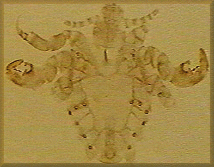
On another occasion co-author Leman, in attempting to learn the standard Cheyenne pronunciation for the word netse 'eagle,' asked a very capable and fluent bilingual: "How do you say netse?" There was a long hesitation before there was a response. The answer came with a finger-and-thumb picking motion to the head and the word "heneno'se" which means 'nits'. The Cheyenne word 'netse' and the English word 'nits' are identical in pronunciation!
Humorous Translations of Idioms
Some terms are used by Cheyenne even though they realize that they are "funny". They have come into Cheyenne translated literally from English. Among them are: énó'êstoeto 'he has a hangover (literally, he is hung over).'
The verb éhemé'konomóhtahe means 'he has a bad headache', literally, "he-has-head-sick." This verb is funny because the preverb for 'have' he- would not be used in this grammatical context[12]. It is used appropriately in verbs such as éhevéese 'he has teeth' or éhemótseške 'he has a knife'.
Some people like to be funny by telling someone else, "Hó'ótóva né'évâhóseamêhéeseana'oo'o!" This translation from English means literally 'Drop in again sometime!' Ouch!
Some Cheyenne speakers continue to regularly translate other English idioms, such as, "We're
scraping the bottom of the barrel," into Cheyenne to be funny. They realize, of course, that the
literal translations to Cheyenne do not make any sense in Cheyenne, and that is why they are
funny.
Conclusion
Co-author Leman grew up in an Alaskan village where people were shifting from use of Russian to English. There was humor in his village because of the use of both languages. He finds the same kind of thing fascinating as he lives among the Cheyenne people. May each of us who research Amerindian languages be able and willing to "stop and smell the roses" along the Indian trails of life, enjoying the humor and hospitality of our Native American friends.
NOTES:
*Co-author Leman has worked on the Northern Cheyenne Indian Reservation since 1975. He was born and raised in Alaska, where he descends from Russian and Aleut ancestry. Co-author Glenmore is a long-time resident of Busby, the westernmost town on this reservation. She is a native speaker of Cheyenne, has taught Cheyenne language classes to non-Cheyenne-speakers, and presently helps Leman with his field work and Bible translation and related tasks.
(Note: Endnotes are indicated within the text, and following, with [ ] brackets.)
[1]Because one of the best words for illustrating this sound is Cheyenne šé'še 'duck'!
[2]More technical accounts of the sounds and grammar of Cheyenne are found in Leman (1979 and
1981).
[3]The name means 'Big-Bellied Woman'.
[4]A dialectal variant of Hóma'ke. Both mean 'Little Beaver'.
[5]Word-final vowels are voiceless when a word is phrase-final or spoken in isolation. So
"manehe" is very close in pronunciation to the English word, 'money'.
[6]Co-author Glenmore comes by an appreciation for Cheyenne humor naturally: her father was the
late John Stands in Timber, well known Cheyenne elder and self-appointed tribal historian.
[7]Our note: the Cheyenne word is paa'e and is used to mean 'ashes', 'powder', or 'gunpowder'.
[8]Our note: the southern half of the Cheyenne tribe lives in Oklahoma.
[9]Our note: the actual command was "Tâhóohto'âhéotseo'o! Vó'héé'êse tamâsóhešeésevo'êšenao'o!
(Run home! From a distance away slide in!)"
[10]'Beetle' is grammatically "animate", while 'spoon' is grammatically "inanimate". The
difference can be seen in their plurals, hámêškono and hámêškonôtse, respectively.
[11]Literally, 'big-berry', referring to either 'apple' or 'plum'. Originally, má'xeme
(the singular noun form) was a wild "plum" berry, still picked today.
[12]To be used properly, the preverb he- needs to precede a noun final. In this verb -
mé'konomóhtahe is a verb final. The two following verbs properly have noun finals following them:
GO TO "Native Poetry"
Return toMain Menu
1) vé'ho'e naa xaevo'êstane é'éenéšeohtsésesto
And they were going to lie down.
and then the white man told this indian,
tsépêhéveováxêstse hétsetseha taa'eva tsetamèvo tsé'tóhe šè'xo
"he who dreams well now at night will eat this duck"
éxhesêstse
he said.
And this Indian agreed with this whiteman.
And then they lay down.
And when it was morning the whiteman got up really early.
And this Indian was already lying with his eyes open.
naováxestôtse éxhetósesto
my dream!" he told him.
éxhesêstse
he said.
xaevo'êstane éhnêhetósesto tsé'tóhe vé'hó'e
Indian told this whiteman,
mónáováxenâhéhe éxhesêstse tsé'tóhe xaevo'êstane
I must have dreamed," said this Indian.
éxhetósesto
he told him.
The Absent-minded Indian
hé'tóhe na'êstse máto hová'éhe ta'se tsééemaehéne'enátanó'tomo
This is just one more (of), like, what you want to know,
// vá'nêhóhta'heonôtse // vo'êstane tsé'éveó'ôsetanôse // heva
the regular stories, a person who was not very observant, like,
tséstaéveó'ôsenétâhévo'eetaese // na'êstse ma'háhkése tâháóhe évaveto //.
when he did something stupid, one old man, long ago.
nánêxhéne'enövo // ôhméseestse é'ôhkêhestohe //. vétanovéo'hé'e
I knew him, Eater he was called. At Tongue River
éhvo'êstanéheve //.
he lived.
nêhe'xóvéva é'ôhkeosée'évêhoháeméoto'eo'o // tsééšêhátaa'éhahese.
At that time they used to get up very early, the older people.
mósto'seméoasêto'eohtsêhevóhe // tsé'ôhkêsó'hoxomevôse //
They were going to go very early in the morning to go after rations
tsêhéóhe méave'ho'eno //vó'aehéo'hé'e //.
here at the agency in Lame Deer (lit. antelope-creek).
ta'méo'éxaneneo'o, nâhtsenêxhého'eoha'ovoo'o mo'éhno'häme //,
"Get ready early, I'm going after the horses,"
éxhetósesto he'óho tséá'enose2 //.
he told his wife.
mó'osáaneotá'méoto'éotsêhéhe tsésto'seéševó'neotsetse //.
He got up early when it was almost daylight.
móstâho'eohtsé'tovôhevóhe hestotseho tséhnéetsêse //.
He came to his horses where they (obv.) were standing.
na'êstse móhnâha'enôhevóhe. mó'osáanetáxevonêhnêhnotóhe //.
One he caught. He got on it.
móstaosáaneasêhoemôhevóhe tséhestôxetsêse //
He started counting them, how many there were of
hestotseho. éxaeno'tšêhováneehésesto3 na'êstse //.
his animals. It was simply gone one (of them).
tséstaéšetšêšêhóvo'ooha'ovôse // éstasenôhtséoohé'tovósesto
After he rounded them up he started looking for
néhe // né=tsétáhoese. éhvóhpe'xoénêsesto //.
it (the missing horse), the one which he was riding. It was grayfaced.
tâháóhe tséstamé'a'xêse // tsésta'óma'o'etse //
There when he came over the hill where it had been obscured
éssáavóomóhesesto //. nêhe'še mó'asetá'hasó'hehéhe //
he didn't see it (the horse). Then he started loping his horse.
nonó'hónó'e háá'êše éstâhešenôhtsé'ovósesto //. nêhe'še nonó'hónó'e
On and on quite a ways he went looking for it. Then more and more
móstanêšenó'nêševeohtsêhéhe //. nêhe'še tséhne'éšemé'êhnetsêse éše'hóho
he was galloping his horse. Then after the sun had come up
éhnéhnetameotsesêstse //. nêhe'še móhnêšêhóohta'ovo'hamêhéhe //.
he gave up. Then he drove his horses home.
éstâho'a'ovo'hamesêstse hevenôtse tséxho'tatse. he'óho tséá'enose
He drove his animals to where his tepee was. His wife
anósema é'amóeóesesesto. móhnêhnôhtsevóomaehevóhe //.
outside was standing. She was looking for him.
éstâho'etáhoeotsé'tovósesto //. éxaeno'kêhovánee'e na'êstse
He rode up to her. "It’s just missing one
mo'éhno'ha //. ta'se éxamae'éstsêhévoeotse4 // vóhpe'xoénéhe,
horse. It's just like it went under water, Grayface "
éxhetósesto //.
he told her.
naa néváéso né=tsétáhoeto? éxhetaesesto.
"And who is this one you're riding?" she (obv.) said to him.
éstamónêhéne'enánôse //. né=tséno'kêhováneehétsese
He came to his senses. The one that was missing
móstáhoehénotóhe //. éstatšêšeánôhetsêheta'éotsesêstse. tsêhéóhe
he was riding. He lowered his head down. Here
hemé'kóne he'ama // tsêhéóhe néhmâsóoomêstse!
on his head on the top (he indicated), "Here hit me hard!"
éxhetósesto hestse'emo //.
he told his wife.
hená'hanehe né=ma'háhkése tséhešeó'ôsetänôse //
That's the way that old man was not observant.
FOOTNOTES:
Croft's double slash (//) pause notation has been retained, but omitted his single slash (/) notation which appears simply to indicate a word boundary. We found Croft's interlinear English
glosses to be very helpful. Punctuation and paragraphing guesses are by the editor (W. Leman).
Croft's title of this section of his fieldnotes was "Absent-Minded Indians" Croft did not note the name of the Cheyenne narrator, but it would appear to be a Montana Cheyenne, quite possibly John Stands In Timber who enjoyed telling such stories, as can be seen from accounts which appear in Stands In Timber and Liberty (1967).
Notation2:-Literally, 'the woman (obv.) that he owns', which used to be a common way to designate a wife. It is not used as commonly today, perhaps due to its paternalistic connotation. Similarly, the common term hestse'èmo 'his woman' for 'his wife' has fallen into disuse. A neutral substitute for both terms has been tsévéstoemose 'his/her spouse', literally, 'the one he/she sits with'.
Narrator3:-The narrator occasionally palatalizes Cheyenne k before e, a mark of an old style of male speech. Today a few male speakers pronounce palatalized forms, and then not always consistently.
Others pronounce this word in the unpalatalized form, éxaeno'kêhováneehésesto.
That is 4:- it's just as if he vanished.
Fieldnotes5:-In Croft's fieldnotes the transcription continues from this point with an account of another episode of absent-mindedness, and with no indication of a major break. This next episode is about when a man called Squint Eye got irritated because he kept finding a gate open.
He, of course, was the one who kept leaving the gate open. Following that text is yet another episode, again with no major break indicated, about forgetfulness on the part of Squint Eye. Croft was able to collect many interesting texts, many are humorous, others are of historical importance.
His entire collection deserves to be re -transcribed and made available to the public.
This text was first published in Náévâhóo'ôhtséme / We are going back home: Cheyenne history and stories told by James Shoulderblade and others, edited by:- Wayne Leman. Memoir 4. Winnipeg: Algonquian and Iroquoian Linguistics. Copyright 1987. Used by permission. The text presentation here has been adjusted so that English translations align better with the Cheyenne words; this includes adjustment of some of the English word order.
Cheyenne Warrior
Surely every ethnic group appreciates humor. Cheyenne are no exception. Because both Cheyenne and English have been in use in Cheyenne communities for many years a number of episodes have occurred in which the humor of a situation was due to some problem in translation from one language to the other. We have enjoyed hearing and retelling the following stories and want to share them with a wider audience. It is not necessary to understand much about the sounds or grammar of the Cheyenne language to appreciate the humor of these accounts, but a brief exposure to the alphabet and sounds will help. The Cheyenne alphabet has fourteen letters: a, e, h, k, ', m, n, o, p, s, š, t, v, and x. The stops p, t, and k are unaspirated, or in the colloquial language used in literacy classes, "soft" . š (called "esh" or sometimes "duck"[1]) is a voiceless alveopalatal fricative (same as English sh). x is a voiceless velar fricative, as in xao'o, 'skunk'. A dot or small circle over a vowel indicates that it is voiceless or "whispered" (on screen, for this paper, a whispered vowel will appear with a caret, as â). The apostrophe (') represents the glottal stop, a quick catch or stop in a vowel sound. Vowels are marked for high pitch (e.g. á) and low pitch (unmarked).[2]
"Stick around!"
A number of years ago the white clerk in the little grocery store here in our reservation town of Busby was trying to communicate with a lady who did not speak much English. She wanted some bread, but the bread supply was out, soon to be replenished. So the clerk turned to a young bilingual man and told him to tell the lady to stick around. She still had two loaves of bread coming on the food truck. The young man translated too literally, "Néto'sêšéešeéenéma'ó'he'keóó'e!" (Stick around, like for something that might be stuck in the ground) and then added, "Neše kóhkonôheonôtse nénêsó'eamenóhtsêhótaenósestôtse (two bread-loaves are coming-walking to you)."
This young man became rather well known for such mistakes in translation. Unfortunately, his life was tragically cut short in a car accident not long ago. Besides much more, he has left us funny stories which are always enjoyed by the Cheyenne in the retelling. He also was responsible for the next story.
"Hang around!"
There was once going to be a community meal. A white man in charge told this young man to tell the people "Hang around, we're going to eat soon!" So that's exactly what he translated: Néto'sêšéešeéenêšenéma'ó'eá'kavoe'tome! Néto'semésêhéotsémáne. (But who would want to hang around, like clothes hanging on a circular clothes line!)
"Naked in the Bushes"
Once two men were sitting in a bar in Billings (90 miles west of the Northern Cheyenne Indian Reservation in Montana). One was a Cheyenne, the other was a white man. When the white man found out that the Indian was a Cheyenne, he told him that he could speak some Cheyenne. The Indian was interested. The white man said, "I can say 'Give me a smoke!': naked in the bushes."
The white man had come close. The correct pronunciation for 'Give me a smoke!' is
"Néxhe'pó'sešêstse!"
"The Moccasins"
In the days when white people first came to Indian camps, some came wanting to buy some moccasins. They arrived and announced that they were looking for moccasins. But the Cheyenne who heard them thought they were looking for Má'kâsé'e[3], a Cheyenne lady. So they called for Má'kâsé'e. She arrived, wearing standard footware, moccasins.
The white people saw her moccasins and assumed she was willing to sell moccasins to them. So they asked "How much?" But the Indians thought they were asking, this time, for Hóma'tše[4], a large-nosed Cheyenne man. Perhaps the whites could see that something wasn't fully understood, so they asked, more clearly, "How much money?" (for the moccasins). Well, the word 'money' didn't help much, for the Indians thought it was "manehe[5]", meaning 'pelican', a large-billed bird. The Indians figured that the whites must be saying something about Hóma'tše being a pelican. They tried to clear up the misunderstanding by telling the whites about Hóma'tše, "ésáamanêhévéhe, évá'nenêhetaa'eese" (he's not a pelican, he just has a big nose)!
Two funny stories known by Cheyenne were included by John Stands in Timber, Mrs. Glenmore’s
father, in his book, Cheyenne Memories (1967). We quote his section "Trouble with the Language"
[6] (pages 280-81): Another trouble in those early years was with the language. Most Cheyenne still do not talk English at home, even today. The languages do not exactly compare. I know from interpreting. Some things in one language cannot be said very well in the other. One story they still tell is about the fellow who translated[7] a certain kind of tobacco as:
"Powder!"
You can scrape this black stuff out of a pipe when you have smoked store tobacco, and mix it with kinnikinick. It tastes pretty good. This one Cheyenne went to his friend's house and smoked some for the first time. He asked what it was and his friend said "powder". So he went home and got his kinnikinick sack and some gunpowder, and mixed it up. "You must be crazy," his wife said. "That stuff explodes." "Don't tell me," he said to her. "I just smoked some and it sure tasted good." He loaded his pipe up tight. "Well, I don't want to see you exploded," said his wife. She went out, and there was a big bang. He had touched a charcoal from the fire to light up. When he came out of it a piece of the stem was blown way back inside his mouth. And his wife was mad. "Go ahead," she said. "Smoke some more of that powder."
"Run Home and Slide In!"
Another time they[8] got mixed up translating was when they started to play baseball. They were still telling the story in Oklahoma five years ago:
Some boys had learned baseball at school and they had a game going in the middle of the village.
They were teaching each other, all talking Cheyenne. One boy who was in his first game had come
around and was on third, and this other fellow was coaching him. "Lie down on your hands," he told him, "and get ready to jump out and run like a foot race. When the pitcher raises his arm, run home and slide in."[9]
So this boy got down and watched. When the pitcher raised his arm he took off. But he did not go
to the plate. He ran straight to his tent in the village and when they yelled at him he ran
faster. He slid in and knocked the pole down and spilled some pots of food his wife was giving to visitors. He crawled out in a hurry and ran back to the game. "Well, I did it," he said. "How many points did we get?" They had told him to "run home and slide in," in Cheyenne.
"Spoon or Beetle?"
People like to talk about the time when an Anglo teacher at Busby School took her students out of doors for a little field trip. They came upon a beetle, so the teacher asked the students what it was. One of the young fellows answered, "It's a spoon." The answer may seem odd until you know that the Cheyenne words for 'beetle' and 'spoon' are homonymns. Both are pronounced háméško.[10]
"It's Plum Easy!"
During some recent work sessions , James Shoulderblade, a Cheyenne elder and practiced language humorist, remarked that something was "éma'xemenéhe'anáto (it's plum easy)," literally translating the English idiom. After that many things were found to talk about using ma'xemené-[11], the newly-created proverb.
"Netse or Nits?"
On another occasion co-author Leman, in attempting to learn the standard Cheyenne pronunciation for the word netse 'eagle,' asked a very capable and fluent bilingual: "How do you say netse?" There was a long hesitation before there was a response. The answer came with a finger-and-thumb picking motion to the head and the word "heneno'se" which means 'nits'. The Cheyenne word 'netse' and the English word 'nits' are identical in pronunciation!
Humorous Translations of Idioms
Some terms are used by Cheyenne even though they realize that they are "funny". They have come into Cheyenne translated literally from English. Among them are: énó'êstoeto 'he has a hangover (literally, he is hung over).'
The verb éhemé'konomóhtahe means 'he has a bad headache', literally, "he-has-head-sick." This verb is funny because the preverb for 'have' he- would not be used in this grammatical context[12]. It is used appropriately in verbs such as éhevéese 'he has teeth' or éhemótseške 'he has a knife'.
Some people like to be funny by telling someone else, "Hó'ótóva né'évâhóseamêhéeseana'oo'o!" This translation from English means literally 'Drop in again sometime!' Ouch!
Some Cheyenne speakers continue to regularly translate other English idioms, such as, "We're
scraping the bottom of the barrel," into Cheyenne to be funny. They realize, of course, that the
literal translations to Cheyenne do not make any sense in Cheyenne, and that is why they are
funny.
Conclusion
Co-author Leman grew up in an Alaskan village where people were shifting from use of Russian to English. There was humor in his village because of the use of both languages. He finds the same kind of thing fascinating as he lives among the Cheyenne people. May each of us who research Amerindian languages be able and willing to "stop and smell the roses" along the Indian trails of life, enjoying the humor and hospitality of our Native American friends.
NOTES:
*Co-author Leman has worked on the Northern Cheyenne Indian Reservation since 1975. He was born and raised in Alaska, where he descends from Russian and Aleut ancestry. Co-author Glenmore is a long-time resident of Busby, the westernmost town on this reservation. She is a native speaker of Cheyenne, has taught Cheyenne language classes to non-Cheyenne-speakers, and presently helps Leman with his field work and Bible translation and related tasks.
(Note: Endnotes are indicated within the text, and following, with [ ] brackets.)
[1]Because one of the best words for illustrating this sound is Cheyenne šé'še 'duck'!
[2]More technical accounts of the sounds and grammar of Cheyenne are found in Leman (1979 and
1981).
[3]The name means 'Big-Bellied Woman'.
[4]A dialectal variant of Hóma'ke. Both mean 'Little Beaver'.
[5]Word-final vowels are voiceless when a word is phrase-final or spoken in isolation. So
"manehe" is very close in pronunciation to the English word, 'money'.
[6]Co-author Glenmore comes by an appreciation for Cheyenne humor naturally: her father was the
late John Stands in Timber, well known Cheyenne elder and self-appointed tribal historian.
[7]Our note: the Cheyenne word is paa'e and is used to mean 'ashes', 'powder', or 'gunpowder'.
[8]Our note: the southern half of the Cheyenne tribe lives in Oklahoma.
[9]Our note: the actual command was "Tâhóohto'âhéotseo'o! Vó'héé'êse tamâsóhešeésevo'êšenao'o!
(Run home! From a distance away slide in!)"
[10]'Beetle' is grammatically "animate", while 'spoon' is grammatically "inanimate". The
difference can be seen in their plurals, hámêškono and hámêškonôtse, respectively.
[11]Literally, 'big-berry', referring to either 'apple' or 'plum'. Originally, má'xeme
(the singular noun form) was a wild "plum" berry, still picked today.
[12]To be used properly, the preverb he- needs to precede a noun final. In this verb -
mé'konomóhtahe is a verb final. The two following verbs properly have noun finals following them:
GO TO "Native Poetry"
Return toMain Menu
hé'tóhe na'êstse máto hová'éhe ta'se tsééemaehéne'enátanó'tomo
FOOTNOTES:
Croft's double slash (//) pause notation has been retained, but omitted his single slash (/) notation which appears simply to indicate a word boundary. We found Croft's interlinear English
glosses to be very helpful. Punctuation and paragraphing guesses are by the editor (W. Leman).
Croft's title of this section of his fieldnotes was "Absent-Minded Indians" Croft did not note the name of the Cheyenne narrator, but it would appear to be a Montana Cheyenne, quite possibly John Stands In Timber who enjoyed telling such stories, as can be seen from accounts which appear in Stands In Timber and Liberty (1967).
Notation2:-Literally, 'the woman (obv.) that he owns', which used to be a common way to designate a wife. It is not used as commonly today, perhaps due to its paternalistic connotation. Similarly, the common term hestse'èmo 'his woman' for 'his wife' has fallen into disuse. A neutral substitute for both terms has been tsévéstoemose 'his/her spouse', literally, 'the one he/she sits with'.
Narrator3:-The narrator occasionally palatalizes Cheyenne k before e, a mark of an old style of male speech. Today a few male speakers pronounce palatalized forms, and then not always consistently.
Others pronounce this word in the unpalatalized form, éxaeno'kêhováneehésesto.
That is 4:- it's just as if he vanished.
Fieldnotes5:-In Croft's fieldnotes the transcription continues from this point with an account of another episode of absent-mindedness, and with no indication of a major break. This next episode is about when a man called Squint Eye got irritated because he kept finding a gate open.
He, of course, was the one who kept leaving the gate open. Following that text is yet another episode, again with no major break indicated, about forgetfulness on the part of Squint Eye. Croft was able to collect many interesting texts, many are humorous, others are of historical importance.
His entire collection deserves to be re -transcribed and made available to the public.
This text was first published in Náévâhóo'ôhtséme / We are going back home: Cheyenne history and stories told by James Shoulderblade and others, edited by:- Wayne Leman. Memoir 4. Winnipeg: Algonquian and Iroquoian Linguistics. Copyright 1987. Used by permission. The text presentation here has been adjusted so that English translations align better with the Cheyenne words; this includes adjustment of some of the English word order.
Cheyenne Warrior
Surely every ethnic group appreciates humor. Cheyenne are no exception. Because both Cheyenne and English have been in use in Cheyenne communities for many years a number of episodes have occurred in which the humor of a situation was due to some problem in translation from one language to the other. We have enjoyed hearing and retelling the following stories and want to share them with a wider audience. It is not necessary to understand much about the sounds or grammar of the Cheyenne language to appreciate the humor of these accounts, but a brief exposure to the alphabet and sounds will help. The Cheyenne alphabet has fourteen letters: a, e, h, k, ', m, n, o, p, s, š, t, v, and x. The stops p, t, and k are unaspirated, or in the colloquial language used in literacy classes, "soft" . š (called "esh" or sometimes "duck"[1]) is a voiceless alveopalatal fricative (same as English sh). x is a voiceless velar fricative, as in xao'o, 'skunk'. A dot or small circle over a vowel indicates that it is voiceless or "whispered" (on screen, for this paper, a whispered vowel will appear with a caret, as â). The apostrophe (') represents the glottal stop, a quick catch or stop in a vowel sound. Vowels are marked for high pitch (e.g. á) and low pitch (unmarked).[2]
"Stick around!"
A number of years ago the white clerk in the little grocery store here in our reservation town of Busby was trying to communicate with a lady who did not speak much English. She wanted some bread, but the bread supply was out, soon to be replenished. So the clerk turned to a young bilingual man and told him to tell the lady to stick around. She still had two loaves of bread coming on the food truck. The young man translated too literally, "Néto'sêšéešeéenéma'ó'he'keóó'e!" (Stick around, like for something that might be stuck in the ground) and then added, "Neše kóhkonôheonôtse nénêsó'eamenóhtsêhótaenósestôtse (two bread-loaves are coming-walking to you)."
This young man became rather well known for such mistakes in translation. Unfortunately, his life was tragically cut short in a car accident not long ago. Besides much more, he has left us funny stories which are always enjoyed by the Cheyenne in the retelling. He also was responsible for the next story.
"Hang around!"
There was once going to be a community meal. A white man in charge told this young man to tell the people "Hang around, we're going to eat soon!" So that's exactly what he translated: Néto'sêšéešeéenêšenéma'ó'eá'kavoe'tome! Néto'semésêhéotsémáne. (But who would want to hang around, like clothes hanging on a circular clothes line!)
"Naked in the Bushes"
Once two men were sitting in a bar in Billings (90 miles west of the Northern Cheyenne Indian Reservation in Montana). One was a Cheyenne, the other was a white man. When the white man found out that the Indian was a Cheyenne, he told him that he could speak some Cheyenne. The Indian was interested. The white man said, "I can say 'Give me a smoke!': naked in the bushes."
The white man had come close. The correct pronunciation for 'Give me a smoke!' is
"Néxhe'pó'sešêstse!"
"The Moccasins"
In the days when white people first came to Indian camps, some came wanting to buy some moccasins. They arrived and announced that they were looking for moccasins. But the Cheyenne who heard them thought they were looking for Má'kâsé'e[3], a Cheyenne lady. So they called for Má'kâsé'e. She arrived, wearing standard footware, moccasins.
The white people saw her moccasins and assumed she was willing to sell moccasins to them. So they asked "How much?" But the Indians thought they were asking, this time, for Hóma'tše[4], a large-nosed Cheyenne man. Perhaps the whites could see that something wasn't fully understood, so they asked, more clearly, "How much money?" (for the moccasins). Well, the word 'money' didn't help much, for the Indians thought it was "manehe[5]", meaning 'pelican', a large-billed bird. The Indians figured that the whites must be saying something about Hóma'tše being a pelican. They tried to clear up the misunderstanding by telling the whites about Hóma'tše, "ésáamanêhévéhe, évá'nenêhetaa'eese" (he's not a pelican, he just has a big nose)!
Two funny stories known by Cheyenne were included by John Stands in Timber, Mrs. Glenmore’s
father, in his book, Cheyenne Memories (1967). We quote his section "Trouble with the Language"
[6] (pages 280-81): Another trouble in those early years was with the language. Most Cheyenne still do not talk English at home, even today. The languages do not exactly compare. I know from interpreting. Some things in one language cannot be said very well in the other. One story they still tell is about the fellow who translated[7] a certain kind of tobacco as:
"Powder!"
You can scrape this black stuff out of a pipe when you have smoked store tobacco, and mix it with kinnikinick. It tastes pretty good. This one Cheyenne went to his friend's house and smoked some for the first time. He asked what it was and his friend said "powder". So he went home and got his kinnikinick sack and some gunpowder, and mixed it up. "You must be crazy," his wife said. "That stuff explodes." "Don't tell me," he said to her. "I just smoked some and it sure tasted good." He loaded his pipe up tight. "Well, I don't want to see you exploded," said his wife. She went out, and there was a big bang. He had touched a charcoal from the fire to light up. When he came out of it a piece of the stem was blown way back inside his mouth. And his wife was mad. "Go ahead," she said. "Smoke some more of that powder."
"Run Home and Slide In!"
Another time they[8] got mixed up translating was when they started to play baseball. They were still telling the story in Oklahoma five years ago:
Some boys had learned baseball at school and they had a game going in the middle of the village.
They were teaching each other, all talking Cheyenne. One boy who was in his first game had come
around and was on third, and this other fellow was coaching him. "Lie down on your hands," he told him, "and get ready to jump out and run like a foot race. When the pitcher raises his arm, run home and slide in."[9]
So this boy got down and watched. When the pitcher raised his arm he took off. But he did not go
to the plate. He ran straight to his tent in the village and when they yelled at him he ran
faster. He slid in and knocked the pole down and spilled some pots of food his wife was giving to visitors. He crawled out in a hurry and ran back to the game. "Well, I did it," he said. "How many points did we get?" They had told him to "run home and slide in," in Cheyenne.
"Spoon or Beetle?"
People like to talk about the time when an Anglo teacher at Busby School took her students out of doors for a little field trip. They came upon a beetle, so the teacher asked the students what it was. One of the young fellows answered, "It's a spoon." The answer may seem odd until you know that the Cheyenne words for 'beetle' and 'spoon' are homonymns. Both are pronounced háméško.[10]
"It's Plum Easy!"
During some recent work sessions , James Shoulderblade, a Cheyenne elder and practiced language humorist, remarked that something was "éma'xemenéhe'anáto (it's plum easy)," literally translating the English idiom. After that many things were found to talk about using ma'xemené-[11], the newly-created proverb.
"Netse or Nits?"
On another occasion co-author Leman, in attempting to learn the standard Cheyenne pronunciation for the word netse 'eagle,' asked a very capable and fluent bilingual: "How do you say netse?" There was a long hesitation before there was a response. The answer came with a finger-and-thumb picking motion to the head and the word "heneno'se" which means 'nits'. The Cheyenne word 'netse' and the English word 'nits' are identical in pronunciation!
Humorous Translations of Idioms
Some terms are used by Cheyenne even though they realize that they are "funny". They have come into Cheyenne translated literally from English. Among them are: énó'êstoeto 'he has a hangover (literally, he is hung over).'
The verb éhemé'konomóhtahe means 'he has a bad headache', literally, "he-has-head-sick." This verb is funny because the preverb for 'have' he- would not be used in this grammatical context[12]. It is used appropriately in verbs such as éhevéese 'he has teeth' or éhemótseške 'he has a knife'.
Some people like to be funny by telling someone else, "Hó'ótóva né'évâhóseamêhéeseana'oo'o!" This translation from English means literally 'Drop in again sometime!' Ouch!
Some Cheyenne speakers continue to regularly translate other English idioms, such as, "We're
scraping the bottom of the barrel," into Cheyenne to be funny. They realize, of course, that the
literal translations to Cheyenne do not make any sense in Cheyenne, and that is why they are
funny.
Conclusion
Co-author Leman grew up in an Alaskan village where people were shifting from use of Russian to English. There was humor in his village because of the use of both languages. He finds the same kind of thing fascinating as he lives among the Cheyenne people. May each of us who research Amerindian languages be able and willing to "stop and smell the roses" along the Indian trails of life, enjoying the humor and hospitality of our Native American friends.
NOTES:
*Co-author Leman has worked on the Northern Cheyenne Indian Reservation since 1975. He was born and raised in Alaska, where he descends from Russian and Aleut ancestry. Co-author Glenmore is a long-time resident of Busby, the westernmost town on this reservation. She is a native speaker of Cheyenne, has taught Cheyenne language classes to non-Cheyenne-speakers, and presently helps Leman with his field work and Bible translation and related tasks.
(Note: Endnotes are indicated within the text, and following, with [ ] brackets.)
[1]Because one of the best words for illustrating this sound is Cheyenne šé'še 'duck'!
[2]More technical accounts of the sounds and grammar of Cheyenne are found in Leman (1979 and
1981).
[3]The name means 'Big-Bellied Woman'.
[4]A dialectal variant of Hóma'ke. Both mean 'Little Beaver'.
[5]Word-final vowels are voiceless when a word is phrase-final or spoken in isolation. So
"manehe" is very close in pronunciation to the English word, 'money'.
[6]Co-author Glenmore comes by an appreciation for Cheyenne humor naturally: her father was the
late John Stands in Timber, well known Cheyenne elder and self-appointed tribal historian.
[7]Our note: the Cheyenne word is paa'e and is used to mean 'ashes', 'powder', or 'gunpowder'.
[8]Our note: the southern half of the Cheyenne tribe lives in Oklahoma.
[9]Our note: the actual command was "Tâhóohto'âhéotseo'o! Vó'héé'êse tamâsóhešeésevo'êšenao'o!
(Run home! From a distance away slide in!)"
[10]'Beetle' is grammatically "animate", while 'spoon' is grammatically "inanimate". The
difference can be seen in their plurals, hámêškono and hámêškonôtse, respectively.
[11]Literally, 'big-berry', referring to either 'apple' or 'plum'. Originally, má'xeme
(the singular noun form) was a wild "plum" berry, still picked today.
[12]To be used properly, the preverb he- needs to precede a noun final. In this verb -
mé'konomóhtahe is a verb final. The two following verbs properly have noun finals following them:
GO TO "Native Poetry"
Return toMain Menu
Notation2:-Literally, 'the woman (obv.) that he owns', which used to be a common way to designate a wife. It is not used as commonly today, perhaps due to its paternalistic connotation. Similarly, the common term hestse'èmo 'his woman' for 'his wife' has fallen into disuse. A neutral substitute for both terms has been tsévéstoemose 'his/her spouse', literally, 'the one he/she sits with'.
Narrator3:-The narrator occasionally palatalizes Cheyenne k before e, a mark of an old style of male speech. Today a few male speakers pronounce palatalized forms, and then not always consistently.
Others pronounce this word in the unpalatalized form, éxaeno'kêhováneehésesto.
That is 4:- it's just as if he vanished.
Fieldnotes5:-In Croft's fieldnotes the transcription continues from this point with an account of another episode of absent-mindedness, and with no indication of a major break. This next episode is about when a man called Squint Eye got irritated because he kept finding a gate open.
He, of course, was the one who kept leaving the gate open. Following that text is yet another episode, again with no major break indicated, about forgetfulness on the part of Squint Eye. Croft was able to collect many interesting texts, many are humorous, others are of historical importance.
His entire collection deserves to be re -transcribed and made available to the public.
This text was first published in Náévâhóo'ôhtséme / We are going back home: Cheyenne history and stories told by James Shoulderblade and others, edited by:- Wayne Leman. Memoir 4. Winnipeg: Algonquian and Iroquoian Linguistics. Copyright 1987. Used by permission. The text presentation here has been adjusted so that English translations align better with the Cheyenne words; this includes adjustment of some of the English word order.
Surely every ethnic group appreciates humor. Cheyenne are no exception. Because both Cheyenne and English have been in use in Cheyenne communities for many years a number of episodes have occurred in which the humor of a situation was due to some problem in translation from one language to the other. We have enjoyed hearing and retelling the following stories and want to share them with a wider audience. It is not necessary to understand much about the sounds or grammar of the Cheyenne language to appreciate the humor of these accounts, but a brief exposure to the alphabet and sounds will help. The Cheyenne alphabet has fourteen letters: a, e, h, k, ', m, n, o, p, s, š, t, v, and x. The stops p, t, and k are unaspirated, or in the colloquial language used in literacy classes, "soft" . š (called "esh" or sometimes "duck"[1]) is a voiceless alveopalatal fricative (same as English sh). x is a voiceless velar fricative, as in xao'o, 'skunk'. A dot or small circle over a vowel indicates that it is voiceless or "whispered" (on screen, for this paper, a whispered vowel will appear with a caret, as â). The apostrophe (') represents the glottal stop, a quick catch or stop in a vowel sound. Vowels are marked for high pitch (e.g. á) and low pitch (unmarked).[2]
"Stick around!"
A number of years ago the white clerk in the little grocery store here in our reservation town of Busby was trying to communicate with a lady who did not speak much English. She wanted some bread, but the bread supply was out, soon to be replenished. So the clerk turned to a young bilingual man and told him to tell the lady to stick around. She still had two loaves of bread coming on the food truck. The young man translated too literally, "Néto'sêšéešeéenéma'ó'he'keóó'e!" (Stick around, like for something that might be stuck in the ground) and then added, "Neše kóhkonôheonôtse nénêsó'eamenóhtsêhótaenósestôtse (two bread-loaves are coming-walking to you)."
This young man became rather well known for such mistakes in translation. Unfortunately, his life was tragically cut short in a car accident not long ago. Besides much more, he has left us funny stories which are always enjoyed by the Cheyenne in the retelling. He also was responsible for the next story.
"Hang around!"
There was once going to be a community meal. A white man in charge told this young man to tell the people "Hang around, we're going to eat soon!" So that's exactly what he translated: Néto'sêšéešeéenêšenéma'ó'eá'kavoe'tome! Néto'semésêhéotsémáne. (But who would want to hang around, like clothes hanging on a circular clothes line!)
"Naked in the Bushes"
Once two men were sitting in a bar in Billings (90 miles west of the Northern Cheyenne Indian Reservation in Montana). One was a Cheyenne, the other was a white man. When the white man found out that the Indian was a Cheyenne, he told him that he could speak some Cheyenne. The Indian was interested. The white man said, "I can say 'Give me a smoke!': naked in the bushes."
The white man had come close. The correct pronunciation for 'Give me a smoke!' is
"Néxhe'pó'sešêstse!"
"The Moccasins"
In the days when white people first came to Indian camps, some came wanting to buy some moccasins. They arrived and announced that they were looking for moccasins. But the Cheyenne who heard them thought they were looking for Má'kâsé'e[3], a Cheyenne lady. So they called for Má'kâsé'e. She arrived, wearing standard footware, moccasins.
The white people saw her moccasins and assumed she was willing to sell moccasins to them. So they asked "How much?" But the Indians thought they were asking, this time, for Hóma'tše[4], a large-nosed Cheyenne man. Perhaps the whites could see that something wasn't fully understood, so they asked, more clearly, "How much money?" (for the moccasins). Well, the word 'money' didn't help much, for the Indians thought it was "manehe[5]", meaning 'pelican', a large-billed bird. The Indians figured that the whites must be saying something about Hóma'tše being a pelican. They tried to clear up the misunderstanding by telling the whites about Hóma'tše, "ésáamanêhévéhe, évá'nenêhetaa'eese" (he's not a pelican, he just has a big nose)!
Two funny stories known by Cheyenne were included by John Stands in Timber, Mrs. Glenmore’s
father, in his book, Cheyenne Memories (1967). We quote his section "Trouble with the Language"
[6] (pages 280-81): Another trouble in those early years was with the language. Most Cheyenne still do not talk English at home, even today. The languages do not exactly compare. I know from interpreting. Some things in one language cannot be said very well in the other. One story they still tell is about the fellow who translated[7] a certain kind of tobacco as:
"Powder!"
You can scrape this black stuff out of a pipe when you have smoked store tobacco, and mix it with kinnikinick. It tastes pretty good. This one Cheyenne went to his friend's house and smoked some for the first time. He asked what it was and his friend said "powder". So he went home and got his kinnikinick sack and some gunpowder, and mixed it up. "You must be crazy," his wife said. "That stuff explodes." "Don't tell me," he said to her. "I just smoked some and it sure tasted good." He loaded his pipe up tight. "Well, I don't want to see you exploded," said his wife. She went out, and there was a big bang. He had touched a charcoal from the fire to light up. When he came out of it a piece of the stem was blown way back inside his mouth. And his wife was mad. "Go ahead," she said. "Smoke some more of that powder."
"Run Home and Slide In!"
Another time they[8] got mixed up translating was when they started to play baseball. They were still telling the story in Oklahoma five years ago:
Some boys had learned baseball at school and they had a game going in the middle of the village.
They were teaching each other, all talking Cheyenne. One boy who was in his first game had come
around and was on third, and this other fellow was coaching him. "Lie down on your hands," he told him, "and get ready to jump out and run like a foot race. When the pitcher raises his arm, run home and slide in."[9]
So this boy got down and watched. When the pitcher raised his arm he took off. But he did not go
to the plate. He ran straight to his tent in the village and when they yelled at him he ran
faster. He slid in and knocked the pole down and spilled some pots of food his wife was giving to visitors. He crawled out in a hurry and ran back to the game. "Well, I did it," he said. "How many points did we get?" They had told him to "run home and slide in," in Cheyenne.
"Spoon or Beetle?"
People like to talk about the time when an Anglo teacher at Busby School took her students out of doors for a little field trip. They came upon a beetle, so the teacher asked the students what it was. One of the young fellows answered, "It's a spoon." The answer may seem odd until you know that the Cheyenne words for 'beetle' and 'spoon' are homonymns. Both are pronounced háméško.[10]
"It's Plum Easy!"
During some recent work sessions , James Shoulderblade, a Cheyenne elder and practiced language humorist, remarked that something was "éma'xemenéhe'anáto (it's plum easy)," literally translating the English idiom. After that many things were found to talk about using ma'xemené-[11], the newly-created proverb.
"Netse or Nits?"
On another occasion co-author Leman, in attempting to learn the standard Cheyenne pronunciation for the word netse 'eagle,' asked a very capable and fluent bilingual: "How do you say netse?" There was a long hesitation before there was a response. The answer came with a finger-and-thumb picking motion to the head and the word "heneno'se" which means 'nits'. The Cheyenne word 'netse' and the English word 'nits' are identical in pronunciation!
Humorous Translations of Idioms
Some terms are used by Cheyenne even though they realize that they are "funny". They have come into Cheyenne translated literally from English. Among them are: énó'êstoeto 'he has a hangover (literally, he is hung over).'
The verb éhemé'konomóhtahe means 'he has a bad headache', literally, "he-has-head-sick." This verb is funny because the preverb for 'have' he- would not be used in this grammatical context[12]. It is used appropriately in verbs such as éhevéese 'he has teeth' or éhemótseške 'he has a knife'.
Some people like to be funny by telling someone else, "Hó'ótóva né'évâhóseamêhéeseana'oo'o!" This translation from English means literally 'Drop in again sometime!' Ouch!
Some Cheyenne speakers continue to regularly translate other English idioms, such as, "We're
scraping the bottom of the barrel," into Cheyenne to be funny. They realize, of course, that the
literal translations to Cheyenne do not make any sense in Cheyenne, and that is why they are
funny.
Conclusion
Co-author Leman grew up in an Alaskan village where people were shifting from use of Russian to English. There was humor in his village because of the use of both languages. He finds the same kind of thing fascinating as he lives among the Cheyenne people. May each of us who research Amerindian languages be able and willing to "stop and smell the roses" along the Indian trails of life, enjoying the humor and hospitality of our Native American friends.
NOTES:
*Co-author Leman has worked on the Northern Cheyenne Indian Reservation since 1975. He was born and raised in Alaska, where he descends from Russian and Aleut ancestry. Co-author Glenmore is a long-time resident of Busby, the westernmost town on this reservation. She is a native speaker of Cheyenne, has taught Cheyenne language classes to non-Cheyenne-speakers, and presently helps Leman with his field work and Bible translation and related tasks.
(Note: Endnotes are indicated within the text, and following, with [ ] brackets.)
[1]Because one of the best words for illustrating this sound is Cheyenne šé'še 'duck'!
[2]More technical accounts of the sounds and grammar of Cheyenne are found in Leman (1979 and
1981).
[3]The name means 'Big-Bellied Woman'.
[4]A dialectal variant of Hóma'ke. Both mean 'Little Beaver'.
[5]Word-final vowels are voiceless when a word is phrase-final or spoken in isolation. So
"manehe" is very close in pronunciation to the English word, 'money'.
[6]Co-author Glenmore comes by an appreciation for Cheyenne humor naturally: her father was the
late John Stands in Timber, well known Cheyenne elder and self-appointed tribal historian.
[7]Our note: the Cheyenne word is paa'e and is used to mean 'ashes', 'powder', or 'gunpowder'.
[8]Our note: the southern half of the Cheyenne tribe lives in Oklahoma.
[9]Our note: the actual command was "Tâhóohto'âhéotseo'o! Vó'héé'êse tamâsóhešeésevo'êšenao'o!
(Run home! From a distance away slide in!)"
[10]'Beetle' is grammatically "animate", while 'spoon' is grammatically "inanimate". The
difference can be seen in their plurals, hámêškono and hámêškonôtse, respectively.
[11]Literally, 'big-berry', referring to either 'apple' or 'plum'. Originally, má'xeme
(the singular noun form) was a wild "plum" berry, still picked today.
[12]To be used properly, the preverb he- needs to precede a noun final. In this verb -
mé'konomóhtahe is a verb final. The two following verbs properly have noun finals following them:
GO TO "Native Poetry"
Return toMain Menu
This young man became rather well known for such mistakes in translation. Unfortunately, his life was tragically cut short in a car accident not long ago. Besides much more, he has left us funny stories which are always enjoyed by the Cheyenne in the retelling. He also was responsible for the next story.
"Hang around!"
There was once going to be a community meal. A white man in charge told this young man to tell the people "Hang around, we're going to eat soon!" So that's exactly what he translated: Néto'sêšéešeéenêšenéma'ó'eá'kavoe'tome! Néto'semésêhéotsémáne. (But who would want to hang around, like clothes hanging on a circular clothes line!)
"Naked in the Bushes"
Once two men were sitting in a bar in Billings (90 miles west of the Northern Cheyenne Indian Reservation in Montana). One was a Cheyenne, the other was a white man. When the white man found out that the Indian was a Cheyenne, he told him that he could speak some Cheyenne. The Indian was interested. The white man said, "I can say 'Give me a smoke!': naked in the bushes."
The white man had come close. The correct pronunciation for 'Give me a smoke!' is
"Néxhe'pó'sešêstse!"
"The Moccasins"
In the days when white people first came to Indian camps, some came wanting to buy some moccasins. They arrived and announced that they were looking for moccasins. But the Cheyenne who heard them thought they were looking for Má'kâsé'e[3], a Cheyenne lady. So they called for Má'kâsé'e. She arrived, wearing standard footware, moccasins.
The white people saw her moccasins and assumed she was willing to sell moccasins to them. So they asked "How much?" But the Indians thought they were asking, this time, for Hóma'tše[4], a large-nosed Cheyenne man. Perhaps the whites could see that something wasn't fully understood, so they asked, more clearly, "How much money?" (for the moccasins). Well, the word 'money' didn't help much, for the Indians thought it was "manehe[5]", meaning 'pelican', a large-billed bird. The Indians figured that the whites must be saying something about Hóma'tše being a pelican. They tried to clear up the misunderstanding by telling the whites about Hóma'tše, "ésáamanêhévéhe, évá'nenêhetaa'eese" (he's not a pelican, he just has a big nose)!
Two funny stories known by Cheyenne were included by John Stands in Timber, Mrs. Glenmore’s
father, in his book, Cheyenne Memories (1967). We quote his section "Trouble with the Language"
[6] (pages 280-81): Another trouble in those early years was with the language. Most Cheyenne still do not talk English at home, even today. The languages do not exactly compare. I know from interpreting. Some things in one language cannot be said very well in the other. One story they still tell is about the fellow who translated[7] a certain kind of tobacco as:
"Powder!"
You can scrape this black stuff out of a pipe when you have smoked store tobacco, and mix it with kinnikinick. It tastes pretty good. This one Cheyenne went to his friend's house and smoked some for the first time. He asked what it was and his friend said "powder". So he went home and got his kinnikinick sack and some gunpowder, and mixed it up. "You must be crazy," his wife said. "That stuff explodes." "Don't tell me," he said to her. "I just smoked some and it sure tasted good." He loaded his pipe up tight. "Well, I don't want to see you exploded," said his wife. She went out, and there was a big bang. He had touched a charcoal from the fire to light up. When he came out of it a piece of the stem was blown way back inside his mouth. And his wife was mad. "Go ahead," she said. "Smoke some more of that powder."
"Run Home and Slide In!"
Another time they[8] got mixed up translating was when they started to play baseball. They were still telling the story in Oklahoma five years ago:
Some boys had learned baseball at school and they had a game going in the middle of the village.
They were teaching each other, all talking Cheyenne. One boy who was in his first game had come
around and was on third, and this other fellow was coaching him. "Lie down on your hands," he told him, "and get ready to jump out and run like a foot race. When the pitcher raises his arm, run home and slide in."[9]
So this boy got down and watched. When the pitcher raised his arm he took off. But he did not go
to the plate. He ran straight to his tent in the village and when they yelled at him he ran
faster. He slid in and knocked the pole down and spilled some pots of food his wife was giving to visitors. He crawled out in a hurry and ran back to the game. "Well, I did it," he said. "How many points did we get?" They had told him to "run home and slide in," in Cheyenne.
"Spoon or Beetle?"
People like to talk about the time when an Anglo teacher at Busby School took her students out of doors for a little field trip. They came upon a beetle, so the teacher asked the students what it was. One of the young fellows answered, "It's a spoon." The answer may seem odd until you know that the Cheyenne words for 'beetle' and 'spoon' are homonymns. Both are pronounced háméško.[10]
"It's Plum Easy!"
During some recent work sessions , James Shoulderblade, a Cheyenne elder and practiced language humorist, remarked that something was "éma'xemenéhe'anáto (it's plum easy)," literally translating the English idiom. After that many things were found to talk about using ma'xemené-[11], the newly-created proverb.
"Netse or Nits?"
On another occasion co-author Leman, in attempting to learn the standard Cheyenne pronunciation for the word netse 'eagle,' asked a very capable and fluent bilingual: "How do you say netse?" There was a long hesitation before there was a response. The answer came with a finger-and-thumb picking motion to the head and the word "heneno'se" which means 'nits'. The Cheyenne word 'netse' and the English word 'nits' are identical in pronunciation!
Humorous Translations of Idioms
Some terms are used by Cheyenne even though they realize that they are "funny". They have come into Cheyenne translated literally from English. Among them are: énó'êstoeto 'he has a hangover (literally, he is hung over).'
The verb éhemé'konomóhtahe means 'he has a bad headache', literally, "he-has-head-sick." This verb is funny because the preverb for 'have' he- would not be used in this grammatical context[12]. It is used appropriately in verbs such as éhevéese 'he has teeth' or éhemótseške 'he has a knife'.
Some people like to be funny by telling someone else, "Hó'ótóva né'évâhóseamêhéeseana'oo'o!" This translation from English means literally 'Drop in again sometime!' Ouch!
Some Cheyenne speakers continue to regularly translate other English idioms, such as, "We're
scraping the bottom of the barrel," into Cheyenne to be funny. They realize, of course, that the
literal translations to Cheyenne do not make any sense in Cheyenne, and that is why they are
funny.
Conclusion
Co-author Leman grew up in an Alaskan village where people were shifting from use of Russian to English. There was humor in his village because of the use of both languages. He finds the same kind of thing fascinating as he lives among the Cheyenne people. May each of us who research Amerindian languages be able and willing to "stop and smell the roses" along the Indian trails of life, enjoying the humor and hospitality of our Native American friends.
NOTES:
*Co-author Leman has worked on the Northern Cheyenne Indian Reservation since 1975. He was born and raised in Alaska, where he descends from Russian and Aleut ancestry. Co-author Glenmore is a long-time resident of Busby, the westernmost town on this reservation. She is a native speaker of Cheyenne, has taught Cheyenne language classes to non-Cheyenne-speakers, and presently helps Leman with his field work and Bible translation and related tasks.
(Note: Endnotes are indicated within the text, and following, with [ ] brackets.)
[1]Because one of the best words for illustrating this sound is Cheyenne šé'še 'duck'!
[2]More technical accounts of the sounds and grammar of Cheyenne are found in Leman (1979 and
1981).
[3]The name means 'Big-Bellied Woman'.
[4]A dialectal variant of Hóma'ke. Both mean 'Little Beaver'.
[5]Word-final vowels are voiceless when a word is phrase-final or spoken in isolation. So
"manehe" is very close in pronunciation to the English word, 'money'.
[6]Co-author Glenmore comes by an appreciation for Cheyenne humor naturally: her father was the
late John Stands in Timber, well known Cheyenne elder and self-appointed tribal historian.
[7]Our note: the Cheyenne word is paa'e and is used to mean 'ashes', 'powder', or 'gunpowder'.
[8]Our note: the southern half of the Cheyenne tribe lives in Oklahoma.
[9]Our note: the actual command was "Tâhóohto'âhéotseo'o! Vó'héé'êse tamâsóhešeésevo'êšenao'o!
(Run home! From a distance away slide in!)"
[10]'Beetle' is grammatically "animate", while 'spoon' is grammatically "inanimate". The
difference can be seen in their plurals, hámêškono and hámêškonôtse, respectively.
[11]Literally, 'big-berry', referring to either 'apple' or 'plum'. Originally, má'xeme
(the singular noun form) was a wild "plum" berry, still picked today.
[12]To be used properly, the preverb he- needs to precede a noun final. In this verb -
mé'konomóhtahe is a verb final. The two following verbs properly have noun finals following them:
GO TO "Native Poetry"
Return toMain Menu
"Naked in the Bushes"
Once two men were sitting in a bar in Billings (90 miles west of the Northern Cheyenne Indian Reservation in Montana). One was a Cheyenne, the other was a white man. When the white man found out that the Indian was a Cheyenne, he told him that he could speak some Cheyenne. The Indian was interested. The white man said, "I can say 'Give me a smoke!': naked in the bushes."
The white man had come close. The correct pronunciation for 'Give me a smoke!' is
"Néxhe'pó'sešêstse!"
"The Moccasins"
In the days when white people first came to Indian camps, some came wanting to buy some moccasins. They arrived and announced that they were looking for moccasins. But the Cheyenne who heard them thought they were looking for Má'kâsé'e[3], a Cheyenne lady. So they called for Má'kâsé'e. She arrived, wearing standard footware, moccasins.
The white people saw her moccasins and assumed she was willing to sell moccasins to them. So they asked "How much?" But the Indians thought they were asking, this time, for Hóma'tše[4], a large-nosed Cheyenne man. Perhaps the whites could see that something wasn't fully understood, so they asked, more clearly, "How much money?" (for the moccasins). Well, the word 'money' didn't help much, for the Indians thought it was "manehe[5]", meaning 'pelican', a large-billed bird. The Indians figured that the whites must be saying something about Hóma'tše being a pelican. They tried to clear up the misunderstanding by telling the whites about Hóma'tše, "ésáamanêhévéhe, évá'nenêhetaa'eese" (he's not a pelican, he just has a big nose)!
Two funny stories known by Cheyenne were included by John Stands in Timber, Mrs. Glenmore’s
father, in his book, Cheyenne Memories (1967). We quote his section "Trouble with the Language"
[6] (pages 280-81): Another trouble in those early years was with the language. Most Cheyenne still do not talk English at home, even today. The languages do not exactly compare. I know from interpreting. Some things in one language cannot be said very well in the other. One story they still tell is about the fellow who translated[7] a certain kind of tobacco as:
"Powder!"
You can scrape this black stuff out of a pipe when you have smoked store tobacco, and mix it with kinnikinick. It tastes pretty good. This one Cheyenne went to his friend's house and smoked some for the first time. He asked what it was and his friend said "powder". So he went home and got his kinnikinick sack and some gunpowder, and mixed it up. "You must be crazy," his wife said. "That stuff explodes." "Don't tell me," he said to her. "I just smoked some and it sure tasted good." He loaded his pipe up tight. "Well, I don't want to see you exploded," said his wife. She went out, and there was a big bang. He had touched a charcoal from the fire to light up. When he came out of it a piece of the stem was blown way back inside his mouth. And his wife was mad. "Go ahead," she said. "Smoke some more of that powder."
"Run Home and Slide In!"
Another time they[8] got mixed up translating was when they started to play baseball. They were still telling the story in Oklahoma five years ago:
Some boys had learned baseball at school and they had a game going in the middle of the village.
They were teaching each other, all talking Cheyenne. One boy who was in his first game had come
around and was on third, and this other fellow was coaching him. "Lie down on your hands," he told him, "and get ready to jump out and run like a foot race. When the pitcher raises his arm, run home and slide in."[9]
So this boy got down and watched. When the pitcher raised his arm he took off. But he did not go
to the plate. He ran straight to his tent in the village and when they yelled at him he ran
faster. He slid in and knocked the pole down and spilled some pots of food his wife was giving to visitors. He crawled out in a hurry and ran back to the game. "Well, I did it," he said. "How many points did we get?" They had told him to "run home and slide in," in Cheyenne.
"Spoon or Beetle?"
People like to talk about the time when an Anglo teacher at Busby School took her students out of doors for a little field trip. They came upon a beetle, so the teacher asked the students what it was. One of the young fellows answered, "It's a spoon." The answer may seem odd until you know that the Cheyenne words for 'beetle' and 'spoon' are homonymns. Both are pronounced háméško.[10]
"It's Plum Easy!"
During some recent work sessions , James Shoulderblade, a Cheyenne elder and practiced language humorist, remarked that something was "éma'xemenéhe'anáto (it's plum easy)," literally translating the English idiom. After that many things were found to talk about using ma'xemené-[11], the newly-created proverb.
"Netse or Nits?"
On another occasion co-author Leman, in attempting to learn the standard Cheyenne pronunciation for the word netse 'eagle,' asked a very capable and fluent bilingual: "How do you say netse?" There was a long hesitation before there was a response. The answer came with a finger-and-thumb picking motion to the head and the word "heneno'se" which means 'nits'. The Cheyenne word 'netse' and the English word 'nits' are identical in pronunciation!
Humorous Translations of Idioms
Some terms are used by Cheyenne even though they realize that they are "funny". They have come into Cheyenne translated literally from English. Among them are: énó'êstoeto 'he has a hangover (literally, he is hung over).'
The verb éhemé'konomóhtahe means 'he has a bad headache', literally, "he-has-head-sick." This verb is funny because the preverb for 'have' he- would not be used in this grammatical context[12]. It is used appropriately in verbs such as éhevéese 'he has teeth' or éhemótseške 'he has a knife'.
Some people like to be funny by telling someone else, "Hó'ótóva né'évâhóseamêhéeseana'oo'o!" This translation from English means literally 'Drop in again sometime!' Ouch!
Some Cheyenne speakers continue to regularly translate other English idioms, such as, "We're
scraping the bottom of the barrel," into Cheyenne to be funny. They realize, of course, that the
literal translations to Cheyenne do not make any sense in Cheyenne, and that is why they are
funny.
Conclusion
Co-author Leman grew up in an Alaskan village where people were shifting from use of Russian to English. There was humor in his village because of the use of both languages. He finds the same kind of thing fascinating as he lives among the Cheyenne people. May each of us who research Amerindian languages be able and willing to "stop and smell the roses" along the Indian trails of life, enjoying the humor and hospitality of our Native American friends.
NOTES:
*Co-author Leman has worked on the Northern Cheyenne Indian Reservation since 1975. He was born and raised in Alaska, where he descends from Russian and Aleut ancestry. Co-author Glenmore is a long-time resident of Busby, the westernmost town on this reservation. She is a native speaker of Cheyenne, has taught Cheyenne language classes to non-Cheyenne-speakers, and presently helps Leman with his field work and Bible translation and related tasks.
(Note: Endnotes are indicated within the text, and following, with [ ] brackets.)
[1]Because one of the best words for illustrating this sound is Cheyenne šé'še 'duck'!
[2]More technical accounts of the sounds and grammar of Cheyenne are found in Leman (1979 and
1981).
[3]The name means 'Big-Bellied Woman'.
[4]A dialectal variant of Hóma'ke. Both mean 'Little Beaver'.
[5]Word-final vowels are voiceless when a word is phrase-final or spoken in isolation. So
"manehe" is very close in pronunciation to the English word, 'money'.
[6]Co-author Glenmore comes by an appreciation for Cheyenne humor naturally: her father was the
late John Stands in Timber, well known Cheyenne elder and self-appointed tribal historian.
[7]Our note: the Cheyenne word is paa'e and is used to mean 'ashes', 'powder', or 'gunpowder'.
[8]Our note: the southern half of the Cheyenne tribe lives in Oklahoma.
[9]Our note: the actual command was "Tâhóohto'âhéotseo'o! Vó'héé'êse tamâsóhešeésevo'êšenao'o!
(Run home! From a distance away slide in!)"
[10]'Beetle' is grammatically "animate", while 'spoon' is grammatically "inanimate". The
difference can be seen in their plurals, hámêškono and hámêškonôtse, respectively.
[11]Literally, 'big-berry', referring to either 'apple' or 'plum'. Originally, má'xeme
(the singular noun form) was a wild "plum" berry, still picked today.
[12]To be used properly, the preverb he- needs to precede a noun final. In this verb -
mé'konomóhtahe is a verb final. The two following verbs properly have noun finals following them:
GO TO "Native Poetry"
Return toMain Menu
Once two men were sitting in a bar in Billings (90 miles west of the Northern Cheyenne Indian Reservation in Montana). One was a Cheyenne, the other was a white man. When the white man found out that the Indian was a Cheyenne, he told him that he could speak some Cheyenne. The Indian was interested. The white man said, "I can say 'Give me a smoke!': naked in the bushes."
The white man had come close. The correct pronunciation for 'Give me a smoke!' is
"Néxhe'pó'sešêstse!"
"The Moccasins"
In the days when white people first came to Indian camps, some came wanting to buy some moccasins. They arrived and announced that they were looking for moccasins. But the Cheyenne who heard them thought they were looking for Má'kâsé'e[3], a Cheyenne lady. So they called for Má'kâsé'e. She arrived, wearing standard footware, moccasins.
The white people saw her moccasins and assumed she was willing to sell moccasins to them. So they asked "How much?" But the Indians thought they were asking, this time, for Hóma'tše[4], a large-nosed Cheyenne man. Perhaps the whites could see that something wasn't fully understood, so they asked, more clearly, "How much money?" (for the moccasins). Well, the word 'money' didn't help much, for the Indians thought it was "manehe[5]", meaning 'pelican', a large-billed bird. The Indians figured that the whites must be saying something about Hóma'tše being a pelican. They tried to clear up the misunderstanding by telling the whites about Hóma'tše, "ésáamanêhévéhe, évá'nenêhetaa'eese" (he's not a pelican, he just has a big nose)!
Two funny stories known by Cheyenne were included by John Stands in Timber, Mrs. Glenmore’s
father, in his book, Cheyenne Memories (1967). We quote his section "Trouble with the Language"
[6] (pages 280-81): Another trouble in those early years was with the language. Most Cheyenne still do not talk English at home, even today. The languages do not exactly compare. I know from interpreting. Some things in one language cannot be said very well in the other. One story they still tell is about the fellow who translated[7] a certain kind of tobacco as:
"Powder!"
You can scrape this black stuff out of a pipe when you have smoked store tobacco, and mix it with kinnikinick. It tastes pretty good. This one Cheyenne went to his friend's house and smoked some for the first time. He asked what it was and his friend said "powder". So he went home and got his kinnikinick sack and some gunpowder, and mixed it up. "You must be crazy," his wife said. "That stuff explodes." "Don't tell me," he said to her. "I just smoked some and it sure tasted good." He loaded his pipe up tight. "Well, I don't want to see you exploded," said his wife. She went out, and there was a big bang. He had touched a charcoal from the fire to light up. When he came out of it a piece of the stem was blown way back inside his mouth. And his wife was mad. "Go ahead," she said. "Smoke some more of that powder."
"Run Home and Slide In!"
Another time they[8] got mixed up translating was when they started to play baseball. They were still telling the story in Oklahoma five years ago:
Some boys had learned baseball at school and they had a game going in the middle of the village.
They were teaching each other, all talking Cheyenne. One boy who was in his first game had come
around and was on third, and this other fellow was coaching him. "Lie down on your hands," he told him, "and get ready to jump out and run like a foot race. When the pitcher raises his arm, run home and slide in."[9]
So this boy got down and watched. When the pitcher raised his arm he took off. But he did not go
to the plate. He ran straight to his tent in the village and when they yelled at him he ran
faster. He slid in and knocked the pole down and spilled some pots of food his wife was giving to visitors. He crawled out in a hurry and ran back to the game. "Well, I did it," he said. "How many points did we get?" They had told him to "run home and slide in," in Cheyenne.
"Spoon or Beetle?"
People like to talk about the time when an Anglo teacher at Busby School took her students out of doors for a little field trip. They came upon a beetle, so the teacher asked the students what it was. One of the young fellows answered, "It's a spoon." The answer may seem odd until you know that the Cheyenne words for 'beetle' and 'spoon' are homonymns. Both are pronounced háméško.[10]
"It's Plum Easy!"
During some recent work sessions , James Shoulderblade, a Cheyenne elder and practiced language humorist, remarked that something was "éma'xemenéhe'anáto (it's plum easy)," literally translating the English idiom. After that many things were found to talk about using ma'xemené-[11], the newly-created proverb.
"Netse or Nits?"
On another occasion co-author Leman, in attempting to learn the standard Cheyenne pronunciation for the word netse 'eagle,' asked a very capable and fluent bilingual: "How do you say netse?" There was a long hesitation before there was a response. The answer came with a finger-and-thumb picking motion to the head and the word "heneno'se" which means 'nits'. The Cheyenne word 'netse' and the English word 'nits' are identical in pronunciation!
Humorous Translations of Idioms
Some terms are used by Cheyenne even though they realize that they are "funny". They have come into Cheyenne translated literally from English. Among them are: énó'êstoeto 'he has a hangover (literally, he is hung over).'
The verb éhemé'konomóhtahe means 'he has a bad headache', literally, "he-has-head-sick." This verb is funny because the preverb for 'have' he- would not be used in this grammatical context[12]. It is used appropriately in verbs such as éhevéese 'he has teeth' or éhemótseške 'he has a knife'.
Some people like to be funny by telling someone else, "Hó'ótóva né'évâhóseamêhéeseana'oo'o!" This translation from English means literally 'Drop in again sometime!' Ouch!
Some Cheyenne speakers continue to regularly translate other English idioms, such as, "We're
scraping the bottom of the barrel," into Cheyenne to be funny. They realize, of course, that the
literal translations to Cheyenne do not make any sense in Cheyenne, and that is why they are
funny.
Conclusion
Co-author Leman grew up in an Alaskan village where people were shifting from use of Russian to English. There was humor in his village because of the use of both languages. He finds the same kind of thing fascinating as he lives among the Cheyenne people. May each of us who research Amerindian languages be able and willing to "stop and smell the roses" along the Indian trails of life, enjoying the humor and hospitality of our Native American friends.
NOTES:
*Co-author Leman has worked on the Northern Cheyenne Indian Reservation since 1975. He was born and raised in Alaska, where he descends from Russian and Aleut ancestry. Co-author Glenmore is a long-time resident of Busby, the westernmost town on this reservation. She is a native speaker of Cheyenne, has taught Cheyenne language classes to non-Cheyenne-speakers, and presently helps Leman with his field work and Bible translation and related tasks.
(Note: Endnotes are indicated within the text, and following, with [ ] brackets.)
[1]Because one of the best words for illustrating this sound is Cheyenne šé'še 'duck'!
[2]More technical accounts of the sounds and grammar of Cheyenne are found in Leman (1979 and
1981).
[3]The name means 'Big-Bellied Woman'.
[4]A dialectal variant of Hóma'ke. Both mean 'Little Beaver'.
[5]Word-final vowels are voiceless when a word is phrase-final or spoken in isolation. So
"manehe" is very close in pronunciation to the English word, 'money'.
[6]Co-author Glenmore comes by an appreciation for Cheyenne humor naturally: her father was the
late John Stands in Timber, well known Cheyenne elder and self-appointed tribal historian.
[7]Our note: the Cheyenne word is paa'e and is used to mean 'ashes', 'powder', or 'gunpowder'.
[8]Our note: the southern half of the Cheyenne tribe lives in Oklahoma.
[9]Our note: the actual command was "Tâhóohto'âhéotseo'o! Vó'héé'êse tamâsóhešeésevo'êšenao'o!
(Run home! From a distance away slide in!)"
[10]'Beetle' is grammatically "animate", while 'spoon' is grammatically "inanimate". The
difference can be seen in their plurals, hámêškono and hámêškonôtse, respectively.
[11]Literally, 'big-berry', referring to either 'apple' or 'plum'. Originally, má'xeme
(the singular noun form) was a wild "plum" berry, still picked today.
[12]To be used properly, the preverb he- needs to precede a noun final. In this verb -
mé'konomóhtahe is a verb final. The two following verbs properly have noun finals following them:
GO TO "Native Poetry"
Return toMain Menu
In the days when white people first came to Indian camps, some came wanting to buy some moccasins. They arrived and announced that they were looking for moccasins. But the Cheyenne who heard them thought they were looking for Má'kâsé'e[3], a Cheyenne lady. So they called for Má'kâsé'e. She arrived, wearing standard footware, moccasins.
The white people saw her moccasins and assumed she was willing to sell moccasins to them. So they asked "How much?" But the Indians thought they were asking, this time, for Hóma'tše[4], a large-nosed Cheyenne man. Perhaps the whites could see that something wasn't fully understood, so they asked, more clearly, "How much money?" (for the moccasins). Well, the word 'money' didn't help much, for the Indians thought it was "manehe[5]", meaning 'pelican', a large-billed bird. The Indians figured that the whites must be saying something about Hóma'tše being a pelican. They tried to clear up the misunderstanding by telling the whites about Hóma'tše, "ésáamanêhévéhe, évá'nenêhetaa'eese" (he's not a pelican, he just has a big nose)!
Two funny stories known by Cheyenne were included by John Stands in Timber, Mrs. Glenmore’s
father, in his book, Cheyenne Memories (1967). We quote his section "Trouble with the Language"
[6] (pages 280-81): Another trouble in those early years was with the language. Most Cheyenne still do not talk English at home, even today. The languages do not exactly compare. I know from interpreting. Some things in one language cannot be said very well in the other. One story they still tell is about the fellow who translated[7] a certain kind of tobacco as:
"Powder!"
You can scrape this black stuff out of a pipe when you have smoked store tobacco, and mix it with kinnikinick. It tastes pretty good. This one Cheyenne went to his friend's house and smoked some for the first time. He asked what it was and his friend said "powder". So he went home and got his kinnikinick sack and some gunpowder, and mixed it up. "You must be crazy," his wife said. "That stuff explodes." "Don't tell me," he said to her. "I just smoked some and it sure tasted good." He loaded his pipe up tight. "Well, I don't want to see you exploded," said his wife. She went out, and there was a big bang. He had touched a charcoal from the fire to light up. When he came out of it a piece of the stem was blown way back inside his mouth. And his wife was mad. "Go ahead," she said. "Smoke some more of that powder."
"Run Home and Slide In!"
Another time they[8] got mixed up translating was when they started to play baseball. They were still telling the story in Oklahoma five years ago:
Some boys had learned baseball at school and they had a game going in the middle of the village.
They were teaching each other, all talking Cheyenne. One boy who was in his first game had come
around and was on third, and this other fellow was coaching him. "Lie down on your hands," he told him, "and get ready to jump out and run like a foot race. When the pitcher raises his arm, run home and slide in."[9]
So this boy got down and watched. When the pitcher raised his arm he took off. But he did not go
to the plate. He ran straight to his tent in the village and when they yelled at him he ran
faster. He slid in and knocked the pole down and spilled some pots of food his wife was giving to visitors. He crawled out in a hurry and ran back to the game. "Well, I did it," he said. "How many points did we get?" They had told him to "run home and slide in," in Cheyenne.
"Spoon or Beetle?"
People like to talk about the time when an Anglo teacher at Busby School took her students out of doors for a little field trip. They came upon a beetle, so the teacher asked the students what it was. One of the young fellows answered, "It's a spoon." The answer may seem odd until you know that the Cheyenne words for 'beetle' and 'spoon' are homonymns. Both are pronounced háméško.[10]
"It's Plum Easy!"
During some recent work sessions , James Shoulderblade, a Cheyenne elder and practiced language humorist, remarked that something was "éma'xemenéhe'anáto (it's plum easy)," literally translating the English idiom. After that many things were found to talk about using ma'xemené-[11], the newly-created proverb.
"Netse or Nits?"
On another occasion co-author Leman, in attempting to learn the standard Cheyenne pronunciation for the word netse 'eagle,' asked a very capable and fluent bilingual: "How do you say netse?" There was a long hesitation before there was a response. The answer came with a finger-and-thumb picking motion to the head and the word "heneno'se" which means 'nits'. The Cheyenne word 'netse' and the English word 'nits' are identical in pronunciation!
Humorous Translations of Idioms
Some terms are used by Cheyenne even though they realize that they are "funny". They have come into Cheyenne translated literally from English. Among them are: énó'êstoeto 'he has a hangover (literally, he is hung over).'
The verb éhemé'konomóhtahe means 'he has a bad headache', literally, "he-has-head-sick." This verb is funny because the preverb for 'have' he- would not be used in this grammatical context[12]. It is used appropriately in verbs such as éhevéese 'he has teeth' or éhemótseške 'he has a knife'.
Some people like to be funny by telling someone else, "Hó'ótóva né'évâhóseamêhéeseana'oo'o!" This translation from English means literally 'Drop in again sometime!' Ouch!
Some Cheyenne speakers continue to regularly translate other English idioms, such as, "We're
scraping the bottom of the barrel," into Cheyenne to be funny. They realize, of course, that the
literal translations to Cheyenne do not make any sense in Cheyenne, and that is why they are
funny.
Conclusion
Co-author Leman grew up in an Alaskan village where people were shifting from use of Russian to English. There was humor in his village because of the use of both languages. He finds the same kind of thing fascinating as he lives among the Cheyenne people. May each of us who research Amerindian languages be able and willing to "stop and smell the roses" along the Indian trails of life, enjoying the humor and hospitality of our Native American friends.
NOTES:
*Co-author Leman has worked on the Northern Cheyenne Indian Reservation since 1975. He was born and raised in Alaska, where he descends from Russian and Aleut ancestry. Co-author Glenmore is a long-time resident of Busby, the westernmost town on this reservation. She is a native speaker of Cheyenne, has taught Cheyenne language classes to non-Cheyenne-speakers, and presently helps Leman with his field work and Bible translation and related tasks.
(Note: Endnotes are indicated within the text, and following, with [ ] brackets.)
[1]Because one of the best words for illustrating this sound is Cheyenne šé'še 'duck'!
[2]More technical accounts of the sounds and grammar of Cheyenne are found in Leman (1979 and
1981).
[3]The name means 'Big-Bellied Woman'.
[4]A dialectal variant of Hóma'ke. Both mean 'Little Beaver'.
[5]Word-final vowels are voiceless when a word is phrase-final or spoken in isolation. So
"manehe" is very close in pronunciation to the English word, 'money'.
[6]Co-author Glenmore comes by an appreciation for Cheyenne humor naturally: her father was the
late John Stands in Timber, well known Cheyenne elder and self-appointed tribal historian.
[7]Our note: the Cheyenne word is paa'e and is used to mean 'ashes', 'powder', or 'gunpowder'.
[8]Our note: the southern half of the Cheyenne tribe lives in Oklahoma.
[9]Our note: the actual command was "Tâhóohto'âhéotseo'o! Vó'héé'êse tamâsóhešeésevo'êšenao'o!
(Run home! From a distance away slide in!)"
[10]'Beetle' is grammatically "animate", while 'spoon' is grammatically "inanimate". The
difference can be seen in their plurals, hámêškono and hámêškonôtse, respectively.
[11]Literally, 'big-berry', referring to either 'apple' or 'plum'. Originally, má'xeme
(the singular noun form) was a wild "plum" berry, still picked today.
[12]To be used properly, the preverb he- needs to precede a noun final. In this verb -
mé'konomóhtahe is a verb final. The two following verbs properly have noun finals following them:
GO TO "Native Poetry"
Return toMain Menu
You can scrape this black stuff out of a pipe when you have smoked store tobacco, and mix it with kinnikinick. It tastes pretty good. This one Cheyenne went to his friend's house and smoked some for the first time. He asked what it was and his friend said "powder". So he went home and got his kinnikinick sack and some gunpowder, and mixed it up. "You must be crazy," his wife said. "That stuff explodes." "Don't tell me," he said to her. "I just smoked some and it sure tasted good." He loaded his pipe up tight. "Well, I don't want to see you exploded," said his wife. She went out, and there was a big bang. He had touched a charcoal from the fire to light up. When he came out of it a piece of the stem was blown way back inside his mouth. And his wife was mad. "Go ahead," she said. "Smoke some more of that powder."
"Run Home and Slide In!"
Another time they[8] got mixed up translating was when they started to play baseball. They were still telling the story in Oklahoma five years ago:
Some boys had learned baseball at school and they had a game going in the middle of the village.
They were teaching each other, all talking Cheyenne. One boy who was in his first game had come
around and was on third, and this other fellow was coaching him. "Lie down on your hands," he told him, "and get ready to jump out and run like a foot race. When the pitcher raises his arm, run home and slide in."[9]
So this boy got down and watched. When the pitcher raised his arm he took off. But he did not go
to the plate. He ran straight to his tent in the village and when they yelled at him he ran
faster. He slid in and knocked the pole down and spilled some pots of food his wife was giving to visitors. He crawled out in a hurry and ran back to the game. "Well, I did it," he said. "How many points did we get?" They had told him to "run home and slide in," in Cheyenne.
"Spoon or Beetle?"
People like to talk about the time when an Anglo teacher at Busby School took her students out of doors for a little field trip. They came upon a beetle, so the teacher asked the students what it was. One of the young fellows answered, "It's a spoon." The answer may seem odd until you know that the Cheyenne words for 'beetle' and 'spoon' are homonymns. Both are pronounced háméško.[10]
"It's Plum Easy!"
During some recent work sessions , James Shoulderblade, a Cheyenne elder and practiced language humorist, remarked that something was "éma'xemenéhe'anáto (it's plum easy)," literally translating the English idiom. After that many things were found to talk about using ma'xemené-[11], the newly-created proverb.
"Netse or Nits?"
On another occasion co-author Leman, in attempting to learn the standard Cheyenne pronunciation for the word netse 'eagle,' asked a very capable and fluent bilingual: "How do you say netse?" There was a long hesitation before there was a response. The answer came with a finger-and-thumb picking motion to the head and the word "heneno'se" which means 'nits'. The Cheyenne word 'netse' and the English word 'nits' are identical in pronunciation!
Humorous Translations of Idioms
Some terms are used by Cheyenne even though they realize that they are "funny". They have come into Cheyenne translated literally from English. Among them are: énó'êstoeto 'he has a hangover (literally, he is hung over).'
The verb éhemé'konomóhtahe means 'he has a bad headache', literally, "he-has-head-sick." This verb is funny because the preverb for 'have' he- would not be used in this grammatical context[12]. It is used appropriately in verbs such as éhevéese 'he has teeth' or éhemótseške 'he has a knife'.
Some people like to be funny by telling someone else, "Hó'ótóva né'évâhóseamêhéeseana'oo'o!" This translation from English means literally 'Drop in again sometime!' Ouch!
Some Cheyenne speakers continue to regularly translate other English idioms, such as, "We're
scraping the bottom of the barrel," into Cheyenne to be funny. They realize, of course, that the
literal translations to Cheyenne do not make any sense in Cheyenne, and that is why they are
funny.
Conclusion
Co-author Leman grew up in an Alaskan village where people were shifting from use of Russian to English. There was humor in his village because of the use of both languages. He finds the same kind of thing fascinating as he lives among the Cheyenne people. May each of us who research Amerindian languages be able and willing to "stop and smell the roses" along the Indian trails of life, enjoying the humor and hospitality of our Native American friends.
NOTES:
*Co-author Leman has worked on the Northern Cheyenne Indian Reservation since 1975. He was born and raised in Alaska, where he descends from Russian and Aleut ancestry. Co-author Glenmore is a long-time resident of Busby, the westernmost town on this reservation. She is a native speaker of Cheyenne, has taught Cheyenne language classes to non-Cheyenne-speakers, and presently helps Leman with his field work and Bible translation and related tasks.
(Note: Endnotes are indicated within the text, and following, with [ ] brackets.)
[1]Because one of the best words for illustrating this sound is Cheyenne šé'še 'duck'!
[2]More technical accounts of the sounds and grammar of Cheyenne are found in Leman (1979 and
1981).
[3]The name means 'Big-Bellied Woman'.
[4]A dialectal variant of Hóma'ke. Both mean 'Little Beaver'.
[5]Word-final vowels are voiceless when a word is phrase-final or spoken in isolation. So
"manehe" is very close in pronunciation to the English word, 'money'.
[6]Co-author Glenmore comes by an appreciation for Cheyenne humor naturally: her father was the
late John Stands in Timber, well known Cheyenne elder and self-appointed tribal historian.
[7]Our note: the Cheyenne word is paa'e and is used to mean 'ashes', 'powder', or 'gunpowder'.
[8]Our note: the southern half of the Cheyenne tribe lives in Oklahoma.
[9]Our note: the actual command was "Tâhóohto'âhéotseo'o! Vó'héé'êse tamâsóhešeésevo'êšenao'o!
(Run home! From a distance away slide in!)"
[10]'Beetle' is grammatically "animate", while 'spoon' is grammatically "inanimate". The
difference can be seen in their plurals, hámêškono and hámêškonôtse, respectively.
[11]Literally, 'big-berry', referring to either 'apple' or 'plum'. Originally, má'xeme
(the singular noun form) was a wild "plum" berry, still picked today.
[12]To be used properly, the preverb he- needs to precede a noun final. In this verb -
mé'konomóhtahe is a verb final. The two following verbs properly have noun finals following them:
GO TO "Native Poetry"
Return toMain Menu
Some boys had learned baseball at school and they had a game going in the middle of the village. They were teaching each other, all talking Cheyenne. One boy who was in his first game had come around and was on third, and this other fellow was coaching him. "Lie down on your hands," he told him, "and get ready to jump out and run like a foot race. When the pitcher raises his arm, run home and slide in."[9]
So this boy got down and watched. When the pitcher raised his arm he took off. But he did not go to the plate. He ran straight to his tent in the village and when they yelled at him he ran faster. He slid in and knocked the pole down and spilled some pots of food his wife was giving to visitors. He crawled out in a hurry and ran back to the game. "Well, I did it," he said. "How many points did we get?" They had told him to "run home and slide in," in Cheyenne.
"Spoon or Beetle?"
People like to talk about the time when an Anglo teacher at Busby School took her students out of doors for a little field trip. They came upon a beetle, so the teacher asked the students what it was. One of the young fellows answered, "It's a spoon." The answer may seem odd until you know that the Cheyenne words for 'beetle' and 'spoon' are homonymns. Both are pronounced háméško.[10]
"It's Plum Easy!"
During some recent work sessions , James Shoulderblade, a Cheyenne elder and practiced language humorist, remarked that something was "éma'xemenéhe'anáto (it's plum easy)," literally translating the English idiom. After that many things were found to talk about using ma'xemené-[11], the newly-created proverb.
"Netse or Nits?"
On another occasion co-author Leman, in attempting to learn the standard Cheyenne pronunciation for the word netse 'eagle,' asked a very capable and fluent bilingual: "How do you say netse?" There was a long hesitation before there was a response. The answer came with a finger-and-thumb picking motion to the head and the word "heneno'se" which means 'nits'. The Cheyenne word 'netse' and the English word 'nits' are identical in pronunciation!
Humorous Translations of Idioms
Some terms are used by Cheyenne even though they realize that they are "funny". They have come into Cheyenne translated literally from English. Among them are: énó'êstoeto 'he has a hangover (literally, he is hung over).'
The verb éhemé'konomóhtahe means 'he has a bad headache', literally, "he-has-head-sick." This verb is funny because the preverb for 'have' he- would not be used in this grammatical context[12]. It is used appropriately in verbs such as éhevéese 'he has teeth' or éhemótseške 'he has a knife'.
Some people like to be funny by telling someone else, "Hó'ótóva né'évâhóseamêhéeseana'oo'o!" This translation from English means literally 'Drop in again sometime!' Ouch!
Some Cheyenne speakers continue to regularly translate other English idioms, such as, "We're
scraping the bottom of the barrel," into Cheyenne to be funny. They realize, of course, that the
literal translations to Cheyenne do not make any sense in Cheyenne, and that is why they are
funny.
Conclusion
Co-author Leman grew up in an Alaskan village where people were shifting from use of Russian to English. There was humor in his village because of the use of both languages. He finds the same kind of thing fascinating as he lives among the Cheyenne people. May each of us who research Amerindian languages be able and willing to "stop and smell the roses" along the Indian trails of life, enjoying the humor and hospitality of our Native American friends.
NOTES:
*Co-author Leman has worked on the Northern Cheyenne Indian Reservation since 1975. He was born and raised in Alaska, where he descends from Russian and Aleut ancestry. Co-author Glenmore is a long-time resident of Busby, the westernmost town on this reservation. She is a native speaker of Cheyenne, has taught Cheyenne language classes to non-Cheyenne-speakers, and presently helps Leman with his field work and Bible translation and related tasks.
(Note: Endnotes are indicated within the text, and following, with [ ] brackets.)
[1]Because one of the best words for illustrating this sound is Cheyenne šé'še 'duck'!
[2]More technical accounts of the sounds and grammar of Cheyenne are found in Leman (1979 and
1981).
[3]The name means 'Big-Bellied Woman'.
[4]A dialectal variant of Hóma'ke. Both mean 'Little Beaver'.
[5]Word-final vowels are voiceless when a word is phrase-final or spoken in isolation. So
"manehe" is very close in pronunciation to the English word, 'money'.
[6]Co-author Glenmore comes by an appreciation for Cheyenne humor naturally: her father was the
late John Stands in Timber, well known Cheyenne elder and self-appointed tribal historian.
[7]Our note: the Cheyenne word is paa'e and is used to mean 'ashes', 'powder', or 'gunpowder'.
[8]Our note: the southern half of the Cheyenne tribe lives in Oklahoma.
[9]Our note: the actual command was "Tâhóohto'âhéotseo'o! Vó'héé'êse tamâsóhešeésevo'êšenao'o!
(Run home! From a distance away slide in!)"
[10]'Beetle' is grammatically "animate", while 'spoon' is grammatically "inanimate". The
difference can be seen in their plurals, hámêškono and hámêškonôtse, respectively.
[11]Literally, 'big-berry', referring to either 'apple' or 'plum'. Originally, má'xeme
(the singular noun form) was a wild "plum" berry, still picked today.
[12]To be used properly, the preverb he- needs to precede a noun final. In this verb -
mé'konomóhtahe is a verb final. The two following verbs properly have noun finals following them:
GO TO "Native Poetry"
Return toMain Menu
People like to talk about the time when an Anglo teacher at Busby School took her students out of doors for a little field trip. They came upon a beetle, so the teacher asked the students what it was. One of the young fellows answered, "It's a spoon." The answer may seem odd until you know that the Cheyenne words for 'beetle' and 'spoon' are homonymns. Both are pronounced háméško.[10]
"It's Plum Easy!"
During some recent work sessions , James Shoulderblade, a Cheyenne elder and practiced language humorist, remarked that something was "éma'xemenéhe'anáto (it's plum easy)," literally translating the English idiom. After that many things were found to talk about using ma'xemené-[11], the newly-created proverb.
"Netse or Nits?"
On another occasion co-author Leman, in attempting to learn the standard Cheyenne pronunciation for the word netse 'eagle,' asked a very capable and fluent bilingual: "How do you say netse?" There was a long hesitation before there was a response. The answer came with a finger-and-thumb picking motion to the head and the word "heneno'se" which means 'nits'. The Cheyenne word 'netse' and the English word 'nits' are identical in pronunciation!
Humorous Translations of Idioms
Some terms are used by Cheyenne even though they realize that they are "funny". They have come into Cheyenne translated literally from English. Among them are: énó'êstoeto 'he has a hangover (literally, he is hung over).'
The verb éhemé'konomóhtahe means 'he has a bad headache', literally, "he-has-head-sick." This verb is funny because the preverb for 'have' he- would not be used in this grammatical context[12]. It is used appropriately in verbs such as éhevéese 'he has teeth' or éhemótseške 'he has a knife'.
Some people like to be funny by telling someone else, "Hó'ótóva né'évâhóseamêhéeseana'oo'o!" This translation from English means literally 'Drop in again sometime!' Ouch!
Some Cheyenne speakers continue to regularly translate other English idioms, such as, "We're
scraping the bottom of the barrel," into Cheyenne to be funny. They realize, of course, that the
literal translations to Cheyenne do not make any sense in Cheyenne, and that is why they are
funny.
Conclusion
Co-author Leman grew up in an Alaskan village where people were shifting from use of Russian to English. There was humor in his village because of the use of both languages. He finds the same kind of thing fascinating as he lives among the Cheyenne people. May each of us who research Amerindian languages be able and willing to "stop and smell the roses" along the Indian trails of life, enjoying the humor and hospitality of our Native American friends.
NOTES:
*Co-author Leman has worked on the Northern Cheyenne Indian Reservation since 1975. He was born and raised in Alaska, where he descends from Russian and Aleut ancestry. Co-author Glenmore is a long-time resident of Busby, the westernmost town on this reservation. She is a native speaker of Cheyenne, has taught Cheyenne language classes to non-Cheyenne-speakers, and presently helps Leman with his field work and Bible translation and related tasks.
(Note: Endnotes are indicated within the text, and following, with [ ] brackets.)
[1]Because one of the best words for illustrating this sound is Cheyenne šé'še 'duck'!
[2]More technical accounts of the sounds and grammar of Cheyenne are found in Leman (1979 and
1981).
[3]The name means 'Big-Bellied Woman'.
[4]A dialectal variant of Hóma'ke. Both mean 'Little Beaver'.
[5]Word-final vowels are voiceless when a word is phrase-final or spoken in isolation. So
"manehe" is very close in pronunciation to the English word, 'money'.
[6]Co-author Glenmore comes by an appreciation for Cheyenne humor naturally: her father was the
late John Stands in Timber, well known Cheyenne elder and self-appointed tribal historian.
[7]Our note: the Cheyenne word is paa'e and is used to mean 'ashes', 'powder', or 'gunpowder'.
[8]Our note: the southern half of the Cheyenne tribe lives in Oklahoma.
[9]Our note: the actual command was "Tâhóohto'âhéotseo'o! Vó'héé'êse tamâsóhešeésevo'êšenao'o!
(Run home! From a distance away slide in!)"
[10]'Beetle' is grammatically "animate", while 'spoon' is grammatically "inanimate". The
difference can be seen in their plurals, hámêškono and hámêškonôtse, respectively.
[11]Literally, 'big-berry', referring to either 'apple' or 'plum'. Originally, má'xeme
(the singular noun form) was a wild "plum" berry, still picked today.
[12]To be used properly, the preverb he- needs to precede a noun final. In this verb -
mé'konomóhtahe is a verb final. The two following verbs properly have noun finals following them:
GO TO "Native Poetry"
Return toMain Menu
"Netse or Nits?"
On another occasion co-author Leman, in attempting to learn the standard Cheyenne pronunciation for the word netse 'eagle,' asked a very capable and fluent bilingual: "How do you say netse?" There was a long hesitation before there was a response. The answer came with a finger-and-thumb picking motion to the head and the word "heneno'se" which means 'nits'. The Cheyenne word 'netse' and the English word 'nits' are identical in pronunciation!
Humorous Translations of Idioms
Some terms are used by Cheyenne even though they realize that they are "funny". They have come into Cheyenne translated literally from English. Among them are: énó'êstoeto 'he has a hangover (literally, he is hung over).'
The verb éhemé'konomóhtahe means 'he has a bad headache', literally, "he-has-head-sick." This verb is funny because the preverb for 'have' he- would not be used in this grammatical context[12]. It is used appropriately in verbs such as éhevéese 'he has teeth' or éhemótseške 'he has a knife'.
Some people like to be funny by telling someone else, "Hó'ótóva né'évâhóseamêhéeseana'oo'o!" This translation from English means literally 'Drop in again sometime!' Ouch!
Some Cheyenne speakers continue to regularly translate other English idioms, such as, "We're
scraping the bottom of the barrel," into Cheyenne to be funny. They realize, of course, that the
literal translations to Cheyenne do not make any sense in Cheyenne, and that is why they are
funny.
Conclusion
Co-author Leman grew up in an Alaskan village where people were shifting from use of Russian to English. There was humor in his village because of the use of both languages. He finds the same kind of thing fascinating as he lives among the Cheyenne people. May each of us who research Amerindian languages be able and willing to "stop and smell the roses" along the Indian trails of life, enjoying the humor and hospitality of our Native American friends.
NOTES:
*Co-author Leman has worked on the Northern Cheyenne Indian Reservation since 1975. He was born and raised in Alaska, where he descends from Russian and Aleut ancestry. Co-author Glenmore is a long-time resident of Busby, the westernmost town on this reservation. She is a native speaker of Cheyenne, has taught Cheyenne language classes to non-Cheyenne-speakers, and presently helps Leman with his field work and Bible translation and related tasks.
(Note: Endnotes are indicated within the text, and following, with [ ] brackets.)
[1]Because one of the best words for illustrating this sound is Cheyenne šé'še 'duck'!
[2]More technical accounts of the sounds and grammar of Cheyenne are found in Leman (1979 and
1981).
[3]The name means 'Big-Bellied Woman'.
[4]A dialectal variant of Hóma'ke. Both mean 'Little Beaver'.
[5]Word-final vowels are voiceless when a word is phrase-final or spoken in isolation. So
"manehe" is very close in pronunciation to the English word, 'money'.
[6]Co-author Glenmore comes by an appreciation for Cheyenne humor naturally: her father was the
late John Stands in Timber, well known Cheyenne elder and self-appointed tribal historian.
[7]Our note: the Cheyenne word is paa'e and is used to mean 'ashes', 'powder', or 'gunpowder'.
[8]Our note: the southern half of the Cheyenne tribe lives in Oklahoma.
[9]Our note: the actual command was "Tâhóohto'âhéotseo'o! Vó'héé'êse tamâsóhešeésevo'êšenao'o!
(Run home! From a distance away slide in!)"
[10]'Beetle' is grammatically "animate", while 'spoon' is grammatically "inanimate". The
difference can be seen in their plurals, hámêškono and hámêškonôtse, respectively.
[11]Literally, 'big-berry', referring to either 'apple' or 'plum'. Originally, má'xeme
(the singular noun form) was a wild "plum" berry, still picked today.
[12]To be used properly, the preverb he- needs to precede a noun final. In this verb -
mé'konomóhtahe is a verb final. The two following verbs properly have noun finals following them:
GO TO "Native Poetry"
Return toMain Menu
On another occasion co-author Leman, in attempting to learn the standard Cheyenne pronunciation for the word netse 'eagle,' asked a very capable and fluent bilingual: "How do you say netse?" There was a long hesitation before there was a response. The answer came with a finger-and-thumb picking motion to the head and the word "heneno'se" which means 'nits'. The Cheyenne word 'netse' and the English word 'nits' are identical in pronunciation!
Humorous Translations of Idioms
Some terms are used by Cheyenne even though they realize that they are "funny". They have come into Cheyenne translated literally from English. Among them are: énó'êstoeto 'he has a hangover (literally, he is hung over).'
The verb éhemé'konomóhtahe means 'he has a bad headache', literally, "he-has-head-sick." This verb is funny because the preverb for 'have' he- would not be used in this grammatical context[12]. It is used appropriately in verbs such as éhevéese 'he has teeth' or éhemótseške 'he has a knife'.
Some people like to be funny by telling someone else, "Hó'ótóva né'évâhóseamêhéeseana'oo'o!" This translation from English means literally 'Drop in again sometime!' Ouch!
Some Cheyenne speakers continue to regularly translate other English idioms, such as, "We're
scraping the bottom of the barrel," into Cheyenne to be funny. They realize, of course, that the
literal translations to Cheyenne do not make any sense in Cheyenne, and that is why they are
funny.
Conclusion
Co-author Leman grew up in an Alaskan village where people were shifting from use of Russian to English. There was humor in his village because of the use of both languages. He finds the same kind of thing fascinating as he lives among the Cheyenne people. May each of us who research Amerindian languages be able and willing to "stop and smell the roses" along the Indian trails of life, enjoying the humor and hospitality of our Native American friends.
NOTES:
*Co-author Leman has worked on the Northern Cheyenne Indian Reservation since 1975. He was born and raised in Alaska, where he descends from Russian and Aleut ancestry. Co-author Glenmore is a long-time resident of Busby, the westernmost town on this reservation. She is a native speaker of Cheyenne, has taught Cheyenne language classes to non-Cheyenne-speakers, and presently helps Leman with his field work and Bible translation and related tasks.
(Note: Endnotes are indicated within the text, and following, with [ ] brackets.)
[1]Because one of the best words for illustrating this sound is Cheyenne šé'še 'duck'!
[2]More technical accounts of the sounds and grammar of Cheyenne are found in Leman (1979 and
1981).
[3]The name means 'Big-Bellied Woman'.
[4]A dialectal variant of Hóma'ke. Both mean 'Little Beaver'.
[5]Word-final vowels are voiceless when a word is phrase-final or spoken in isolation. So
"manehe" is very close in pronunciation to the English word, 'money'.
[6]Co-author Glenmore comes by an appreciation for Cheyenne humor naturally: her father was the
late John Stands in Timber, well known Cheyenne elder and self-appointed tribal historian.
[7]Our note: the Cheyenne word is paa'e and is used to mean 'ashes', 'powder', or 'gunpowder'.
[8]Our note: the southern half of the Cheyenne tribe lives in Oklahoma.
[9]Our note: the actual command was "Tâhóohto'âhéotseo'o! Vó'héé'êse tamâsóhešeésevo'êšenao'o!
(Run home! From a distance away slide in!)"
[10]'Beetle' is grammatically "animate", while 'spoon' is grammatically "inanimate". The
difference can be seen in their plurals, hámêškono and hámêškonôtse, respectively.
[11]Literally, 'big-berry', referring to either 'apple' or 'plum'. Originally, má'xeme
(the singular noun form) was a wild "plum" berry, still picked today.
[12]To be used properly, the preverb he- needs to precede a noun final. In this verb -
mé'konomóhtahe is a verb final. The two following verbs properly have noun finals following them:
GO TO "Native Poetry"
Return toMain Menu
The verb éhemé'konomóhtahe means 'he has a bad headache', literally, "he-has-head-sick." This verb is funny because the preverb for 'have' he- would not be used in this grammatical context[12]. It is used appropriately in verbs such as éhevéese 'he has teeth' or éhemótseške 'he has a knife'.
Some people like to be funny by telling someone else, "Hó'ótóva né'évâhóseamêhéeseana'oo'o!" This translation from English means literally 'Drop in again sometime!' Ouch!
Some Cheyenne speakers continue to regularly translate other English idioms, such as, "We're scraping the bottom of the barrel," into Cheyenne to be funny. They realize, of course, that the literal translations to Cheyenne do not make any sense in Cheyenne, and that is why they are funny.
Conclusion
Co-author Leman grew up in an Alaskan village where people were shifting from use of Russian to English. There was humor in his village because of the use of both languages. He finds the same kind of thing fascinating as he lives among the Cheyenne people. May each of us who research Amerindian languages be able and willing to "stop and smell the roses" along the Indian trails of life, enjoying the humor and hospitality of our Native American friends.
NOTES:
*Co-author Leman has worked on the Northern Cheyenne Indian Reservation since 1975. He was born and raised in Alaska, where he descends from Russian and Aleut ancestry. Co-author Glenmore is a long-time resident of Busby, the westernmost town on this reservation. She is a native speaker of Cheyenne, has taught Cheyenne language classes to non-Cheyenne-speakers, and presently helps Leman with his field work and Bible translation and related tasks.
(Note: Endnotes are indicated within the text, and following, with [ ] brackets.)
[1]Because one of the best words for illustrating this sound is Cheyenne šé'še 'duck'!
[2]More technical accounts of the sounds and grammar of Cheyenne are found in Leman (1979 and
1981).
[3]The name means 'Big-Bellied Woman'.
[4]A dialectal variant of Hóma'ke. Both mean 'Little Beaver'.
[5]Word-final vowels are voiceless when a word is phrase-final or spoken in isolation. So
"manehe" is very close in pronunciation to the English word, 'money'.
[6]Co-author Glenmore comes by an appreciation for Cheyenne humor naturally: her father was the
late John Stands in Timber, well known Cheyenne elder and self-appointed tribal historian.
[7]Our note: the Cheyenne word is paa'e and is used to mean 'ashes', 'powder', or 'gunpowder'.
[8]Our note: the southern half of the Cheyenne tribe lives in Oklahoma.
[9]Our note: the actual command was "Tâhóohto'âhéotseo'o! Vó'héé'êse tamâsóhešeésevo'êšenao'o!
(Run home! From a distance away slide in!)"
[10]'Beetle' is grammatically "animate", while 'spoon' is grammatically "inanimate". The
difference can be seen in their plurals, hámêškono and hámêškonôtse, respectively.
[11]Literally, 'big-berry', referring to either 'apple' or 'plum'. Originally, má'xeme
(the singular noun form) was a wild "plum" berry, still picked today.
[12]To be used properly, the preverb he- needs to precede a noun final. In this verb -
mé'konomóhtahe is a verb final. The two following verbs properly have noun finals following them:
GO TO "Native Poetry"
Return toMain Menu
NOTES:
*Co-author Leman has worked on the Northern Cheyenne Indian Reservation since 1975. He was born and raised in Alaska, where he descends from Russian and Aleut ancestry. Co-author Glenmore is a long-time resident of Busby, the westernmost town on this reservation. She is a native speaker of Cheyenne, has taught Cheyenne language classes to non-Cheyenne-speakers, and presently helps Leman with his field work and Bible translation and related tasks.
(Note: Endnotes are indicated within the text, and following, with [ ] brackets.)
[1]Because one of the best words for illustrating this sound is Cheyenne šé'še 'duck'!
[2]More technical accounts of the sounds and grammar of Cheyenne are found in Leman (1979 and 1981).
[3]The name means 'Big-Bellied Woman'.
[4]A dialectal variant of Hóma'ke. Both mean 'Little Beaver'.
[5]Word-final vowels are voiceless when a word is phrase-final or spoken in isolation. So "manehe" is very close in pronunciation to the English word, 'money'.
[6]Co-author Glenmore comes by an appreciation for Cheyenne humor naturally: her father was the late John Stands in Timber, well known Cheyenne elder and self-appointed tribal historian.
[7]Our note: the Cheyenne word is paa'e and is used to mean 'ashes', 'powder', or 'gunpowder'.
[8]Our note: the southern half of the Cheyenne tribe lives in Oklahoma.
[9]Our note: the actual command was "Tâhóohto'âhéotseo'o! Vó'héé'êse tamâsóhešeésevo'êšenao'o! (Run home! From a distance away slide in!)"
[10]'Beetle' is grammatically "animate", while 'spoon' is grammatically "inanimate". The difference can be seen in their plurals, hámêškono and hámêškonôtse, respectively.
[11]Literally, 'big-berry', referring to either 'apple' or 'plum'. Originally, má'xeme (the singular noun form) was a wild "plum" berry, still picked today.
[12]To be used properly, the preverb he- needs to precede a noun final. In this verb - mé'konomóhtahe is a verb final. The two following verbs properly have noun finals following them:
GO TO "Native Poetry"
Main Menu