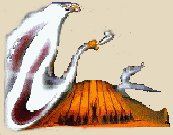

Earth is floating on the waters like a big island, hanging from four rawhide ropes fastened at the top of the Sacred four directions. The ropes are tied to the ceiling of the sky, which is made of hard rock crystal. When the ropes break, this world will come
tumbling down, and all living things will fall with it and die. Then everything will be as if the earth had never existed, for water will cover it. maybe the white man will bring this about.
Well, in the beginning also, water covered everything. Though living creatures existed, their home was up there, above the rainbow, and it was crowded. "We are all jammed together," the animals said. "We need more room." Wondering what was under the
water, they sent Water Beetle to look around.
Water Beetle skimmed over the surface but could'nt find any solid footing, so he dived to the bottom and brought up a little dab of soft mud. Magically the mud spread out in the four directions and became this island we are living on - this earth. Someone
Powerful then fastened it to the sky celing with cords.
In the beginning the earth was flat, soft, and moist. All the animals were eager to live on it, and they kept sending down birds to see if the mud had dried and hardened enough to take their weight. But the birds all flew back and said that there was still no spot they could perch on.
Then the animals sent Gandfather Buzzard down. He flew very close and saw that the earth was still soft, but when he glided low over what would become Cherokee counrty, he found that the mud was getting harder. By that time Buzzard was tired and dragging.
When he flapped his wings down they made a valley where they touched the earth; when he swept them up, they made a mountain. The animals watching from above the rainbow said, "If he keeps on, there will only be mountains," and they made him come back. Thats why we have so many mountains in Cherokee land.
At last the earth was hard and dry enough, and the animals descended. They couldnt see very well because they had no sun or moon, and someone said, "Lets grab Sun from up there behind the rainbow! Lets get him down too!" Pulling Sun down, they told him,
"Here's a road for you," and showed him the way to go....from east to west.
Now they had light, but it was much to hot, because Sun was too close to the earth. The crawfish had his back sticking out of a stream, and Sun burned it red. His meat was spoiled for ever, and the people still won't eat crawfish.
Everyone asked the sorcerers, the shamans, to put Sun higher. They pushed him up as high as a man, but it was still to hot. So they pushed him farther, but it wasn't far enough. They tried four times, and when they had sun up to the height of four men, he was just hot enough. Everyone was satisfied, so they left him there.
Before making humans, Someone Powerful had creatd plants and anmals and had told them to stay awake and watch for seven days and seven nights. ( This is just what young men do today when they fast and prepare for a ceremony.) But most of the plants and
animals couldnt manage it, some fell asleep after one day, some after two days, some after three. Among the animals, only the Owl and the Mountain Lion were still awake after seven days and nights. That is why they were given the gift of seeing in the dark so that they can hunt at night.
Among the trees and other plants, only the ceder, pine, holly, and laurel were still awake on the eighth morning. Someone Powerful said to them,"Because you watched and kept awake as you had been told, you will not lose your hair in the winter." So these plants stay green all the time.
After creating plants and animals, Someone Powerful made man and his sister. The man poked her with a fish and told her to go give birth. After seven days she had a baby, and after seven more days she had another, and every seven days another came. The humans
increased so quickly that Someone Powerful, thinking there would soon be no more room on this earth, arranged things so that a woman could have only one child every year. And thats how it was.
Now, there is still another world under the one we live on. You can reach it by going down a spring, a water hole; but you need underworld people to be your scouts and guide you. The world under our earth is exactly like ours, except that it's winter down there when its summer up here. We can see that easily, because spring water is warmer than the air in winter and cooler than the air in summer.
END
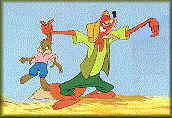
As soon as Big Long Man got back from the mountains he went to his garden to admire his corn and melons. He had planted a big crop for the coming winter. When he saw that half of the corn stalks had been shucked and the ears stolen, and that the biggest melons were gone off of the melon vines, he was very angry.
"Who stole my corn and melons?" he muttered to himself. "I'll catch the thief, whoever he is."
He began to scheme. The next day he built a fence around the garden. But the fence did no good. Each morning Big Long Man found more corn stalks stripped.
At last he thought up a scheme to catch the thief. He gathered a great ball of pine pitch and molded it into the shape of a man. He set the figure up in the corn field and then went to his
hogan.
That night Skunk came along to get a bit of corn for his dinner. He had heard from Badger that Big Long Man was away in the mountains. He squeezed his body under the fence and waddled up to a clump of corn. He was just about to shuck a fat ear when he noticed a man standing by the fence. Skunk let go of the ear of corn in fright. He could see in the moonlight that the man was not Big Long Man. He waddled over to the fence and spoke to the figure.
"Who are you, in Big Long Man's corn patch?'' asked Skunk. The figure did not answer.
"Who are you?" said Skunk again, moving closer. The figure did not answer.
"Speak!" said Skunk boldly, "or I will punch your face." The figure did not say a word. It did not move an inch.
"Tell me who you are," said Skunk a fourth time, raising his fist, "or I will punch your face." The figure said not a word. It was very quiet in the moonlit corn field. Even the wind had gone away.
Plup went Skunk's fist into the pine gum face. It sunk into the soft pitch, which is as sticky as glue, and there it stuck. Skunk pulled and pulled.
"If you don't let go my hand," he shouted, "I will hit you harder with my left hand." But the pine pitch held tight.
Plup went Skunk's left hand. Now both hands stuck fast.
"Let go my hands, or I will kick you," cried Skunk, who was by this time getting mad.
The pine gum man did not let go.
Plup, Skunk gave a mighty kick with his right foot. The foot stuck too, just like the hands.
"I will kick you harder," said Skunk and Plup he kicked with all of his strength with his left foot. Pine gum man held that foot too. Skunk struggled but he could not get loose. Now he was in
a fine plight. Every limb was held tight. He had only one more weapon, his teeth.
"I will bite your throat," he shouted and he dug his teeth into the pine gum throat.
"Ugh!" he gurgled for he could no longer say a word. His tongue and teeth were held fast in the pine pitch.
The next morning Big Long Man came to his corn patch and there was Skunk stuck onto the pine gum man. Only his tail was free, waving behind him.
"Ah!" said Big Long Man. "So it's you, Skunk, who has been stealing my corn."
"Ugh," replied Skunk. His mouth full of pine pitch.
Big Long Man pulled him away from the gum figure, tied a rope around his neck and led him to his hogan. He put a great pot of water on the stove to boil, then he took the rope off of Skunk's
neck.
"Now, Skunk," he said, "go fetch wood."
Skunk went out into the back yard. Just then Fox happened to pass by. He was on his way to Big Long Man's corn patch. Skunk began to cry loudly. Fox stopped running, and pricked up his sharp
ears.
"Who is crying?" he said.
"I am crying," said Skunk.
"Why?" said Fox.
"Because I have to carry wood for Big Long Man. He gives me all of the corn I want to eat, but I do not want to carry wood."
Fox was hungry. He knew that if he stole corn he was liable to get caught. "What an easy way to get corn," he thought. "I would not mind carrying wood."
Out loud he said, "Cousin, let us change places. You go home and I will carry wood for Big Long Man. I like the job. Besides, I was just on my way to steal an ear of corn down at the field."
"All right," said Skunk. "But don't eat too much corn. I have a stomach ache." He felt his fat stomach and groaned. Then he waddled happily away. Fox gathered up an armful of pi�on wood. He
hurried into Big Long Man's hogan. Big Long Man looked at him in surprise.
"Well, well, Skunk, you changed into a fox, did you? That's funny."
Fox did not say a word. He was afraid he might say the wrong thing and not get any corn to eat. Big Long Man took the rope which had been around Skunk's neck and tied it around Fox's neck.
Fox sat down and waited patiently. Soon the water in the big pot began to bubble and steam. At last Fox said, "Isn't the corn cooked yet, Big Long Man?"
"Corn?" asked Big Long Man. "What corn?"
"Why the corn you are cooking for me," said Fox. "Skunk said you would feed me all of the corn I could eat if I carried wood for you."
"The rascal," said Big Long Man. "He tricked you and he tricked me. Well, Fox, you will have to pay for this." So saying he picked up Fox by the ears and set him down in the boiling water. It was so hot that it took off every hair on his body. Big Long Man left him in the pot for a minute and then he pulled him out by the ears and set him free out of doors.
"Don't be thinking you will ever get any of my corn by tricks," said Big Long Man.
Fox ran yelping toward his den. He was sore all over. Half way home he passed Red Monument. Red Monument is a tall slab of red sand stone that stands alone in a valley. On top of the rock sat Raven eating corn that he had stolen from the corn patch. At the bottom was Coyote holding on to the rock with his paws. He was watching for Raven to drop a few kernels. He glanced behind him when Fox appeared. He did not let go of the rock, however, because he thought Fox might get his place. He was surprised at Fox's appearance.
"Where is your fur, Fox?" he asked over his shoulder.
"I ate too much corn," said Fox sadly. "Don't ever eat too much corn, Coyote. It is very painful." Fox held his stomach and groaned. "Corn is very bad for one's fur. It ruined mine."
"But where did you get so much corn, cousin?" asked Coyote, still holding on to the rock.
"Didn't you hear?" asked Fox. "Why, Big Long Man is giving corn to all the animals who carry wood for him. He will give you all you can eat and more too. Just gather an armful of pi�on sticks and walk right into his hogan."
Coyote thought a moment. He was greedy. He decided to go to Big Long Man's hogan but he did not want Fox to go with him. He wanted everything for himself.
"Cousin," he said, "will you do me a favor? Will you hold this rock while I go and get a bite of corn from Big Long Man? I am very hungry and I do not dare leave this rock. It will fall and kill somebody."
"All right," said Fox, smiling to himself. "I will hold the rock. But do not eat too much." He placed his paws on the back side of the rock and Coyote let go. The next minute Coyote was running away as fast as he could toward Big Long Man's hogan. Fox laughed to himself, but after a bit he became tired of holding the rock. He decided to let it fall.
"Look out, Cousin Raven," he shouted. "The rock is going to fall." Fox let go, and jumped far away. then he ran and did not look behind. He was afraid the rock would hit his tail. If Fox had looked behind him he would have seen the rock standing as steady as a mountain.
Presently, along came Coyote, back from Big Long Man's hogan. He was running at top speed and yowling fearfully. There was not a hair left on his body. When he came to Red Monument he saw Raven still sitting on his high perch nibbling kernels of corn.
"Where has Fox gone?" howled Coyote who was in a rage.
Raven looked down at Coyote. "Fox?" he said. "Why, Fox went home, I suppose. What did you do with your hair, Coyote?"
Coyote didn't answer. He just sat down by the foot of the rock and with his snout up in the air waited for Raven to drop a few kernels of corn.
"I'll get Fox some other day," he muttered to himself.

In the beginning of the world, there was no fire. The animal people were often cold. Only the Thunders, who lived in the world beyond the sky arch, had fire. At last they sent Lightning down to an island. Lightning put fire into the bottom of a hollow sycamore tree.
The animal people knew that the fire was there, because they could see smoke rising from the top of the tree. But they could not get to it on account of the water. So they held a council to decide what to do.
Everyone that could fly or could swim was eager to go after the fire. Raven said, "Let me go. I am large and strong."
At that time Raven was white. He flew high and far across the water and reached the top of the sycamore tree. While he sat there wondering what to do, the heat scorched all his
feathers black. The frightened Raven flew home without the fire, and his feathers have been black ever since.
Then the council sent Screech Owl. He flew to the island. But while he was looking down into the hollow tree, a blast of hot air came up and nearly burned out his eyes. He flew home and to this day, Screech Owl's eyes are red.
Then Hooting Owl and Horned Owl were sent to the island together. But the smoke nearly blinded them, and the ashes carried up by the wind made white rings about their eyes. They had to come home, and were never able to get rid of the white rings.
Then Little Snake swam across to the island, crawled through the grass to the tree, and entered it through a small hole at the bottom. But the smoke and the heat were too much for him, too. He escaped alive, but his body had been scorched black. And it was so twisted that he doubled on his track as if always trying to escape from a small space.
Big Snake, the climber, offered to go for fire, but he fell into the burning stump and became as black as Little Snake. He has been the great blacksnake ever since.
At last Water Spider said that she would go. Water Spider has black downy hair and red stripes on her body. She could run on top of water and she could dive to the bottom. She would have no trouble in getting to the island.
"But you are so little, how will you carry enough fire?" the council asked.
"I'll manage all right," answered Water Spider. "I can spin a web." so she spun a thread from her body and wove it into a little bowl and fastened the little bowl on her back. Then she crossed over to the island and through the grass. She put one little coal of fire into her bowl and brought it across to the people.
Every since, we have had fire. And the Water Spider still has her little bowl on her back.
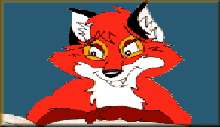
One day Fox was out walking along. He'd been hunting but had no luck. It was a long time since he'd eaten. His stomach was growling so loudly he could hardly hear anything else. Suddenly he realized someone was coming singing a song. Quicker than the flick of a wren's tail Fox leaped off the path and crouched down on his belly in the bushes. Louder and louder grew the song. Then Fox saw something begin to appear over the crest of the hill. It was a single heron feather. Fox moved his front paws, getting ready to leap out at the bird he thought the feather was attached to. But as the feather lifted higher and higher, he realized it was no bird at all. It was the feather attached to the top of a gustoweh, the head-dress of an Iroquois man whose face now bobbed into sight as he came over the hill on horseback.
If he sees me, Fox thought, I can forget about my hunger forever! It was well known that fox skins were prized by the Iroquois. Fox tried to make himself smaller than a mouse, hoping he wouldn't be seen.
Closer and closer the man came. He was wearing fine clothes and Fox could hear the words of man's song very clearly now. It was a boasting song.
"No one is braver than Heron Feather," sang the young man.
"And I should know that for I am he. No one wears finer clothing. No one is a better fisherman. If you doubt this, look and see."
He was on his way to the lodge of a young woman he had been watching for some time. He was going to try to impress her and her mother so that the girl would ask him to marry her. His song and his fine clothing were part of the plan.
But Fox was no longer listening to Heron Feather's song. He was not seeing those fine clothes. All of Fox's attention was on what he was smelling. Fish. That large bag hanging from the young man's blanketroll was full of fish! Fox's mouth watered and his tongue hung out. It had been such a long time since he had eaten fish. His fears left him. The young man on the horse passed him by, but Fox's thoughts were far ahead.
Yes, Fox said to himself. I think there is a way. As quickly as he could, he ran along through the woods keeping out of sight of the road. Soon he was ahead of the Iroquois man. Just around a bend, Fox laid himself down by the edge of the path. He closed his eyes and opened his mouth so that his tongue hung out in the dirt. Not moving a muscle, he waited. Soon he began to near Heron Feather's boasting song.
Heron Feather was so intent on his singing, trying to find a few more words to describe just how fine he looked in his new white buckskin breechclout that he almost rode right past Fox. When he saw Fox out of the corner of his eye, he stopped. "Enh," he said, "what is this?" He climbed down from his horse.
"Kweh, a dead fox?" Picking up a long stick he carefully prodded the side of the animal. It did not move. "Nyoh," he said, "it is surely dead." He bent down and looked at it closely. It was skinny, but the pelt was in fine condition. He picked it up by the tail. "Hmm, it has not been dead for long. It only stinks a little bit." When he said that, Fox's mouth opened a little and his lips curled back from his teeth, but Heron Feather did not notice.
"Hmm," Heron Feather said, "maybe I should skin it out now." When he said that one of Fox's eyes twitched a little, but Heron Feather did not notice. "Neh," he went on, "I should not skin him out now. If I do I may dirty my fine new clothes. I will just take him with me." He walked back to his horse and began to unlace the bag. "Weh-yoh," he smiled, "when Swaying Reed's mother sees this fox I caught she will know I am a great hunter. Then she will surely allow her daughter to bring me marriage bread." He dropped the fox in with his fish, laced the bag shut and climbed back on his horse. Soon he was singing again. This time it was a song about how great a hunter Heron Feather was.
Inside the bag Fox lay still for a few minutes. Then he began to gnaw at the side. When he had made a hole large enough, he began to drop the fish out, one by one. Finally, when all the fish were gone, he made the hole larger and jumped out to freedom and his best meal in many days.
Too busy with his singing, Heron Feather did not even notice. He rode all the way to the village where Swaying Reed lived. He stopped in front of her mother's lodge and sat there on his horse, singing til many people had gathered around. He sang of his beautiful clothes, of the many fish he caught (he actually had traded his mother's beaded moccasins for them), of all the animals he hunted and trapped. Swaying Reed and her mother came out of the lodge and watched as he reached back for his bag. Now
he would show them what a good provider he was!
When he held up the bag and saw that it was empty with a hole in the bottom he stopped singing. Turning around, he rode silently away. He learned that day that boasting songs do not make a person great. It is one thing to find a fox and another skin it.