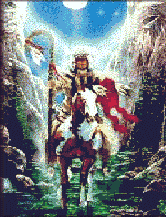
IKTOMI is a spider fairy. He wears brown deerskin leggins with long soft fringes on either side, and tiny beaded moccasins on his feet. His long black hair is parted in the middle and wrapped with red, red bands. Each round braid hangs over a small brown ear and falls forward over his shoulders.
He even paints his funny face with red and yellow, and draws
big black rings around his eyes. He wears a deerskin jacket, with bright colored beads sewed tightly on it. Iktomi dresses like a real Dakota brave. In truth, his paint and deerskins are the best part of him--if ever dress is part of man or fairy.
Iktomi is a wily fellow. His hands are always kept in mischief. He prefers to spread a snare rather than to earn the smallest thing with honest hunting. Why! he laughs outright with wide open mouth when some simple folk are caught in a trap, sure
and fast.
He never dreams another lives so bright as he. Often his own
conceit leads him hard against the common sense of simpler people.
Poor Iktomi cannot help being a little imp. And so long as he
is a naughty fairy, he cannot find a single friend. No one helps
him when he is in trouble. No one really loves him. Those who
come to admire his handsome beaded jacket and long fringed leggins soon go away sick and tired of his vain, vain words and heartless laughter.
Thus Iktomi lives alone in a cone-shaped wigwam upon the plain. One day he sat hungry within his teepee. Suddenly he rushed out, dragging after him his blanket. Quickly spreading it on the ground, he tore up dry tall grass with both his hands and tossed it fast into the blanket.
Tying all the four corners together in a knot, he threw the
light bundle of grass over his shoulder.
Snatching up a slender willow stick with his free left hand,
he started off with a hop and a leap. From side to side bounced
the bundle on his back, as he ran light-footed over the uneven
ground. Soon he came to the edge of the great level land. On the
hilltop he paused for breath. With wicked smacks of his dry
parched lips, as if tasting some tender meat, he looked straight
into space toward the marshy river bottom. With a thin palm
shading his eyes from the western sun, he peered far away into the lowlands, munching his own cheeks all the while. "Ah-ha!" grunted he, satisfied with what he saw.
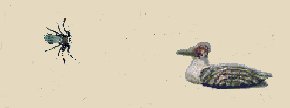
A group of wild ducks were dancing and feasting in the marshes. With wings outspread, tip to tip, they moved up and down in a large circle. Within the ring, around a small drum, sat the
chosen singers, nodding their heads and blinking their eyes.
They sang in unison a merry dance-song, and beat a lively
tattoo on the drum.
Following a winding footpath near by, came a bent figure of a
Dakota brave. He bore on his back a very large bundle. With a
willow cane he propped himself up as he staggered along beneath his burden.
"Ho! who is there?" called out a curious old duck, still
bobbing up and down in the circular dance.
Hereupon the drummers stretched their necks till they
strangled their song for a look at the stranger passing by.
"Ho, Iktomi! Old fellow, pray tell us what you carry in your
blanket. Do not hurry off! Stop! halt!" urged one of the singers.
"Stop! stay! Show us what is in your blanket!" cried out
other voices.
"My friends, I must not spoil your dance. Oh, you would not
care to see if you only knew what is in my blanket. Sing on! dance on! I must not show you what I carry on my back," answered Iktomi, nudging his own sides with his elbows. This reply broke up the ring entirely. Now all the ducks crowded about Iktomi.
"We must see what you carry! We must know what is in your
blanket!" they shouted in both his ears. Some even brushed their
wings against the mysterious bundle. Nudging himself again, wily
Iktomi said, "My friends, 'tis only a pack of songs I carry in my
blanket."
"Oh, then let us hear your songs!" cried the curious ducks.
At length Iktomi consented to sing his songs. With delight
all the ducks flapped their wings and cried together, "Hoye! hoye!"
Iktomi, with great care, laid down his bundle on the ground.
"I will build first a round straw house, for I never sing my
songs in the open air," said he.
Quickly he bent green willow sticks, planting both ends of
each pole into the earth. These he covered thick with reeds and
grasses. Soon the straw hut was ready. One by one the fat ducks
waddled in through a small opening, which was the only entrance
way. Beside the door Iktomi stood smiling, as the ducks, eyeing
his bundle of songs, strutted into the hut.
In a strange low voice Iktomi began his queer old tunes. All
the ducks sat round-eyed in a circle about the mysterious singer.
It was dim in that straw hut, for Iktomi had not forgot to cover up the small entrance way. All of a sudden his song burst into full voice. As the startled ducks sat uneasily on the ground, Iktomi changed his tune into a minor strain. These were the words he sang:
"Istokmus wacipo, tuwayatunwanpi kinhan ista nisasapi kta,"
which is, "With eyes closed you must dance. He who dares to open
his eyes, forever red eyes shall have."
Up rose the circle of seated ducks and holding their wings
close against their sides began to dance to the rhythm of Iktomi's song and drum.
With eyes closed they did dance! Iktomi ceased to beat his
drum. He began to sing louder and faster. He seemed to be moving about in the center of the ring. No duck dared blink a wink. Each one shut his eyes very tight and danced even harder. Up and down! Shifting to the right of them they hopped round and round in that blind dance. It was a difficult dance for the curious folk.
At length one of the dancers could close his eyes no longer!
It was a Skiska who peeped the least tiny blink at Iktomi within
the center of the circle. "Oh! oh!" squawked he in awful terror!
"Run! fly! Iktomi is twisting your heads and breaking your necks! Run out and fly! fly!" he cried. Hereupon the ducks opened their eyes. There beside Iktomi's bundle of songs lay half of their crowd--flat on their backs.
Out they flew through the opening Skiska had made as he rushed
forth with his alarm.
But as they soared high into the blue sky they cried to one
another: "Oh! your eyes are red-red!" "And yours are red-red!"
For the warning words of the magic minor strain had proven true.
"Ah-ha!" laughed Iktomi, untying the four corners of his blanket,
"I shall sit no more hungry within my dwelling." Homeward he
trudged along with nice fat ducks in his blanket. He left the
little straw hut for the rains and winds to pull down.
Having reached his own teepee on the high level lands, Iktomi
kindled a large fire out of doors. He planted sharp-pointed sticks around the leaping flames. On each stake he fastened a duck to roast. A few he buried under the ashes to bake. Disappearing within his teepee, he came out again with some huge seashells. These were his dishes. Placing one under each roasting duck, he muttered, "The sweet fat oozing out will taste well with the hard-cooked breasts."
Heaping more willows upon the fire, Iktomi sat down on the
ground with crossed shins. A long chin between his knees pointed
toward the red flames, while his eyes were on the browning ducks.
Just above his ankles he clasped and unclasped his long bony
fingers. Now and then he sniffed impatiently the savory odor.
The brisk wind which stirred the fire also played with a
squeaky old tree beside Iktomi's wigwam.
From side to side the tree was swaying and crying in an old
man's voice, "Help! I'll break! I'll fall!" Iktomi shrugged his
great shoulders, but did not once take his eyes from the ducks.
The dripping of amber oil into pearly dishes, drop by drop, pleased his hungry eyes. Still the old tree man called for help. "He! What sound is it that makes my ear ache!" exclaimed Iktomi, holding a hand on his ear.
He rose and looked around. The squeaking came from the tree.
Then he began climbing the tree to find the disagreeable sound. He placed his foot right on a cracked limb without seeing it. Just then a whiff of wind came rushing by and pressed together the broken edges. There in a strong wooden hand Iktomi's foot was
caught.
"Oh! my foot is crushed!" he howled like a coward. In vain he
pulled and puffed to free himself.
While sitting a prisoner on the tree he spied, through his
tears, a pack of gray wolves roaming over the level lands. Waving his hands toward them, he called in his loudest voice, "He! Gray wolves! Don't you come here! I'm caught fast in the tree so that my duck feast is getting cold. Don't you come to eat up my meal."
The leader of the pack upon hearing Iktomi's words turned to
his comrades and said:
"Ah! hear the foolish fellow! He says he has a duck feast to
be eaten! Let us hurry there for our share!" Away bounded the
wolves toward Iktomi's lodge.
From the tree Iktomi watched the hungry wolves eat up his
nicely browned fat ducks. His foot pained him more and more. He
heard them crack the small round bones with their strong long teeth and eat out the oily marrow. Now severe pains shot up from his foot through his whole body. "Hin-hin-hin!" sobbed Iktomi. Real tears washed brown streaks across his red-painted cheeks. Smacking their lips, the wolves began to leave the place, when Iktomi cried out like a pouting child, "At least you have left my baking under the ashes!"
"Ho! Po!" shouted the mischievous wolves; "he says more ducks
are to be found under the ashes! Come! Let us have our fill this
once!"
Running back to the dead fire, they pawed out the ducks with
such rude haste that a cloud of ashes rose like gray smoke over
them.
"Hin-hin-hin!" moaned Iktomi, when the wolves had scampered
off. All too late, the sturdy breeze returned, and, passing by,
pulled apart the broken edges of the tree. Iktomi was released.
But alas! he had no duck feast.
Old Indian Legend
AFAR off upon a large level land, a summer sun was shining bright. Here and there over the rolling green were tall bunches of coarse gray weeds. Iktomi in his fringed buckskins walked alone across the prairie with a black bare head glossy in the sunlight. He walked through the grass without following any well-worn footpath.
From one large bunch of coarse weeds to another he wound his
way about the great plain. He lifted his foot lightly and placed
it gently forward like a wildcat prowling noiselessly through the
thick grass. He stopped a few steps away from a very large bunch
of wild sage. From shoulder to shoulder he tilted his head. Still farther he bent from side to side, first low over one hip and then over the other. Far forward he stooped, stretching his long thin neck like a duck, to see what lay under a fur coat beyond the bunch of coarse grass.
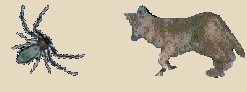
A sleek gray-faced prairie wolf! his pointed black nose tucked
in between his four feet drawn snugly together; his handsome bushy tail wound over his nose and feet; a coyote fast asleep in the shadow of a bunch of grass!--this is what Iktomi spied. Carefully he raised one foot and cautiously reached out with his toes. Gently, gently he lifted the foot behind and placed it before the other. Thus he came nearer and nearer to the round fur ball lying motionless under the sage grass.
Now Iktomi stood beside it, looking at the closed eyelids that
did not quiver the least bit. Pressing his lips into straight
lines and nodding his head slowly, he bent over the wolf. He held
his ear close to the coyote's nose, but not a breath of air stirred from it.
"Dead!" said he at last. "Dead, but not long since he ran
over these plains! See! there in his paw is caught a fresh
feather. He is nice fat meat!" Taking hold of the paw with the
bird feather fast on it, he exclaimed, "Why, he is still warm!
I'll carry him to my dwelling and have a roast for my evening meal. Ah-ha!" he laughed, as he seized the coyote by its two fore paws and its two hind feet and swung him over head across his shoulders. The wolf was large and the teepee was far across the prairie. Iktomi trudged along with his burden, smacking his hungry lips together. He blinked his eyes hard to keep out the salty perspiration streaming down his face.
All the while the coyote on his back lay gazing into the sky
with wide open eyes. His long white teeth fairly gleamed as he
smiled and smiled.
"To ride on one's own feet is tiresome, but to be carried like
a warrior from a brave fight is great fun!" said the coyote in his heart. He had never been borne on any one's back before and the new experience delighted him. He lay there lazily on Iktomi's
shoulders, now and then blinking blue winks. Did you never see a
birdie blink a blue wink? This is how it first became a saying
among the plains people. When a bird stands aloof watching your
strange ways, a thin bluish white tissue slips quickly over his
eyes and as quickly off again; so quick that you think it was only a mysterious blue wink. Sometimes when children grow drowsy they blink blue winks, while others who are too proud to look with friendly eyes upon people blink in this cold bird-manner.
The coyote was affected by both sleepiness and pride. His
winks were almost as blue as the sky. In the midst of his new
pleasure the swaying motion ceased. Iktomi had reached his
dwelling place. The coyote felt drowsy no longer, for in the next instant he was slipping out of Iktomi's hands. He was falling, falling through space, and then he struck the ground with such a bump he did not wish to breathe for a while. He wondered what Iktomi would do, thus he lay still where he fell. Humming a dance-song, one from his bundle o f mystery songs, Iktomi hopped and darted about at an imaginary dance and feast. He gathered dry willow sticks and broke them in two against his knee. He built a large fire out of doors. The flames leaped up high in red and yellow streaks. Now Iktomi returned to the coyote who had been looking on through his eyelashes.
Taking him again by his paws and hind feet, he swung him to
and fro. Then as the wolf swung toward the red flames, Iktomi let him go. Once again the coyote fell through space. Hot air smote his nostrils. He saw red dancing fire, and now he struck a bed of cracking embers. With a quick turn he leaped out of the flames. From his heels were scattered a shower of red coals upon Iktomi's bare arms and shoulders. Dumbfounded, Iktomi thought he saw a spirit walk out of his fire. His jaws fell apart. He thrust a palm to his face, hard over his mouth! He could scarce keep from shrieking.
Rolling over and over on the grass and rubbing the sides of
his head against the ground, the coyote soon put out the fire on
his fur. Iktomi's eyes were almost ready to jump out of his head
as he stood cooling a burn on his brown arm with his breath.
Sitting on his haunches, on the opposite side of the fire from
where Iktomi stood, the coyote began to laugh at him.
"Another day, my friend, do not take too much for granted.
Make sure the enemy is stone dead before you make a fire!"
Then off he ran so swiftly that his long bushy tail hung out
in a straight line with his back.
IN one of his wanderings through the wooded lands, Iktomi saw a rare bird sitting high in a tree-top. Its long fan-like tail feathers had caught all the beautiful colors of the rainbow. Handsome in the glistening summer sun sat the bird of rainbow plumage. Iktomi hurried hither with his eyes fast on the bird. He stood beneath the tree looking long and wistfully at the peacock's bright feathers. At length he heaved a sigh and began: "Oh, I wish I had such pretty feathers! How I wish I were not I! If only I were a handsome feathered creature how happy I would be! I'd be so glad to sit upon a very high tree and bask in the summer sun like you!" said he suddenly, pointing his bony finger up toward the peacock, who was eyeing the stranger below, turning his head from side to side.
"I beg of you make me into a bird with green and purple
feathers like yours!" implored Iktomi, tired now of playing the
brave in beaded buckskins. The peacock then spoke to Iktomi: "I
have a magic power. My touch will change you in a moment into the most beautiful peacock if you can keep one condition."
"Yes! yes!" shouted Iktomi, jumping up and down, patting his
lips with his palm, which caused his voice to vibrate in a peculiar fashion. "Yes! yes! I could keep ten conditions if only you would change me into a bird with long, bright tail feathers. Oh, I am so ugly! I am so tired of being myself! Change me! Do!"
Hereupon the peacock spread out both his wings, and scarce
moving them, he sailed slowly down upon the ground. Right beside
Iktomi he alighted. Very low in Iktomi's ear the peacock
whispered, "Are you willing to keep one condition, though hard it
be?"
"Yes! yes! I've told you ten of them if need be!" exclaimed
Iktomi, with some impatience.
"Then I pronounce you a handsome feathered bird. No longer
are you Iktomi the mischief-maker." Saying this the peacock
touched Iktomi with the tips of his wings.
Iktomi vanished at the touch. There stood beneath the tree
two handsome peacocks. While one of the pair strutted about with
a head turned aside as if dazzled by his own bright-tinted tail
feathers, the other bird soared slowly upward. He sat quiet and
unconscious of his gay plumage. He seemed content to perch there
on a large limb in the warm sunshine.
After a little while the vain peacock, dizzy with his bright
colors, spread out his wings and lit on the same branch with the
elder bird.
"Oh!" he exclaimed, "how hard to fly! Brightly tinted
feathers are handsome, but I wish they were light enough to fly!"
Just there the elder bird interrupted him. "That is the one
condition. Never try to fly like other birds. Upon the day you
try to fly you shall be changed into your former self."
"Oh, what a shame that bright feathers cannot fly into the
sky!" cried the peacock. Already he grew restless. He longed to
soar through space. He yearned to fly above the trees high upward to the sun.
"Oh, there I see a flock of birds flying thither! Oh! oh!"
said he, flapping his wings, "I must try my wings! I am tired of
bright tail feathers. I want to try my wings."
"No, no!" clucked the elder bird. The flock of chattering
birds flew by with whirring wings. "Oop! oop!" called some to
their mates.
Possessed by an irrepressible impulse the Iktomi peacock
called out, "He! I want to come! Wait for me!" and with that he
gave a lunge into the air. The flock of flying feathers wheeled
about and lowered over the tree whence came the peacock's cry.
Only one rare bird sat on the tree, and beneath, on the ground,
stood a brave in brown buckskins.
"I am my old self again!" groaned Iktomi in a sad voice.
"Make me over, pretty bird. Try me this once again!" he pleaded in vain.
"Old Iktomi wants to fly! Ah! We cannot wait for him!" sang
the birds as they flew away.
Muttering unhappy vows to himself, Iktomi had not gone far
when he chanced upon a bunch of long slender arrows. One by one
they rose in the air and shot a straight line over the prairie.
Others shot up into the blue sky and were soon lost to sight. Only one was left. He was making ready for his flight when Iktomi rushed upon him and wailed, "I want to be an arrow! Make me into an arrow! I want to pierce the blue Blue overhead. I want to strike yonder summer sun in its center. Make me into an arrow!"
"Can you keep a condition? One condition, though hard it be?"
the arrow turned to ask.
"Yes! Yes!" shouted Iktomi, delighted.
Hereupon the slender arrow tapped him gently with his sharp
flint beak. There was no Iktomi, but two arrows stood ready
to fly. "Now, young arrow, this is the one condition. Your flight must always be in a straight line. Never turn a curve nor jump about like a young fawn," said the arrow magician. He spoke slowly and sternly.
At once he set about to teach the new arrow how to shoot in a
long straight line.
"This is the way to pierce the Blue overhead," said he; and
off he spun high into the sky.
While he was gone a herd of deer came trotting by. Behind
them played the young fawns together. They frolicked about like
kittens. They bounced on all fours like balls. Then they pitched forward, kicking their heels in the air. The Iktomi arrow watched them so happy on the ground. Looking quickly up into the sky, he said in his heart, "The magician is out of sight. I'll just romp and frolic with these fawns until he returns. Fawns! Friends, do not fear me. I want to jump and leap with you. I long to be happy as you are," said he. The young fawns stopped with stiff legs and stared at the speaking arrow with large brown wondering eyes. "See! I can jump as well as you!" went on Iktomi. He gave one tiny leap like a fawn. All of a sudden the fawns snorted with extended nostrils at what they beheld. There among them stood Iktomi in brown buckskins, and the strange talking arrow was gone.
"Oh! I am myself. My old self!" cried Iktomi, pinching
himself and plucking imaginary pieces out of his jacket.
"Hin-hin-hin! I wanted to fly!"
The real arrow now returned to the earth. He alighted very
near Iktomi. From the high sky he had seen the fawns playing on
the green. He had seen Iktomi make his one leap, and the charm was broken. Iktomi became his former self.
"Arrow, my friend, change me once more!" begged Iktomi.
"No, no more," replied the arrow. Then away he shot through
the air in the direction his comrades had flown.
By this time the fawns gathered close around Iktomi. They
poked their noses at him trying to know who he was.
Iktomi's tears were like a spring shower. A new desire dried
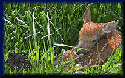
them quickly away. Stepping boldly to the largest fawn, he looked closely at the little brown spots all over the furry face.
"Oh, fawn! What beautiful brown spots on your face! Fawn,
dear little fawn, can you tell me how those brown spots were made
on your face?"
"Yes," said the fawn. "When I was very, very small, my mother
marked them on my face with a red hot fire. She dug a large hole
in the ground and made a soft bed of grass and twigs in it. Then
she placed me gently there. She covered me over with dry sweet
grass and piled dry cedars on top. From a neighbor's fire she
brought hither a red, red ember. This she tucked carefully in at
my head. This is how the brown spots were made on my face."
"Now, fawn, my friend, will you do the same for me? Won't you
mark my face with brown, brown spots just like yours?" asked
Iktomi, always eager to be like other people.
"Yes. I can dig the ground and fill it with dry grass and
sticks. If you will jump into the pit, I'll cover you with sweet
smelling grass and cedar wood," answered the fawn.
"Say," interrupted Ikto, "will you be sure to cover me with a
great deal of dry grass and twigs? You will make sure that the
spots will be as brown as those you wear."
"Oh, yes. I'll pile up grass and willows once oftener than my
mother did."
"Now let us dig the hole, pull the grass, and gather sticks,"
cried Iktomi in glee.
Thus with his own hands he aids in making his grave. After
the hole was dug and cushioned with grass, Iktomi, muttering
something about brown spots, leaped down into it. Lengthwise, flat on his back, he lay. While the fawn covered him over with cedars, a far-away voice came up through them, "Brown, brown spots to wear forever!" A red ember was tucked under the dry grass. Off scampered the fawns after their mothers; and when a great distance away they looked backward. They saw a blue smoke rising, writhing upward till it vanished in the blue ether.
"Is that Iktomi's spirit?" asked one fawn of another.
"No! I think he would jump out before he could burn into
smoke and cinders," answered his comrade.
 Main Menu