
The Warrior of Warriors
ROMAN NOSE
Sauts
The great Cheyenne chiefs Little Wolf and Dull Knife are familiar and honored names to all Cheyenne of today; they won their people a homeland at a severe but acknowledged cost, and yet there are other names of great Cheyenne who gave their lives to save their people's sacred way of life. This testimonial revolves around one man who deserves this recognition and deserves a place in "The Cheyenne Hall of Fame." He is the exceptional Sauts, who is perhaps better known to historians as Roman Nose. The documented life of Chief Roman Nose is to illustrate just why his name should be said with the same reverence as Little Wolf or Dull Knife (and others) and, in so doing, should inspire today's Cheyenne to model their own beliefs, respect and courage after his own.
Sauts, which means "Bat" in the Suhtai-Cheyenne language, was named for his quick and light movements in battle; like a bat swooping through the evening sky (Powell, 1981). Later, as his fame spread across the Plains, he was dubbed Hook Nose for his great eagle-like countenance, but the Whites interpreted this as Roman Nose. George B. Hyde, author of 'The Life of George Bent,' wrote that Sauts was a courageous (Northern) Cheyenne warrior who became prominent to the whites during the great Cheyenne/Sioux raids following the Sand Creek Massacre.
To his own people he was a man whom they held in the highest esteem for his model behavior and strong beliefs, not to mention his fighting prowess (Powell 1981). In Powell's classic book, "The Fighting Cheyennes" George Bird Grinnell expressed that Roman Nose possessed great influence and was an acknowledged leader of war,(1963). Young men of the tribe flocked to follow him whenever he rode off to battle (Powell 1981). In the book Wooden Leg, a warrior who Fought Custer, interpreted by Thomas B. Marquis, Wooden Leg had said, "Roman Nose was, I believe, the most admired of all warriors I ever saw." He spoke of him as an example for the young men, who sacrificed himself for the good of the tribe, and was told many great stories "illustrating the admirable qualities" of Roman Nose.
Although he was a renowned warrior he was also a husband and a father, and like so many other Cheyenne he would fight to the death for the People and their sacred way of life. Stan Hoig, author of "Peace Chiefs of the Cheyenne", would write that Sauts was a superb specimen of Cheyenne manhood and that he so epitomized the Cheyenne warrior, that even today his name symbolizes their fierce, proud spirit (1980).
As we ponder upon the lifestyle so alien to our own, we shall acquaint ourselves with his life and identity. In the 1860's Sauts was closely associated with Gray Beard's band of Dog Soldiers and also lived with the Suhtai under Black Shin, but was reported to be a formal member of the Elkhorn Scraper Society, to whom he was always loyal (Hyde 1968). Although he was known, foremost, as one of the bravest and most famous warriors on the Plains, Powell wrote that he, nonetheless, remained modest, quiet, and self-controlled (1981), perhaps one of the most repected qualities valued by the Cheyenne Nation.
He was truly a natural leader, and yet the modest Sauts actually declined to be seated on the Council of Forty-Four Chiefs, also declining to be placed as a headsmen of the Elkhorn Scrapers (Powell 1981). In fact, Hoig wrote that he was so prominent that the well-known Major Edward Wynkoop mistakenly reported him to be, "the head chief of the Northern Band of Cheyenne (1980)." Along that same vein, Hoig wrote of General Rodenbough being very impressed by the warrior during a council at Fort Ellisworth in 1866 (1980). The general wrote, "Roman Nose moved in a solemn and majestic manner to the center of the chamber."
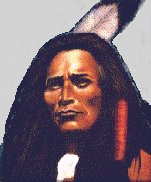
He was one of the finest specimens of the untamed savage. It would be difficult to exaggerate in describing his superb physique. A veritable man of war, the shock of battle and carnage and cruelty were as the breath of his nostrils; about thirty years of age, he towered, giant-like above his companions. A grand head, with strongly marked features, lighted by a pair of fierce black eyes; a large mouth with thin lips, through which gleamed rows of strong white teeth; a Roman nose, with delicate nostrils like those of a thoroughbred horse, first attracted attention, while a broad chest, with symmetrical limbs, on which the muscles under the bronze of his skin stood out like twisted wire, were some of the points of this spledid animal. Clad in buckskin leggings and moccasins, elaborately embroidered with beads and feathers, with a single eagle feather in his scalp-lock, he stood forth, the war-chief of the Cheyenne." And, if all of these qualities were not enough to be endowed with, Sauts was also a man of great spiritual significance, partly due to his relationship with Ice, "the most famous of the old time Northern Cheyenne medicine men (Hyde 1968).
Ice made the legendary one-horned, forty-feathered warbonnet for Roman Nose that rendered him untouchable by bullets when worn in battle. According to George Bent, a Cheyenne half-breed, this warbonnet was created in consideration of a fast Sauts had made when he was young. (His ceremony is recounted in Wooden Leg, A Warrior Who Fought Custer, in the chapter of "Worshipping the Great Medicine.")
While fasting four days and four nights in the middle of a "medicine lake," Sauts received a vision of a great serpent, known as a mihn, with a single horn in its head. Bent wrote that the sacred warbonnet was the only one of its kind ever made and required much ceremony, and that Ice did not use one material that had been produced by the whites, and so Roman Nose would adhere to similar guidelines, abstaining from using certain materials made by the White Man (Hyde 1968).
As his sacred warbonnet was worn for the purpose of battle only, what made him so renowned? He was renowned for his fighting prowess!
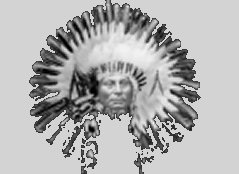
As mentioned before, Sauts became prominent during the 1860's following the Sand Creek Massacre, which had sent a clear indication of how the military dealt with any sovereign Indian nation, peaceful or hostile. Vengeful and desperate to save his people's way of life, he did the only thing he knew, fight! Apparently he fought so well on countless occasions that "his fame spread to the whites and they accredited him with being the leader in all the fights where the Cheyenne were engaged (Hoig 1980)."
According to Father Peter John Powell, author of People of the Sacred Mountain, Sauts was absolutely fearless when fighting the enemy and showed no mercy (1981).
Roman Nose played a major role during the Platte Bridge Fight, an indisputable victory for the Cheyenne and Sioux in July of 1865. Under heavy fire he led a charge armed with mostly bows and arrows against a well-fortified barricade of encircled wagons and destroyed the entire escort of twenty-five soldiers (Hyde 1968). He was wearing his sacred warbonnet and was not harmed.
Barely a month later, during a confrontation with a column of troops under Lieutenants Cole and Walker in the Powder River Country, Sauts once again displayed his bravery and the power of his sacred warbonnet between the two enemy's battle lines. Alone and in a dead run, he charged straight at the troops, when he reached within thirty yards of the soldiers he suddenly turned and rode "slowly the entire length of their line. A magnificent sight to behold as he rode the entire length of the firing troops, the tail of his sacred warbonnet sweeping over his war pony's flanks" (Powell 1981). The conflict was called, "Roman Nose's Battle." On a similar note, Sauts was on a hunting expedition led by Ice and came across another hunting party's trail. They investigated the trail and found that it led to a Blackfeet camp where they "stirred up a fight," and achieved no casualties. Woodenleg said, "The great warrior Roman Nose rode back and forth in front of the Blackfeet and defied them. All of them were said to have shot at him without a bullet or arrow having harmed him. (19XX)"
Another of his awe-inspiring acts was in April of 1867, when General Windield Scott Hancock with his, "Indian hunting expedition," of the Seventh Cavalry under Lt. Col. George A. Custer, singled Roman Nose out as one of the leading chiefs to be reponsible for war or peace to the Cheyenne and Sioux encamped on the Pawnee Fork (Hoig 1980).


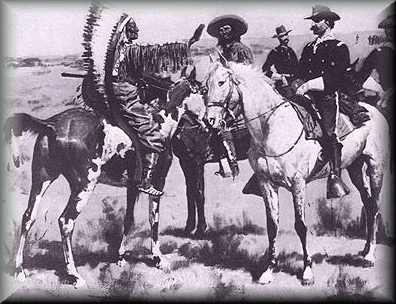
Thinking Sauts to be the head chief of the Cheyenne, as many white men did, General Hancock believed his absence at a meeting to be a hostile sign (Hyde 1968). Seeking out Sauts and his camp, Hancock began to march for them. Suddenly they came into view of, "the wild and fantastic battle array," of the powerful Cheyenne and Sioux warriors (Custer 1952). "At their head, in all of his plumed magnificence, was the warrior of warriors, Roman Nose (Hoig 1980)." In his work, My Life on the Plains, Custer would call the confrontation the finest and most imposing military display he was ever to witness (Custer 1952). The troops immediately fell into battle formation facing the Cheyenne and Sioux. Before the impending battle could begin, a life saving pow-wow was arranged between the leaders; included was Roman Nose, who wore a captured officers blouse with gold epaulets as brilliant as General Hancocks (Brown 1970). Sauts rode up alongside Hancock, stared him hard into the eyes and told him (through an interpreter) that if he did not stop his advance at once and make camp, he would engage war immediately at that location (Powell 1981).
A reporter for Harpers Weekly, T. Davis, was with Hancock and wrote of experiencing the stand off between the two war leaders, and described the imposing Sauts; "I have never seen so fine a specimen of the Indian race as he--quite six feet in height and finely formed, dressed in the uniform of a United States officer and provided with a numerous quantity of arms, he rode his well formed pony up to Hancock and proposed to talk. From his manner it was quite evident that he was indifferent whether he talked or fought (Hoig 1980)." Throughout the talk Hancock behaved arrogantly toward Roman Nose and the chiefs, and stated that he intended to move near the village and make his camp. Powell wrote that Sauts was enraged at Hancock and glared at the insolent general, then reached over and lightly struck him in the face; counting the most honored and prized first coup! With an unusually calm manner, which alarmed the other chiefs, Roman Nose warned his friend Bull Bear to ride back to the warrior battle line, for he would now slay this soldier chief and didn't want his friend killed (Powell 1981).
The concerned chiefs reasoned with Sauts, saying this would bring about the annihiliation of the camp, but he remained steadfast. Although he was intent on killing Hancock, he was prevented from doing so only when Bull Bear seized the bridle of his horse and led Roman Nose away from the pow-wow(Hoig 1980). The dangerous confrontation was somewhat diffused with this parley, which allowed the women, children, and elders of the camp the time needed to escape to safety, although they were forced to leave their lodges along with their most valued possessions inside. The camp was burned to the ground by the outraged General Hancock.
In August of 1867: Sauts led a party of warriors in the defeat of a cavalry unit under Captain G. A. Armes near Prarie Dog Creek, Kansas (1990).
Involved in a perpetual fight to the death with the enemies of the Cheyenne, Roman Nose finally met his death in the fall of 1868 at the Beecher's Island Fight. Tragically, the mystic warrior's death was attributed to the failure of his warbonnet's protective supernatural powers when he unknowingly consumed bread that had been served with a metal fork. Well aware of the infraction against his medicine, which could result in his demise, he did not refuse the call to battle when beseeched by his comrades to lead a charge that would take the discouraged warriors of the Cheyenne and Sioux to victory over the well-fortified and extremely well-armed scouts of Forsyth. Wearing his one-horned warbonnet, Sauts let the massive charge. Just as he was about to thunder over the scouts on the island, a sniper hidden in tall grass shot him in the back, mortally wounding him. The charge broke and fifty or so scouts were able to hold their protective positions and endure the siege.
The Beecher's Island fight became one of the classic battles of the American West (Hoig 1980) but to the Cheyenne it was seen differently and became known as The Battle where Roman Nose was killed. Sauts never compromised his beliefs or way of life to the ever increasing number of the White Man, He fought and ultimately died for the land and people he loved.
Hopefully the memory of Sauts will never end, and the young Cheyenne of today will recognize and revere the name of Sauts or Roman Nose in the same spirit as all the other honored names of Cheyenne History: Little Wolf, Dull Knife, Black Kettle, Two Moon. And in their spirit, it is hoped that the new warriors will use their memory to give them strength and courage to battle the enemies faced by The People today; The enemies of self-determination, prosperity, and traditional beliefs and practices, pride.
Henit-ni-hawnuh.
GO TO "Native Legends"
Return to Main Menu
The great Cheyenne chiefs Little Wolf and Dull Knife are familiar and honored names to all Cheyenne of today; they won their people a homeland at a severe but acknowledged cost, and yet there are other names of great Cheyenne who gave their lives to save their people's sacred way of life. This testimonial revolves around one man who deserves this recognition and deserves a place in "The Cheyenne Hall of Fame." He is the exceptional Sauts, who is perhaps better known to historians as Roman Nose. The documented life of Chief Roman Nose is to illustrate just why his name should be said with the same reverence as Little Wolf or Dull Knife (and others) and, in so doing, should inspire today's Cheyenne to model their own beliefs, respect and courage after his own.
Sauts, which means "Bat" in the Suhtai-Cheyenne language, was named for his quick and light movements in battle; like a bat swooping through the evening sky (Powell, 1981). Later, as his fame spread across the Plains, he was dubbed Hook Nose for his great eagle-like countenance, but the Whites interpreted this as Roman Nose. George B. Hyde, author of 'The Life of George Bent,' wrote that Sauts was a courageous (Northern) Cheyenne warrior who became prominent to the whites during the great Cheyenne/Sioux raids following the Sand Creek Massacre.
To his own people he was a man whom they held in the highest esteem for his model behavior and strong beliefs, not to mention his fighting prowess (Powell 1981). In Powell's classic book, "The Fighting Cheyennes" George Bird Grinnell expressed that Roman Nose possessed great influence and was an acknowledged leader of war,(1963). Young men of the tribe flocked to follow him whenever he rode off to battle (Powell 1981). In the book Wooden Leg, a warrior who Fought Custer, interpreted by Thomas B. Marquis, Wooden Leg had said, "Roman Nose was, I believe, the most admired of all warriors I ever saw." He spoke of him as an example for the young men, who sacrificed himself for the good of the tribe, and was told many great stories "illustrating the admirable qualities" of Roman Nose.
Although he was a renowned warrior he was also a husband and a father, and like so many other Cheyenne he would fight to the death for the People and their sacred way of life. Stan Hoig, author of "Peace Chiefs of the Cheyenne", would write that Sauts was a superb specimen of Cheyenne manhood and that he so epitomized the Cheyenne warrior, that even today his name symbolizes their fierce, proud spirit (1980).
As we ponder upon the lifestyle so alien to our own, we shall acquaint ourselves with his life and identity. In the 1860's Sauts was closely associated with Gray Beard's band of Dog Soldiers and also lived with the Suhtai under Black Shin, but was reported to be a formal member of the Elkhorn Scraper Society, to whom he was always loyal (Hyde 1968). Although he was known, foremost, as one of the bravest and most famous warriors on the Plains, Powell wrote that he, nonetheless, remained modest, quiet, and self-controlled (1981), perhaps one of the most repected qualities valued by the Cheyenne Nation.
He was truly a natural leader, and yet the modest Sauts actually declined to be seated on the Council of Forty-Four Chiefs, also declining to be placed as a headsmen of the Elkhorn Scrapers (Powell 1981). In fact, Hoig wrote that he was so prominent that the well-known Major Edward Wynkoop mistakenly reported him to be, "the head chief of the Northern Band of Cheyenne (1980)." Along that same vein, Hoig wrote of General Rodenbough being very impressed by the warrior during a council at Fort Ellisworth in 1866 (1980). The general wrote, "Roman Nose moved in a solemn and majestic manner to the center of the chamber."
He was one of the finest specimens of the untamed savage. It would be difficult to exaggerate in describing his superb physique. A veritable man of war, the shock of battle and carnage and cruelty were as the breath of his nostrils; about thirty years of age, he towered, giant-like above his companions. A grand head, with strongly marked features, lighted by a pair of fierce black eyes; a large mouth with thin lips, through which gleamed rows of strong white teeth; a Roman nose, with delicate nostrils like those of a thoroughbred horse, first attracted attention, while a broad chest, with symmetrical limbs, on which the muscles under the bronze of his skin stood out like twisted wire, were some of the points of this spledid animal. Clad in buckskin leggings and moccasins, elaborately embroidered with beads and feathers, with a single eagle feather in his scalp-lock, he stood forth, the war-chief of the Cheyenne." And, if all of these qualities were not enough to be endowed with, Sauts was also a man of great spiritual significance, partly due to his relationship with Ice, "the most famous of the old time Northern Cheyenne medicine men (Hyde 1968).
Ice made the legendary one-horned, forty-feathered warbonnet for Roman Nose that rendered him untouchable by bullets when worn in battle. According to George Bent, a Cheyenne half-breed, this warbonnet was created in consideration of a fast Sauts had made when he was young. (His ceremony is recounted in Wooden Leg, A Warrior Who Fought Custer, in the chapter of "Worshipping the Great Medicine.")
While fasting four days and four nights in the middle of a "medicine lake," Sauts received a vision of a great serpent, known as a mihn, with a single horn in its head. Bent wrote that the sacred warbonnet was the only one of its kind ever made and required much ceremony, and that Ice did not use one material that had been produced by the whites, and so Roman Nose would adhere to similar guidelines, abstaining from using certain materials made by the White Man (Hyde 1968).
As his sacred warbonnet was worn for the purpose of battle only, what made him so renowned? He was renowned for his fighting prowess!
As mentioned before, Sauts became prominent during the 1860's following the Sand Creek Massacre, which had sent a clear indication of how the military dealt with any sovereign Indian nation, peaceful or hostile. Vengeful and desperate to save his people's way of life, he did the only thing he knew, fight! Apparently he fought so well on countless occasions that "his fame spread to the whites and they accredited him with being the leader in all the fights where the Cheyenne were engaged (Hoig 1980)."
According to Father Peter John Powell, author of People of the Sacred Mountain, Sauts was absolutely fearless when fighting the enemy and showed no mercy (1981).
Roman Nose played a major role during the Platte Bridge Fight, an indisputable victory for the Cheyenne and Sioux in July of 1865. Under heavy fire he led a charge armed with mostly bows and arrows against a well-fortified barricade of encircled wagons and destroyed the entire escort of twenty-five soldiers (Hyde 1968). He was wearing his sacred warbonnet and was not harmed.
Barely a month later, during a confrontation with a column of troops under Lieutenants Cole and Walker in the Powder River Country, Sauts once again displayed his bravery and the power of his sacred warbonnet between the two enemy's battle lines. Alone and in a dead run, he charged straight at the troops, when he reached within thirty yards of the soldiers he suddenly turned and rode "slowly the entire length of their line. A magnificent sight to behold as he rode the entire length of the firing troops, the tail of his sacred warbonnet sweeping over his war pony's flanks" (Powell 1981). The conflict was called, "Roman Nose's Battle." On a similar note, Sauts was on a hunting expedition led by Ice and came across another hunting party's trail. They investigated the trail and found that it led to a Blackfeet camp where they "stirred up a fight," and achieved no casualties. Woodenleg said, "The great warrior Roman Nose rode back and forth in front of the Blackfeet and defied them. All of them were said to have shot at him without a bullet or arrow having harmed him. (19XX)"
Another of his awe-inspiring acts was in April of 1867, when General Windield Scott Hancock with his, "Indian hunting expedition," of the Seventh Cavalry under Lt. Col. George A. Custer, singled Roman Nose out as one of the leading chiefs to be reponsible for war or peace to the Cheyenne and Sioux encamped on the Pawnee Fork (Hoig 1980).
Thinking Sauts to be the head chief of the Cheyenne, as many white men did, General Hancock believed his absence at a meeting to be a hostile sign (Hyde 1968). Seeking out Sauts and his camp, Hancock began to march for them. Suddenly they came into view of, "the wild and fantastic battle array," of the powerful Cheyenne and Sioux warriors (Custer 1952). "At their head, in all of his plumed magnificence, was the warrior of warriors, Roman Nose (Hoig 1980)." In his work, My Life on the Plains, Custer would call the confrontation the finest and most imposing military display he was ever to witness (Custer 1952). The troops immediately fell into battle formation facing the Cheyenne and Sioux. Before the impending battle could begin, a life saving pow-wow was arranged between the leaders; included was Roman Nose, who wore a captured officers blouse with gold epaulets as brilliant as General Hancocks (Brown 1970). Sauts rode up alongside Hancock, stared him hard into the eyes and told him (through an interpreter) that if he did not stop his advance at once and make camp, he would engage war immediately at that location (Powell 1981).
A reporter for Harpers Weekly, T. Davis, was with Hancock and wrote of experiencing the stand off between the two war leaders, and described the imposing Sauts; "I have never seen so fine a specimen of the Indian race as he--quite six feet in height and finely formed, dressed in the uniform of a United States officer and provided with a numerous quantity of arms, he rode his well formed pony up to Hancock and proposed to talk. From his manner it was quite evident that he was indifferent whether he talked or fought (Hoig 1980)." Throughout the talk Hancock behaved arrogantly toward Roman Nose and the chiefs, and stated that he intended to move near the village and make his camp. Powell wrote that Sauts was enraged at Hancock and glared at the insolent general, then reached over and lightly struck him in the face; counting the most honored and prized first coup! With an unusually calm manner, which alarmed the other chiefs, Roman Nose warned his friend Bull Bear to ride back to the warrior battle line, for he would now slay this soldier chief and didn't want his friend killed (Powell 1981).
The concerned chiefs reasoned with Sauts, saying this would bring about the annihiliation of the camp, but he remained steadfast. Although he was intent on killing Hancock, he was prevented from doing so only when Bull Bear seized the bridle of his horse and led Roman Nose away from the pow-wow(Hoig 1980). The dangerous confrontation was somewhat diffused with this parley, which allowed the women, children, and elders of the camp the time needed to escape to safety, although they were forced to leave their lodges along with their most valued possessions inside. The camp was burned to the ground by the outraged General Hancock.
In August of 1867: Sauts led a party of warriors in the defeat of a cavalry unit under Captain G. A. Armes near Prarie Dog Creek, Kansas (1990).
Involved in a perpetual fight to the death with the enemies of the Cheyenne, Roman Nose finally met his death in the fall of 1868 at the Beecher's Island Fight. Tragically, the mystic warrior's death was attributed to the failure of his warbonnet's protective supernatural powers when he unknowingly consumed bread that had been served with a metal fork. Well aware of the infraction against his medicine, which could result in his demise, he did not refuse the call to battle when beseeched by his comrades to lead a charge that would take the discouraged warriors of the Cheyenne and Sioux to victory over the well-fortified and extremely well-armed scouts of Forsyth. Wearing his one-horned warbonnet, Sauts let the massive charge. Just as he was about to thunder over the scouts on the island, a sniper hidden in tall grass shot him in the back, mortally wounding him. The charge broke and fifty or so scouts were able to hold their protective positions and endure the siege.
The Beecher's Island fight became one of the classic battles of the American West (Hoig 1980) but to the Cheyenne it was seen differently and became known as The Battle where Roman Nose was killed. Sauts never compromised his beliefs or way of life to the ever increasing number of the White Man, He fought and ultimately died for the land and people he loved.
Hopefully the memory of Sauts will never end, and the young Cheyenne of today will recognize and revere the name of Sauts or Roman Nose in the same spirit as all the other honored names of Cheyenne History: Little Wolf, Dull Knife, Black Kettle, Two Moon. And in their spirit, it is hoped that the new warriors will use their memory to give them strength and courage to battle the enemies faced by The People today; The enemies of self-determination, prosperity, and traditional beliefs and practices, pride.
Main Menu