
Chief Joseph (Nez Perce)
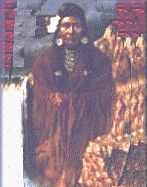
at
Bear Paw Mountains, 1877
Chief Joseph's Speech
"Tell General Howard that I know his heart. What he told me before I have in my heart. I am tired of fighting. Our chiefs are killed. Looking Glass is dead, Tu-hul-hil-sote is dead. the old men are all dead. It is the young men who now say yes or no.
He who led the young men [Joseph's brother Alikut] is dead. It is cold and we have no blankets. The little children are freezing to death. My people, some of them have run away to the hills and have no blankets and no food. No one knows where they are, perhaps freezing to death. I want to have time to look for my children and see how many of them I can find. Maybe I shall find them among the dead.
Hear me, my chiefs, my heart is sick and sad.
From where the sun now stands I will fight no more, forever, against the white man".
Joseph, chief of the Wallowa band of Nez Perce in northeast Oregon, was often credited for his military genius by U.S. Army officials. Respected by whites and Indians for his wisdom and eloquence, he often acted as the spokesperson of the non-treaty Nez Perce bands. Despite a series of disregarded treaties and broken promises from the U.S. government, Joseph continued his attempts to regain a portion of the Wallowa Valley to which he and the survivors of his band could return. His efforts were in vain and he died in front of his campfire in 1904 on the Colville Reservation in central Washington.
Excerpt Edward S. Curtis, Flury & Co./(p)1992
Speech and Image derived from Encarta.
Copyright. All rights reserved.
Chief Joseph's Speech
"I have heard talk and talk
but nothing is done.
Good words do not last long
unless they are amount to something.
Words do not pay for my dead people;
they do not pay for my country;
they do not protect my father's grave.
Good words do not give me back my children.
Good words do not give my people good health,
nor stop them from dying.
I'm tired of talk that has come to nothing.
It made my heart sick.
I remembered all the good words
and all the broken promises.
Chief Seattle
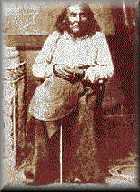
Skokomish
Puget Sound Indians
in response to President Franklin Pierce - Washington.
How can you buy or sell the warmth of the land? The idea is strange to us. If we do not own the freshness of the air and the sparkle of the water, how can you buy them? Every part of the earth is sacred to my people. Every shining pine needle, every sandy shore, every mist in the dark woods, every clearing and humming insect is holy in the memory and experience of my people.
The sap which courses through the trees carries the memories of the red man. The white man's dead forget the country of their birth when they go to walk among the stars. Our dead never forget this beautiful earth, for it is the mother of the red man.
We are a part of the earth and it is a part of us. The perfumed flowers are our sisters; the deer, the horse, the great eagle, these are our brothers.
The rocky crests, the juices in the meadows, the body heat of the pony, and the man -- all belong to the same family. So when the great chief in Washington sends word that he wishes to buy our land, he asks much of us.
The Great Chief sends word he will reserve for us a place so that we can live comfortably to ourselves. He will be our father and we will be his children. So we will consider your offer to buy our land.
But it will not be easy, For the land is sacred to us. This shining water that moves in the streams and the rivers is not just water, but the blood of our ancestors.
If we sell you our land, you must remember that it is sacred, and you must teach your children that it is sacred, and that each ghostly reflection in the clear water of the lakes tells of events and memories in the life of my people.
The water's murmur is the voice of my father's father. The rivers are our brothers; they quench our thirst. The rivers carry our canoes and feed our children.
If we sell you our land, you must remember, and teach your children, that the rivers are our brothers, and yours, and you must henceforth give the rivers the kindness you would give any brother.
We know that the white man does not understand our ways. One portion of land is the same to him as the next, for he is a stranger who comes in the night and takes from the land whatever he needs. The earth is not his brother, but his enemy, and when he has conquered it, he moves on. He leaves his father's graves and his children's birthright is forgotten. He treats his mother, the earth, and his brother, the sky, as things to be bought, plundered, sold like sheep or bright beads. His appetite will devour the earth and leave behind only desert.
I do not know.
Our ways are different from your ways.
The sight of your cities pains the eye of the red man. But perhaps it is because the red man is savage and does not understand. There is no quiet place in the white man's cities. No place to hear the unfurling of leaves in spring, or the rustle of an insect's wings.
But perhaps it is because I am savage and do not understand.
The clatter only seems to insult the ears. And what is there to life if a man cannot hear the lonely cry of the whip-poor-will or the arguments of the frogs around a pond, and the smell of the wind itself, cleansed by rain or scented with the pine cone. The air is precious to the red man, for all things share the same breath; the beast, the tree, the man, they all share the same breath.
The white men , they all share the same breath. The white man does not seem to notice the air he breathes. Like a man dying for many days, he is numb to the stench.
But if we sell you our land, you must remember that the air is precious to us, that the air shares its spirit with all life it supports. The wind that gave our grandfather his first breath also received his last sigh.
And if we sell you our land you must keep it apart and sacred, as a place where even the white man can go and taste the wind that is sweetened by the meadow's flowers.
So we will consider your offer to buy our land. If we decide to accept I will make one condition. The white man must treat the beasts of this land as his brothers. I am savage and do not understand any other way.
I have seen a thousand rotting buffaloes on the prairie, left by the white man who shot them from a passing train. I am savage and do not understand how the smoking iron horse can be more important than the buffalo that we kill only to stay live. What is man without the beasts? If all the beasts were gone, man would die from a great loneliness of spirit. For whatever happens to the beasts, soon happens to man. All things are connected.
You must teach your children that the ground beneath their feet is the ashes of our grandfathers; so that they will respect the land, tell your children that the earth is rich with the lives of our kin. Teach your children what we have taught our children, that the earth is our mother. Whatever befalls the earth befalls the sons of earth. Man did not weave the web of life, he is merely a strand in it. Whatever he does to the web, he does to himself. Even the white man, whose God walks and talks with him as a friend to friend, cannot be exempt from the common destiny.
We may be brothers after all.
We shall see.
One thing we know, which the white man may one day discover -- our God is the same God.
You may think now that you own Him as you wish to own our land; but you cannot. He is the God of man and his compassion is equal for the red man and the white. The earth is precious to him, and to harm the earth is to heap contempt upon its Creator.
The Whites, too, shall pass; perhaps sooner than all other tribes. Contaminate your bed, and you will one night suffocate in your own waste. But in your perishing, you will shine brightly, fired by the strength of God who brought you to this land and, for some special purpose, gave you dominion over this land and over the red man. That destiny is a mystery to us, for we do not understand when the buffalo are slaughtered, the wild horses are tamed, the secret corners of the forest heavy with the scent of many men and the view of the ripe hills blotted out by talking wires.
Where is the thicket?

Where is the eagle??.

"Not to be aware of the past is to be forever a child, but those of us who forget the past are condemned to repeat it. Mankind is the sum of his ancestors."
Cochise
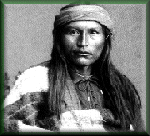
The Apache were once a great nation, who lived well and at peace with each other and nature, covering these beautiful mountains. Cochise's best friend was seized by a white man and treacherously killed. This action brought war among two great nations, the soldiers did the Apache a great wrong, thus bringing about the great war, which brought hardship to both nations. The Apache could no longer roam free, they were placed onto reservations; their beliefs, customs were not respected by the white man. This brought about great sorrow to the Apache race. Cochise was never photographed, and lies buried in a secret grave.
Cochise's Quotation
You must speak straight so that your words may go as sunlight into our hearts.

Ancestors
If you could see your ancestors
all standing in a row
would you be proud of them or not
or don't you really know
now here's a difficult question
requiring a different view
if your ancestors could see you now
would they be proud of you?
Powhatan's (Algonquin) Speech
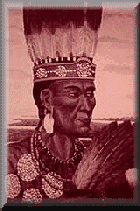
in 1609
Why will you take by force what you may obtain by love?
Why will you destroy us who supply you with food?
What can you get by war?
We are unarmed, and willing to give you what you ask,
if you come in a friendly manner.
I am not so simple as to know it is better to eat good meat,
sleep comfortably, live quietly with my women and children,
laugh and be merry with the English, and being their friend,
trade for their copper and hatchets, than to run away from them.
Take your guns and swords, the cause of all our jealousy,
or you may die in the same manner!
Sitting Bull
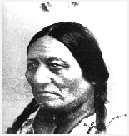
Powder River Speech in 1877
Behold my Brothers, the spring has come, the earth has received the embraces of the sun and we shall soon see the results of that love.
Every seed is awakened and so has all animal life. It is through this mysterious power that we have our being and we therefore yield to our neighbours, even to our animal neighbours the same right as ourselves, to inhabit this land.
Yet, hear me people, we have now to deal with another race -small, but yet feeble, when our fathers first met them - but now, great and overbearing. Strangely enough they have a mind to till the soil and the love of possession is a disease in them.
These people have made many rules that the rich may break but the poor may not. They take riches from the poor and weak and support the rich who rule.
They claim this Mother of ours, the earth for their own, and fence their neighbours away. They deface her with their buildings and their refuse. That nation is like a spring freshet that overruns its banks and destroys all who are in its path.
We cannot dwell side by side. Only seven years ago we made a treaty by which we were assured that the buffalo country should be left to us, forever. Now they threaten to take that away from us.
My brothers, shall we submit or shall we say to them,
"First kill me before you take possession of my Fatherland"
Chief Luther Standing Bear
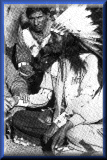
Oglala Sioux
The lessons are written on gentle breezes.
The lessons are written in distant stars.
The lessons are written in the lined faces of elders.
The lessons are written by Mother every day in every blade of grass.
The lessons are written in tears and laughter.
The lessons are written with the blood of the People.
listen to the blood - it cries up from the earth.
listen to the breeze - it carries the cries .
listen to the stars - they have heard the cries.
listen to the grass - it is nurtured by the blood.
The lessons are written everywhere.
why are som e mountains sacred?
These mountains have heard the cries.
These mountains cradle the cries.
These mountains are our lessons.
These mountains hold the spirits of the People.
from these mountains we gained life.
These are our lessons.
look to the mountains.
your lessons are written there.
A Dead Indian
"When the Indian has forgotten the music of his forefathers, when the sound of the tom-tom is no more, when the memory of his heros is no longer told in story ... he will be dead. When from him has been taken all that is his, all that he has visioned in nature, all that has come to him from infinite sources, he then, truely, will be a dead Indian."
Chief Luther StandingBear, Oglala Lakota.
Many broken Promises
My people, many promises were made,
albeit only one was kept, they took our land.
Visit other Pages below.
Go to "Great Chiefs 2"
Return to Main Menu
"Tell General Howard that I know his heart. What he told me before I have in my heart. I am tired of fighting. Our chiefs are killed. Looking Glass is dead, Tu-hul-hil-sote is dead. the old men are all dead. It is the young men who now say yes or no.
He who led the young men [Joseph's brother Alikut] is dead. It is cold and we have no blankets. The little children are freezing to death. My people, some of them have run away to the hills and have no blankets and no food. No one knows where they are, perhaps freezing to death. I want to have time to look for my children and see how many of them I can find. Maybe I shall find them among the dead.
Joseph, chief of the Wallowa band of Nez Perce in northeast Oregon, was often credited for his military genius by U.S. Army officials. Respected by whites and Indians for his wisdom and eloquence, he often acted as the spokesperson of the non-treaty Nez Perce bands. Despite a series of disregarded treaties and broken promises from the U.S. government, Joseph continued his attempts to regain a portion of the Wallowa Valley to which he and the survivors of his band could return. His efforts were in vain and he died in front of his campfire in 1904 on the Colville Reservation in central Washington.
Hear me, my chiefs, my heart is sick and sad.
From where the sun now stands I will fight no more, forever, against the white man".
Excerpt Edward S. Curtis, Flury & Co./(p)1992
Copyright. All rights reserved.
Chief Joseph's Speech
"I have heard talk and talk
but nothing is done.
Good words do not last long
unless they are amount to something.
Words do not pay for my dead people;
they do not pay for my country;
they do not protect my father's grave.
Good words do not give me back my children.
Good words do not give my people good health,
nor stop them from dying.
I'm tired of talk that has come to nothing.
It made my heart sick.
I remembered all the good words
and all the broken promises.
Chief Seattle
Skokomish
Puget Sound Indians
in response to President Franklin Pierce - Washington.
How can you buy or sell the warmth of the land? The idea is strange to us. If we do not own the freshness of the air and the sparkle of the water, how can you buy them? Every part of the earth is sacred to my people. Every shining pine needle, every sandy shore, every mist in the dark woods, every clearing and humming insect is holy in the memory and experience of my people.
The sap which courses through the trees carries the memories of the red man. The white man's dead forget the country of their birth when they go to walk among the stars. Our dead never forget this beautiful earth, for it is the mother of the red man.
We are a part of the earth and it is a part of us. The perfumed flowers are our sisters; the deer, the horse, the great eagle, these are our brothers.
The rocky crests, the juices in the meadows, the body heat of the pony, and the man -- all belong to the same family. So when the great chief in Washington sends word that he wishes to buy our land, he asks much of us.
The Great Chief sends word he will reserve for us a place so that we can live comfortably to ourselves. He will be our father and we will be his children. So we will consider your offer to buy our land.
But it will not be easy, For the land is sacred to us. This shining water that moves in the streams and the rivers is not just water, but the blood of our ancestors.
If we sell you our land, you must remember that it is sacred, and you must teach your children that it is sacred, and that each ghostly reflection in the clear water of the lakes tells of events and memories in the life of my people.
The water's murmur is the voice of my father's father. The rivers are our brothers; they quench our thirst. The rivers carry our canoes and feed our children.
If we sell you our land, you must remember, and teach your children, that the rivers are our brothers, and yours, and you must henceforth give the rivers the kindness you would give any brother.
We know that the white man does not understand our ways. One portion of land is the same to him as the next, for he is a stranger who comes in the night and takes from the land whatever he needs. The earth is not his brother, but his enemy, and when he has conquered it, he moves on. He leaves his father's graves and his children's birthright is forgotten. He treats his mother, the earth, and his brother, the sky, as things to be bought, plundered, sold like sheep or bright beads. His appetite will devour the earth and leave behind only desert.
I do not know.
Our ways are different from your ways.
The sight of your cities pains the eye of the red man. But perhaps it is because the red man is savage and does not understand. There is no quiet place in the white man's cities. No place to hear the unfurling of leaves in spring, or the rustle of an insect's wings.
But perhaps it is because I am savage and do not understand.
The clatter only seems to insult the ears. And what is there to life if a man cannot hear the lonely cry of the whip-poor-will or the arguments of the frogs around a pond, and the smell of the wind itself, cleansed by rain or scented with the pine cone. The air is precious to the red man, for all things share the same breath; the beast, the tree, the man, they all share the same breath.
The white men , they all share the same breath. The white man does not seem to notice the air he breathes. Like a man dying for many days, he is numb to the stench.
But if we sell you our land, you must remember that the air is precious to us, that the air shares its spirit with all life it supports. The wind that gave our grandfather his first breath also received his last sigh.
And if we sell you our land you must keep it apart and sacred, as a place where even the white man can go and taste the wind that is sweetened by the meadow's flowers.
So we will consider your offer to buy our land. If we decide to accept I will make one condition. The white man must treat the beasts of this land as his brothers. I am savage and do not understand any other way.
I have seen a thousand rotting buffaloes on the prairie, left by the white man who shot them from a passing train. I am savage and do not understand how the smoking iron horse can be more important than the buffalo that we kill only to stay live. What is man without the beasts? If all the beasts were gone, man would die from a great loneliness of spirit. For whatever happens to the beasts, soon happens to man. All things are connected.
You must teach your children that the ground beneath their feet is the ashes of our grandfathers; so that they will respect the land, tell your children that the earth is rich with the lives of our kin. Teach your children what we have taught our children, that the earth is our mother. Whatever befalls the earth befalls the sons of earth. Man did not weave the web of life, he is merely a strand in it. Whatever he does to the web, he does to himself. Even the white man, whose God walks and talks with him as a friend to friend, cannot be exempt from the common destiny.
We may be brothers after all.
We shall see.
One thing we know, which the white man may one day discover -- our God is the same God.
You may think now that you own Him as you wish to own our land; but you cannot. He is the God of man and his compassion is equal for the red man and the white. The earth is precious to him, and to harm the earth is to heap contempt upon its Creator.
The Whites, too, shall pass; perhaps sooner than all other tribes. Contaminate your bed, and you will one night suffocate in your own waste. But in your perishing, you will shine brightly, fired by the strength of God who brought you to this land and, for some special purpose, gave you dominion over this land and over the red man. That destiny is a mystery to us, for we do not understand when the buffalo are slaughtered, the wild horses are tamed, the secret corners of the forest heavy with the scent of many men and the view of the ripe hills blotted out by talking wires.
Where is the thicket?
Where is the eagle??.
"Not to be aware of the past is to be forever a child, but those of us who forget the past are condemned to repeat it. Mankind is the sum of his ancestors."
Cochise
The Apache were once a great nation, who lived well and at peace with each other and nature, covering these beautiful mountains. Cochise's best friend was seized by a white man and treacherously killed. This action brought war among two great nations, the soldiers did the Apache a great wrong, thus bringing about the great war, which brought hardship to both nations. The Apache could no longer roam free, they were placed onto reservations; their beliefs, customs were not respected by the white man. This brought about great sorrow to the Apache race. Cochise was never photographed, and lies buried in a secret grave.
Cochise's Quotation
You must speak straight so that your words may go as sunlight into our hearts.
Ancestors
If you could see your ancestors
all standing in a row
would you be proud of them or not
or don't you really know
now here's a difficult question
requiring a different view
if your ancestors could see you now
would they be proud of you?
Powhatan's (Algonquin) Speech
in 1609
Why will you take by force what you may obtain by love?
Why will you destroy us who supply you with food?
What can you get by war?
We are unarmed, and willing to give you what you ask,
if you come in a friendly manner.
I am not so simple as to know it is better to eat good meat,
sleep comfortably, live quietly with my women and children,
laugh and be merry with the English, and being their friend,
trade for their copper and hatchets, than to run away from them.
Take your guns and swords, the cause of all our jealousy,
or you may die in the same manner!
Sitting Bull
Powder River Speech in 1877
Behold my Brothers, the spring has come, the earth has received the embraces of the sun and we shall soon see the results of that love.
Every seed is awakened and so has all animal life. It is through this mysterious power that we have our being and we therefore yield to our neighbours, even to our animal neighbours the same right as ourselves, to inhabit this land.
Yet, hear me people, we have now to deal with another race -small, but yet feeble, when our fathers first met them - but now, great and overbearing. Strangely enough they have a mind to till the soil and the love of possession is a disease in them.
These people have made many rules that the rich may break but the poor may not. They take riches from the poor and weak and support the rich who rule.
They claim this Mother of ours, the earth for their own, and fence their neighbours away. They deface her with their buildings and their refuse. That nation is like a spring freshet that overruns its banks and destroys all who are in its path.
We cannot dwell side by side. Only seven years ago we made a treaty by which we were assured that the buffalo country should be left to us, forever. Now they threaten to take that away from us.
My brothers, shall we submit or shall we say to them,
"First kill me before you take possession of my Fatherland"
Chief Luther Standing Bear
Oglala Sioux
The lessons are written on gentle breezes.
The lessons are written in distant stars.
The lessons are written in the lined faces of elders.
The lessons are written by Mother every day in every blade of grass.
The lessons are written in tears and laughter.
The lessons are written with the blood of the People.
listen to the blood - it cries up from the earth.
listen to the breeze - it carries the cries .
listen to the stars - they have heard the cries.
listen to the grass - it is nurtured by the blood.
The lessons are written everywhere.
why are som e mountains sacred?
These mountains have heard the cries.
These mountains cradle the cries.
These mountains are our lessons.
These mountains hold the spirits of the People.
from these mountains we gained life.
These are our lessons.
look to the mountains.
your lessons are written there.
A Dead Indian
"When the Indian has forgotten the music of his forefathers, when the sound of the tom-tom is no more, when the memory of his heros is no longer told in story ... he will be dead. When from him has been taken all that is his, all that he has visioned in nature, all that has come to him from infinite sources, he then, truely, will be a dead Indian."
Chief Luther StandingBear, Oglala Lakota.
Many broken Promises
My people, many promises were made,
albeit only one was kept, they took our land.
Visit other Pages below.
Go to "Great Chiefs 2"
Return toMain Menu
Chief Seattle
Skokomish
Puget Sound Indians
in response to President Franklin Pierce - Washington.
How can you buy or sell the warmth of the land? The idea is strange to us. If we do not own the freshness of the air and the sparkle of the water, how can you buy them? Every part of the earth is sacred to my people. Every shining pine needle, every sandy shore, every mist in the dark woods, every clearing and humming insect is holy in the memory and experience of my people.
The sap which courses through the trees carries the memories of the red man. The white man's dead forget the country of their birth when they go to walk among the stars. Our dead never forget this beautiful earth, for it is the mother of the red man.
We are a part of the earth and it is a part of us. The perfumed flowers are our sisters; the deer, the horse, the great eagle, these are our brothers.
The rocky crests, the juices in the meadows, the body heat of the pony, and the man -- all belong to the same family. So when the great chief in Washington sends word that he wishes to buy our land, he asks much of us.
The Great Chief sends word he will reserve for us a place so that we can live comfortably to ourselves. He will be our father and we will be his children. So we will consider your offer to buy our land.
But it will not be easy, For the land is sacred to us. This shining water that moves in the streams and the rivers is not just water, but the blood of our ancestors.
If we sell you our land, you must remember that it is sacred, and you must teach your children that it is sacred, and that each ghostly reflection in the clear water of the lakes tells of events and memories in the life of my people.
The water's murmur is the voice of my father's father. The rivers are our brothers; they quench our thirst. The rivers carry our canoes and feed our children.
If we sell you our land, you must remember, and teach your children, that the rivers are our brothers, and yours, and you must henceforth give the rivers the kindness you would give any brother.
We know that the white man does not understand our ways. One portion of land is the same to him as the next, for he is a stranger who comes in the night and takes from the land whatever he needs. The earth is not his brother, but his enemy, and when he has conquered it, he moves on. He leaves his father's graves and his children's birthright is forgotten. He treats his mother, the earth, and his brother, the sky, as things to be bought, plundered, sold like sheep or bright beads. His appetite will devour the earth and leave behind only desert.
I do not know.
Our ways are different from your ways.
The sight of your cities pains the eye of the red man. But perhaps it is because the red man is savage and does not understand. There is no quiet place in the white man's cities. No place to hear the unfurling of leaves in spring, or the rustle of an insect's wings.
But perhaps it is because I am savage and do not understand.
The clatter only seems to insult the ears. And what is there to life if a man cannot hear the lonely cry of the whip-poor-will or the arguments of the frogs around a pond, and the smell of the wind itself, cleansed by rain or scented with the pine cone. The air is precious to the red man, for all things share the same breath; the beast, the tree, the man, they all share the same breath.
The white men , they all share the same breath. The white man does not seem to notice the air he breathes. Like a man dying for many days, he is numb to the stench.
But if we sell you our land, you must remember that the air is precious to us, that the air shares its spirit with all life it supports. The wind that gave our grandfather his first breath also received his last sigh.
And if we sell you our land you must keep it apart and sacred, as a place where even the white man can go and taste the wind that is sweetened by the meadow's flowers.
So we will consider your offer to buy our land. If we decide to accept I will make one condition. The white man must treat the beasts of this land as his brothers. I am savage and do not understand any other way.
I have seen a thousand rotting buffaloes on the prairie, left by the white man who shot them from a passing train. I am savage and do not understand how the smoking iron horse can be more important than the buffalo that we kill only to stay live. What is man without the beasts? If all the beasts were gone, man would die from a great loneliness of spirit. For whatever happens to the beasts, soon happens to man. All things are connected.
You must teach your children that the ground beneath their feet is the ashes of our grandfathers; so that they will respect the land, tell your children that the earth is rich with the lives of our kin. Teach your children what we have taught our children, that the earth is our mother. Whatever befalls the earth befalls the sons of earth. Man did not weave the web of life, he is merely a strand in it. Whatever he does to the web, he does to himself. Even the white man, whose God walks and talks with him as a friend to friend, cannot be exempt from the common destiny.
We may be brothers after all.
We shall see.
One thing we know, which the white man may one day discover -- our God is the same God.
You may think now that you own Him as you wish to own our land; but you cannot. He is the God of man and his compassion is equal for the red man and the white. The earth is precious to him, and to harm the earth is to heap contempt upon its Creator.
The Whites, too, shall pass; perhaps sooner than all other tribes. Contaminate your bed, and you will one night suffocate in your own waste. But in your perishing, you will shine brightly, fired by the strength of God who brought you to this land and, for some special purpose, gave you dominion over this land and over the red man. That destiny is a mystery to us, for we do not understand when the buffalo are slaughtered, the wild horses are tamed, the secret corners of the forest heavy with the scent of many men and the view of the ripe hills blotted out by talking wires.
Where is the thicket?
Where is the eagle??.
"Not to be aware of the past is to be forever a child, but those of us who forget the past are condemned to repeat it. Mankind is the sum of his ancestors."
Cochise
The Apache were once a great nation, who lived well and at peace with each other and nature, covering these beautiful mountains. Cochise's best friend was seized by a white man and treacherously killed. This action brought war among two great nations, the soldiers did the Apache a great wrong, thus bringing about the great war, which brought hardship to both nations. The Apache could no longer roam free, they were placed onto reservations; their beliefs, customs were not respected by the white man. This brought about great sorrow to the Apache race. Cochise was never photographed, and lies buried in a secret grave.
Cochise's Quotation
You must speak straight so that your words may go as sunlight into our hearts.
Ancestors
If you could see your ancestors
all standing in a row
would you be proud of them or not
or don't you really know
now here's a difficult question
requiring a different view
if your ancestors could see you now
would they be proud of you?
Powhatan's (Algonquin) Speech
in 1609
Why will you take by force what you may obtain by love?
Why will you destroy us who supply you with food?
What can you get by war?
We are unarmed, and willing to give you what you ask,
if you come in a friendly manner.
I am not so simple as to know it is better to eat good meat,
sleep comfortably, live quietly with my women and children,
laugh and be merry with the English, and being their friend,
trade for their copper and hatchets, than to run away from them.
Take your guns and swords, the cause of all our jealousy,
or you may die in the same manner!
Sitting Bull
Powder River Speech in 1877
Behold my Brothers, the spring has come, the earth has received the embraces of the sun and we shall soon see the results of that love.
Every seed is awakened and so has all animal life. It is through this mysterious power that we have our being and we therefore yield to our neighbours, even to our animal neighbours the same right as ourselves, to inhabit this land.
Yet, hear me people, we have now to deal with another race -small, but yet feeble, when our fathers first met them - but now, great and overbearing. Strangely enough they have a mind to till the soil and the love of possession is a disease in them.
These people have made many rules that the rich may break but the poor may not. They take riches from the poor and weak and support the rich who rule.
They claim this Mother of ours, the earth for their own, and fence their neighbours away. They deface her with their buildings and their refuse. That nation is like a spring freshet that overruns its banks and destroys all who are in its path.
We cannot dwell side by side. Only seven years ago we made a treaty by which we were assured that the buffalo country should be left to us, forever. Now they threaten to take that away from us.
My brothers, shall we submit or shall we say to them,
"First kill me before you take possession of my Fatherland"
Chief Luther Standing Bear
Oglala Sioux
The lessons are written on gentle breezes.
The lessons are written in distant stars.
The lessons are written in the lined faces of elders.
The lessons are written by Mother every day in every blade of grass.
The lessons are written in tears and laughter.
The lessons are written with the blood of the People.
listen to the blood - it cries up from the earth.
listen to the breeze - it carries the cries .
listen to the stars - they have heard the cries.
listen to the grass - it is nurtured by the blood.
The lessons are written everywhere.
why are som e mountains sacred?
These mountains have heard the cries.
These mountains cradle the cries.
These mountains are our lessons.
These mountains hold the spirits of the People.
from these mountains we gained life.
These are our lessons.
look to the mountains.
your lessons are written there.
A Dead Indian
"When the Indian has forgotten the music of his forefathers, when the sound of the tom-tom is no more, when the memory of his heros is no longer told in story ... he will be dead. When from him has been taken all that is his, all that he has visioned in nature, all that has come to him from infinite sources, he then, truely, will be a dead Indian."
Chief Luther StandingBear, Oglala Lakota.
Many broken Promises
My people, many promises were made,
albeit only one was kept, they took our land.
Visit other Pages below.
Go to "Great Chiefs 2"
Return toMain Menu
How can you buy or sell the warmth of the land? The idea is strange to us. If we do not own the freshness of the air and the sparkle of the water, how can you buy them? Every part of the earth is sacred to my people. Every shining pine needle, every sandy shore, every mist in the dark woods, every clearing and humming insect is holy in the memory and experience of my people.
The sap which courses through the trees carries the memories of the red man. The white man's dead forget the country of their birth when they go to walk among the stars. Our dead never forget this beautiful earth, for it is the mother of the red man.
We are a part of the earth and it is a part of us. The perfumed flowers are our sisters; the deer, the horse, the great eagle, these are our brothers.
The rocky crests, the juices in the meadows, the body heat of the pony, and the man -- all belong to the same family. So when the great chief in Washington sends word that he wishes to buy our land, he asks much of us.
The Great Chief sends word he will reserve for us a place so that we can live comfortably to ourselves. He will be our father and we will be his children. So we will consider your offer to buy our land.
But it will not be easy, For the land is sacred to us. This shining water that moves in the streams and the rivers is not just water, but the blood of our ancestors.
If we sell you our land, you must remember that it is sacred, and you must teach your children that it is sacred, and that each ghostly reflection in the clear water of the lakes tells of events and memories in the life of my people.
The water's murmur is the voice of my father's father. The rivers are our brothers; they quench our thirst. The rivers carry our canoes and feed our children.
If we sell you our land, you must remember, and teach your children, that the rivers are our brothers, and yours, and you must henceforth give the rivers the kindness you would give any brother.
We know that the white man does not understand our ways. One portion of land is the same to him as the next, for he is a stranger who comes in the night and takes from the land whatever he needs. The earth is not his brother, but his enemy, and when he has conquered it, he moves on. He leaves his father's graves and his children's birthright is forgotten. He treats his mother, the earth, and his brother, the sky, as things to be bought, plundered, sold like sheep or bright beads. His appetite will devour the earth and leave behind only desert.
Our ways are different from your ways.
The sight of your cities pains the eye of the red man. But perhaps it is because the red man is savage and does not understand. There is no quiet place in the white man's cities. No place to hear the unfurling of leaves in spring, or the rustle of an insect's wings.
But perhaps it is because I am savage and do not understand.
The clatter only seems to insult the ears. And what is there to life if a man cannot hear the lonely cry of the whip-poor-will or the arguments of the frogs around a pond, and the smell of the wind itself, cleansed by rain or scented with the pine cone. The air is precious to the red man, for all things share the same breath; the beast, the tree, the man, they all share the same breath.
The white men , they all share the same breath. The white man does not seem to notice the air he breathes. Like a man dying for many days, he is numb to the stench.
But if we sell you our land, you must remember that the air is precious to us, that the air shares its spirit with all life it supports. The wind that gave our grandfather his first breath also received his last sigh.
And if we sell you our land you must keep it apart and sacred, as a place where even the white man can go and taste the wind that is sweetened by the meadow's flowers.
So we will consider your offer to buy our land. If we decide to accept I will make one condition. The white man must treat the beasts of this land as his brothers. I am savage and do not understand any other way.
I have seen a thousand rotting buffaloes on the prairie, left by the white man who shot them from a passing train. I am savage and do not understand how the smoking iron horse can be more important than the buffalo that we kill only to stay live. What is man without the beasts? If all the beasts were gone, man would die from a great loneliness of spirit. For whatever happens to the beasts, soon happens to man. All things are connected.
You must teach your children that the ground beneath their feet is the ashes of our grandfathers; so that they will respect the land, tell your children that the earth is rich with the lives of our kin. Teach your children what we have taught our children, that the earth is our mother. Whatever befalls the earth befalls the sons of earth. Man did not weave the web of life, he is merely a strand in it. Whatever he does to the web, he does to himself. Even the white man, whose God walks and talks with him as a friend to friend, cannot be exempt from the common destiny.
We shall see.
One thing we know, which the white man may one day discover -- our God is the same God.
You may think now that you own Him as you wish to own our land; but you cannot. He is the God of man and his compassion is equal for the red man and the white. The earth is precious to him, and to harm the earth is to heap contempt upon its Creator.
The Whites, too, shall pass; perhaps sooner than all other tribes. Contaminate your bed, and you will one night suffocate in your own waste. But in your perishing, you will shine brightly, fired by the strength of God who brought you to this land and, for some special purpose, gave you dominion over this land and over the red man. That destiny is a mystery to us, for we do not understand when the buffalo are slaughtered, the wild horses are tamed, the secret corners of the forest heavy with the scent of many men and the view of the ripe hills blotted out by talking wires.
Where is the eagle??.
Cochise
The Apache were once a great nation, who lived well and at peace with each other and nature, covering these beautiful mountains. Cochise's best friend was seized by a white man and treacherously killed. This action brought war among two great nations, the soldiers did the Apache a great wrong, thus bringing about the great war, which brought hardship to both nations. The Apache could no longer roam free, they were placed onto reservations; their beliefs, customs were not respected by the white man. This brought about great sorrow to the Apache race. Cochise was never photographed, and lies buried in a secret grave.
Cochise's Quotation
You must speak straight so that your words may go as sunlight into our hearts.
Ancestors
If you could see your ancestors
all standing in a row
would you be proud of them or not
or don't you really know
now here's a difficult question
requiring a different view
if your ancestors could see you now
would they be proud of you?
Powhatan's (Algonquin) Speech
in 1609
Why will you take by force what you may obtain by love?
Why will you destroy us who supply you with food?
What can you get by war?
We are unarmed, and willing to give you what you ask,
if you come in a friendly manner.
I am not so simple as to know it is better to eat good meat,
sleep comfortably, live quietly with my women and children,
laugh and be merry with the English, and being their friend,
trade for their copper and hatchets, than to run away from them.
Take your guns and swords, the cause of all our jealousy,
or you may die in the same manner!
Sitting Bull
Powder River Speech in 1877
Behold my Brothers, the spring has come, the earth has received the embraces of the sun and we shall soon see the results of that love.
Every seed is awakened and so has all animal life. It is through this mysterious power that we have our being and we therefore yield to our neighbours, even to our animal neighbours the same right as ourselves, to inhabit this land.
Yet, hear me people, we have now to deal with another race -small, but yet feeble, when our fathers first met them - but now, great and overbearing. Strangely enough they have a mind to till the soil and the love of possession is a disease in them.
These people have made many rules that the rich may break but the poor may not. They take riches from the poor and weak and support the rich who rule.
They claim this Mother of ours, the earth for their own, and fence their neighbours away. They deface her with their buildings and their refuse. That nation is like a spring freshet that overruns its banks and destroys all who are in its path.
We cannot dwell side by side. Only seven years ago we made a treaty by which we were assured that the buffalo country should be left to us, forever. Now they threaten to take that away from us.
My brothers, shall we submit or shall we say to them,
"First kill me before you take possession of my Fatherland"
Chief Luther Standing Bear
Oglala Sioux
The lessons are written on gentle breezes.
The lessons are written in distant stars.
The lessons are written in the lined faces of elders.
The lessons are written by Mother every day in every blade of grass.
The lessons are written in tears and laughter.
The lessons are written with the blood of the People.
listen to the blood - it cries up from the earth.
listen to the breeze - it carries the cries .
listen to the stars - they have heard the cries.
listen to the grass - it is nurtured by the blood.
The lessons are written everywhere.
why are som e mountains sacred?
These mountains have heard the cries.
These mountains cradle the cries.
These mountains are our lessons.
These mountains hold the spirits of the People.
from these mountains we gained life.
These are our lessons.
look to the mountains.
your lessons are written there.
A Dead Indian
"When the Indian has forgotten the music of his forefathers, when the sound of the tom-tom is no more, when the memory of his heros is no longer told in story ... he will be dead. When from him has been taken all that is his, all that he has visioned in nature, all that has come to him from infinite sources, he then, truely, will be a dead Indian."
Chief Luther StandingBear, Oglala Lakota.
Many broken Promises
My people, many promises were made,
albeit only one was kept, they took our land.
Visit other Pages below.
Go to "Great Chiefs 2"
Return toMain Menu
Ancestors
Sitting Bull
Behold my Brothers, the spring has come, the earth has received the embraces of the sun and we shall soon see the results of that love.
Every seed is awakened and so has all animal life. It is through this mysterious power that we have our being and we therefore yield to our neighbours, even to our animal neighbours the same right as ourselves, to inhabit this land.
Yet, hear me people, we have now to deal with another race -small, but yet feeble, when our fathers first met them - but now, great and overbearing. Strangely enough they have a mind to till the soil and the love of possession is a disease in them.
These people have made many rules that the rich may break but the poor may not. They take riches from the poor and weak and support the rich who rule.
They claim this Mother of ours, the earth for their own, and fence their neighbours away. They deface her with their buildings and their refuse. That nation is like a spring freshet that overruns its banks and destroys all who are in its path.
We cannot dwell side by side. Only seven years ago we made a treaty by which we were assured that the buffalo country should be left to us, forever. Now they threaten to take that away from us.
"First kill me before you take possession of my Fatherland"
Chief Luther Standing Bear
The lessons are written on gentle breezes.
A Dead Indian
"When the Indian has forgotten the music of his forefathers, when the sound of the tom-tom is no more, when the memory of his heros is no longer told in story ... he will be dead. When from him has been taken all that is his, all that he has visioned in nature, all that has come to him from infinite sources, he then, truely, will be a dead Indian."
Chief Luther StandingBear, Oglala Lakota.
Many broken Promises
Visit other Pages below.
Main Menu