
"Cheyenne Legend of Peace Pipe"
"!! Sacred Pipe !!"
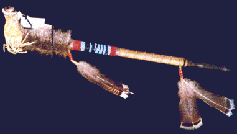
The sacred pipe plays a central ritual role among a great number of North American Indian tribes. The smoke is blown like incense to the celestial Beings, to the earth, and to the four cardinal points. Two young men, in time of famine, were scouting for game upon the prairies. They encounter a solitary beautiful woman. One of the young men, being lascivious in thought of her, is enveloped in a cloud, which, lifting, leaves only his bones. The other, reverent in heart, is instructed to hasten to the tribe and prepare them for the reception of the stranger. The Medicine Lodge is erected, and at sunrise on the following day to the awaiting tribesmen the mysterious maiden appears, bearing with her a sacred calumet. This she bestows, as something very precious, to the tribal custodians, at the same time charging the members of the tribe with their duties to one another. Braided sweet grass was dipped into a buffalo horn containing rain water and was offered to the Maiden. The chief said, 'Sister, we are now ready to hear the good message you have brought.' The pipe, which was in the hands of the Maiden, was lowered and placed on the rack. Then the Maiden sipped the water from the-sweet grass. Then, taking up the pipe again, she arose and said:
'My relatives, brothers and sisters: Wakantanka has looked down, and smiles upon us this day because we have met as belonging to one family. The best thing in a family is good feeling towards every member of the family. I am proud to become a member of your family - a sister to you all. The sun is your grandfather, and he is the same to me. Your tribe has the distinction of being always very faithful to promises, and of possessing great respect and reverence towards sacred things. It is known also that nothing but good feeling prevails in the tribe, and that whenever any member has been found guilty of committing any wrong, that member has been cast out and not allowed to mingle with the other members of the tribe. For all these good qualities in the tribe you have been chosen as worthy and deserving of all good gifts.
I represent the Buffalo tribe, who have sent you this pipe. You are to receive this pipe in the name of all the common people (Indians). Take it, and use it according to my directions. The bowl of the pipe is red stone - a stone not very common and found only at a certain place. This pipe shall be used as a peace maker. The time will come when you shall cease hostilities against other nations. Whenever peace is agreed upon between two tribes or parties this pipe shall be a binding instrument. By this pipe the medicine-men shall be called to administer help to the sick.'"
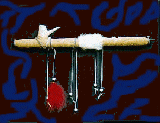
Turning to the women, she said:
'My dear sisters, the women, you have a hard life to live in this world, yet without you this life would not be what it is. Wakantanka intends that you shall bear much sorrow, comfort others in time of sorrow. By your hands the family moves. You have been given the knowledge of making clothes and of feeding the family. Wakantanka is with you in your sorrows and joins you in your griefs. He has given you the great gift of kindness towards every living creature on earth. You, he has chosen to have a feeling for the dead, who are gone. He knows that you remember the dead longer than do the men. He knows that you love your children dearly.'

Then turning to the children:
'My little brothers and sisters, your parents were once little children like you, but in the course of time they became men and women. All living creatures were once small, but if no one took care of them they would never grow up. Your parents love you and have made many sacrifices for your sake in order that Wakantanka may listen to them,and that nothing but good may come to you as you grow up.
I have brought this pipe for them, and you shall reap some benefit from it. Learn to respect and reverence this pipe, and above all, lead pure lives. Wakantanka is your great grandfather.'
Turning to the men:
'Now my dear brothers, In giving you this pipe you are expected to use it for nothing but good purposes. The tribe as a whole shall depend upon it for their necessary needs. You realize that all your necessities of life come from the earth below, the sky above, and the four winds. Whenever you do anything wrong against these elements they will always take some revenge upon you. You should reverence them. Offer sacrifices through this pipe. When you are in need of buffalo meat, smoke this pipe and ask for what you need and it shall be granted you. On you it depends to be a strong help to the women in the raising of children. Share the women's sorrow. Wakantanka smiles on the man who has a kind feeling for a woman, because the woman is weak. Take this pipe, and offer it to Wakantanka daily. Be good and kind to the little children.'
Turning to the chief:
'My older brother, You have been chosen by these people to receive this pipe in the name of the whole Cheyenne tribe.
Wakantanka is pleased and glad this day because you have done what is required and expected that every good leader should do. By this pipe the tribe shall live. It is your duty to see that this pipe is respected and reverenced. I am proud to be called a sister. May Wakantanka look down on us and take pity on us and provide us with what we need. Now we shall smoke the pipe.' Then she took the buffalo chip which lay on the ground, lighted the Pipe, and pointing to the sky with the stem of the pipe, she said, 'I offer this to Wakantanka/ for all the good that comes from above.' (Pointing to the earth:) 'I offer this to the earth, whence come all good gifts.' (Pointing to the cardinal points:) 'I offer this to the four winds, whence come all good things.' Then she took a puff of the pipe, passed it to the chief, and said, 'Now my dear brothers and sisters, I have done the work for which I was sent here and now I will go, but I do not wish any escort. I only ask that the way be cleared before me.' Then, rising, she started, leaving the pipe with the chief, who ordered that the people be quiet until their sister was out of sight. She came out of the tent on the left side, walking very slowly; as soon as she was outside the entrance she turned into a white buffalo calf.
The Sacred Arrow Renewal

Renewal of the sacred arrows is the most sacred of the Cheyenne ceremonies. It is done every year. The ritual is performed around the time of the summer solstice.
Throughout the winter the bands are scattered in smaller groups. The man who pledges ro sponsor the ceremony travels to reach every family encampment to inform them where the ceremony will take place.
On route to the ceremony, each band stops four times to pray and smoke to the four directions. On the day before arriving at camp, they stop to put on their finest clothing and to groom and paint their horses. They approach the camp as they are cheered and applauded by those who have already arrived. Each band goes to the area traditionally reserved for them. Coming together is a social time for visiting, eating, and gambling.
As the ceremony begins, the camp is silent. Silence is strictly enforced. It is the moment of supreme sacredness of the cheyenne people. The individual is insignificant in the solemnness of the ceremony that focuses on the life of the society. The ceremony lasts four days. Women and children remain in their tepees during the four day ritual.
Day 1:
On the first day the pledger's wife raises the Offering Lodge. People bring the offerings (which are robes, food, utensils and colored cloth) they want to give the Great Spirit. The offerings are hung on a pole in front of the lodge or over its door. All the warriors together select a spot for the Arrow Lodge and a few select men with good reputations cut wood for the lodge poles for the Sacred Arrow lodge. The Sacred Arrow Lodge is about two times the size of a regular tepee. After the lodge is erected, the Arrow Keeper and other priests go in and prepare a ceremonial altar and a hearth in the center of the lodge. They also put sage, the ceremonial purifier, around the outer edges of the lodge where the medicine men will sit.
Day 2:
Priests take their places in the Sacred Arrow Lodge. The pledger, who is naked except a buffalo robe and is painted red, leads three other men with good reputations to the Offering Lodge. There they bring in the offerings one by one which the people set outside the Lodge the day before. Then the four men walk slowly to the tepee of the Keeper of the Sacred Arrow. As they approach the tepee they go forward and back four times before going in. The Keeper of the Sacred Arrow prays over them and then gives the pledgers the sacred arrow bundle. Very slowly they return to the Sacred Arrow Lodge with the bundle. Again they stop four times on their way. There the head priest lays the bundle on a prepared bed behind the altar. The Sacred Arrows are removed and examined. If the features are not in good condition a man with a good reputaion is appointed to fix them. The repair is done on the third day.
Day 3:
The third day celebrates the unity of each Cheyenne family with the tribe. A one yard willow stick representing each family is placed near the altar. Every family is represented with the stick unless the family has a murderer within the family. One by one the sticks are burned in the burning incense to bless each individual family. While the family sticks are being burned, the medicine men renew the supernatural power of their medicine paraphernalia in a private ritual.
Day 4:
The Sacred arrows are placed in the sunlight for public view. The pledger carries the Sacred Arrows with the pole they are tied to outside the Sacred Arrow Lodge. Now called the renewal lodge. The priests also bring out the offerings and the boys bring additional offerings from home. All the men and boys (even the smallest of male babies that must be held) go past the arrows and gain the beneficial effects. After all have seen the arrows, the Sacred Arrow Lodge is dismantled and set up over the arrows. A third tepee cover is added so that the tepee is large enough to accomodate all the men of the tribe. This new lodge is called the Sweet Medicine Lodge.
The sacred arrows are removed and taken to the tepee of the Sacred Arrow Keeper. Where the offering tepee was, a sweat bath lodge is erected. The evening of the fourth day, the chief of the tribe, called Sweet Medicine chief, leads the medicine men into the Sweet Medicine Lodge.
They sing four sacred songs which were tought to Sweet Medicine by the Great Spirit.
Just before daybreak of the fifth day, all participants go to the sweat lodge to be symbolically cleansed. Then the women are allowed out of the tepees and the communal hunts begin.
(Hoebel. p. 14-18)
The major important aspects and effects of the Sacred Arrow renewal are:
The dependence of the Cheyenne people on the supernatural is reinforced as well as the belief that all which is good comes from the supernatural world.
It reinforces proper behavior as taught to them by culture heros. If they behave properly the Cheyenne will prosper, if not, bad things may happen. It also honors men who are not chief or medicine men, but who have lived the proper Cheyenne way.
It reinforces the status of the tribal chiefs especially the head chief who has possesion of the medicine bundle. The old men of the tribe are honored, especially the medicine man.
It reinforces the domination of males over females. That is, men participate in the ceremony, but women do not.
It reinforces the unity of the tribe. The tribe is more important than the individual. After the ceremony, they begin a great communal hunt, which also symbolizes their unity.
(Hoebel. p. 14-18).
The Sun Dance
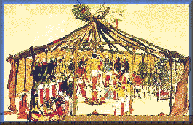
Whereas the Sacred Arrow Renewal is unique to the Cheyenne, the Sun Dance is common to most Plains Indians. The central theme of Sun Dance for the Cheyenne is world renewal. The Sun Dance lasts eight days: four days to build the dance lodge and perform secret rites in the Lone Tepee and four days for the public dance in the Sun Dance Lodge.
One becomes a sponsor of the Sun Dance much the same way as for the Arrow Renewal, for personal reasons. The sponsor or pledger is called "the Reproducer". That is the tribe is renewed and increased in numbers as a consequence of the Sun Dance.
The pledger may not have sexual relationswith his wife for the time he pledges until the completion of the dance. If they do have sexual relations, they will die. The warriors in the pledger's society pick the priest who will enact the part of the Great Spirit. The warriors also give gifts to help defray the cost of the ev ent and direct certain parts of the ceremony.
During the first four days, the participants and others rehearse the Sun Dance songs, feast, and exchange gifts and participate in social dances. This is a time for socializing, feasting and gambling. The entire canp is filled with an atmosphere of fun and happiness.
The building of the Sun Dance lodge is filled with ceremony. A warrior is selected to find a suitable tree for the center pole. He brings the cut tr ee into camp. In mock battle, braves charge at the branches of the tree. Then the other poles are cut and pain ted to represent the four directions. The center pole is the last to be set in place and is done so with ritual and sacrifical offerings. Brush is added to the upper end of the pole to be the nest of the Thunder-bird, the spirit who controls the sun and rain.
In the nest is a "broken arrow, Symbolic of enemy arrows which are thus made useless, a bit of buffalo meat, symbolic of the major food supply, a rope representation of the morning star, and a phallic rawhide effigy of an enemy tribesman." (Hoebel, 1979: 21). As the pole is raised, songs are sung relating to the growth of the earth.
The day the lodge is finished, the priests sing ceremonial songs and dancers dance prescribed dances. It is the time for the great act of regenerative consecration. The high priest and the pledger's wife step over burning incense with a buffalo robe around them to be purified.
The pledger's wife then leads the priests out of the lodge. Outside the lodge they stop and pray for the regeneration of the world. The high priest and the pledger's wife are left alone as the other priests return to the lodge. One of the priest's shout out that the high priest is about to perform the ritual act on behalf of the entire tribe. The high priest and pledger's wife again purify themselves with incense and sing the sacred pipe song while raising the pipe to the sky four times. Then within the buffalo robe, they have sexual intercourse, a ritual to renew the world. Then the dancing begins.
The next day the priests, wife of the pledger, and wife of the high priest build an altar around the sacred buffalo skull (which was prepared in the lone Tepee) in the dance lodge.
The dance itself involves voluntary self-torture in hopes of having good fortune as a result of having been seen favorably by the supernatural spirits. The dancers also gain social prestige and approval. A dancer is attached to a pole by cutting two holes in his skin above his nipples. Skewers are pushed through the holes and ropes hung on the pole are attached to the skewers on both ends. The dancer then dances all night attached to the pole until the skin breaks. If the skin has not broken by morning, a medicine man will cut the skin or a dancer may jerk back in hopes of breaking the skin.
There may also be variations in this. The skewers may be attached to the face or over the shoulder blades. Some may have skewers put in their backs which are attached to as many as fifteen buffalo skulls. The buffalo skulls are dragged around the camp circle.
If the skin has not broken when the dancer is finished with the dance he has pledged the skin is cut away (Hoebel, 1979: 18-22).
According to John Stands in Timber, "the torture never was part of the ceremony at all. It began by itself and then got worked in until people thought it belonged." "Young men would go out in the hills for individual fasting and worship" (Hoebel, 1979: 93). Once a young man got permission to do it in the Sun Dance lodge, and then it became popular to do it in the lodge instead of out in the hills.
The dance lasts four days and nights. The dancers go without food and water for many hours as a sacrifice for aid. Personal torture was added at the end of the ceremony
(Stands in Timber, 92-93)

GO TO "SACRED WAYS 2 (Flute Playing)"
Return to Main Menu
The sacred pipe plays a central ritual role among a great number of North American Indian tribes. The smoke is blown like incense to the celestial Beings, to the earth, and to the four cardinal points. Two young men, in time of famine, were scouting for game upon the prairies. They encounter a solitary beautiful woman. One of the young men, being lascivious in thought of her, is enveloped in a cloud, which, lifting, leaves only his bones. The other, reverent in heart, is instructed to hasten to the tribe and prepare them for the reception of the stranger. The Medicine Lodge is erected, and at sunrise on the following day to the awaiting tribesmen the mysterious maiden appears, bearing with her a sacred calumet. This she bestows, as something very precious, to the tribal custodians, at the same time charging the members of the tribe with their duties to one another. Braided sweet grass was dipped into a buffalo horn containing rain water and was offered to the Maiden. The chief said, 'Sister, we are now ready to hear the good message you have brought.' The pipe, which was in the hands of the Maiden, was lowered and placed on the rack. Then the Maiden sipped the water from the-sweet grass. Then, taking up the pipe again, she arose and said:
'My relatives, brothers and sisters: Wakantanka has looked down, and smiles upon us this day because we have met as belonging to one family. The best thing in a family is good feeling towards every member of the family. I am proud to become a member of your family - a sister to you all. The sun is your grandfather, and he is the same to me. Your tribe has the distinction of being always very faithful to promises, and of possessing great respect and reverence towards sacred things. It is known also that nothing but good feeling prevails in the tribe, and that whenever any member has been found guilty of committing any wrong, that member has been cast out and not allowed to mingle with the other members of the tribe. For all these good qualities in the tribe you have been chosen as worthy and deserving of all good gifts.
I represent the Buffalo tribe, who have sent you this pipe. You are to receive this pipe in the name of all the common people (Indians). Take it, and use it according to my directions. The bowl of the pipe is red stone - a stone not very common and found only at a certain place. This pipe shall be used as a peace maker. The time will come when you shall cease hostilities against other nations. Whenever peace is agreed upon between two tribes or parties this pipe shall be a binding instrument. By this pipe the medicine-men shall be called to administer help to the sick.'"
Turning to the women, she said:
'My dear sisters, the women, you have a hard life to live in this world, yet without you this life would not be what it is. Wakantanka intends that you shall bear much sorrow, comfort others in time of sorrow. By your hands the family moves. You have been given the knowledge of making clothes and of feeding the family. Wakantanka is with you in your sorrows and joins you in your griefs. He has given you the great gift of kindness towards every living creature on earth. You, he has chosen to have a feeling for the dead, who are gone. He knows that you remember the dead longer than do the men. He knows that you love your children dearly.'
Then turning to the children: I have brought this pipe for them, and you shall reap some benefit from it. Learn to respect and reverence this pipe, and above all, lead pure lives. Wakantanka is your great grandfather.'
'My little brothers and sisters, your parents were once little children like you, but in the course of time they became men and women. All living creatures were once small, but if no one took care of them they would never grow up. Your parents love you and have made many sacrifices for your sake in order that Wakantanka may listen to them,and that nothing but good may come to you as you grow up.
Turning to the men:
'Now my dear brothers, In giving you this pipe you are expected to use it for nothing but good purposes. The tribe as a whole shall depend upon it for their necessary needs. You realize that all your necessities of life come from the earth below, the sky above, and the four winds. Whenever you do anything wrong against these elements they will always take some revenge upon you. You should reverence them. Offer sacrifices through this pipe. When you are in need of buffalo meat, smoke this pipe and ask for what you need and it shall be granted you. On you it depends to be a strong help to the women in the raising of children. Share the women's sorrow. Wakantanka smiles on the man who has a kind feeling for a woman, because the woman is weak. Take this pipe, and offer it to Wakantanka daily. Be good and kind to the little children.'
Turning to the chief:
'My older brother, You have been chosen by these people to receive this pipe in the name of the whole Cheyenne tribe.
Wakantanka is pleased and glad this day because you have done what is required and expected that every good leader should do. By this pipe the tribe shall live. It is your duty to see that this pipe is respected and reverenced. I am proud to be called a sister. May Wakantanka look down on us and take pity on us and provide us with what we need. Now we shall smoke the pipe.' Then she took the buffalo chip which lay on the ground, lighted the Pipe, and pointing to the sky with the stem of the pipe, she said, 'I offer this to Wakantanka/ for all the good that comes from above.' (Pointing to the earth:) 'I offer this to the earth, whence come all good gifts.' (Pointing to the cardinal points:) 'I offer this to the four winds, whence come all good things.' Then she took a puff of the pipe, passed it to the chief, and said, 'Now my dear brothers and sisters, I have done the work for which I was sent here and now I will go, but I do not wish any escort. I only ask that the way be cleared before me.' Then, rising, she started, leaving the pipe with the chief, who ordered that the people be quiet until their sister was out of sight. She came out of the tent on the left side, walking very slowly; as soon as she was outside the entrance she turned into a white buffalo calf.
The Sacred Arrow Renewal
Renewal of the sacred arrows is the most sacred of the Cheyenne ceremonies. It is done every year. The ritual is performed around the time of the summer solstice.
Throughout the winter the bands are scattered in smaller groups. The man who pledges ro sponsor the ceremony travels to reach every family encampment to inform them where the ceremony will take place.
On route to the ceremony, each band stops four times to pray and smoke to the four directions. On the day before arriving at camp, they stop to put on their finest clothing and to groom and paint their horses. They approach the camp as they are cheered and applauded by those who have already arrived. Each band goes to the area traditionally reserved for them. Coming together is a social time for visiting, eating, and gambling.
As the ceremony begins, the camp is silent. Silence is strictly enforced. It is the moment of supreme sacredness of the cheyenne people. The individual is insignificant in the solemnness of the ceremony that focuses on the life of the society. The ceremony lasts four days. Women and children remain in their tepees during the four day ritual.
Day 1:
On the first day the pledger's wife raises the Offering Lodge. People bring the offerings (which are robes, food, utensils and colored cloth) they want to give the Great Spirit. The offerings are hung on a pole in front of the lodge or over its door. All the warriors together select a spot for the Arrow Lodge and a few select men with good reputations cut wood for the lodge poles for the Sacred Arrow lodge. The Sacred Arrow Lodge is about two times the size of a regular tepee. After the lodge is erected, the Arrow Keeper and other priests go in and prepare a ceremonial altar and a hearth in the center of the lodge. They also put sage, the ceremonial purifier, around the outer edges of the lodge where the medicine men will sit.
Day 2:
Priests take their places in the Sacred Arrow Lodge. The pledger, who is naked except a buffalo robe and is painted red, leads three other men with good reputations to the Offering Lodge. There they bring in the offerings one by one which the people set outside the Lodge the day before. Then the four men walk slowly to the tepee of the Keeper of the Sacred Arrow. As they approach the tepee they go forward and back four times before going in. The Keeper of the Sacred Arrow prays over them and then gives the pledgers the sacred arrow bundle. Very slowly they return to the Sacred Arrow Lodge with the bundle. Again they stop four times on their way. There the head priest lays the bundle on a prepared bed behind the altar. The Sacred Arrows are removed and examined. If the features are not in good condition a man with a good reputaion is appointed to fix them. The repair is done on the third day.
Day 3:
The third day celebrates the unity of each Cheyenne family with the tribe. A one yard willow stick representing each family is placed near the altar. Every family is represented with the stick unless the family has a murderer within the family. One by one the sticks are burned in the burning incense to bless each individual family. While the family sticks are being burned, the medicine men renew the supernatural power of their medicine paraphernalia in a private ritual.
Day 4:
The Sacred arrows are placed in the sunlight for public view. The pledger carries the Sacred Arrows with the pole they are tied to outside the Sacred Arrow Lodge. Now called the renewal lodge. The priests also bring out the offerings and the boys bring additional offerings from home. All the men and boys (even the smallest of male babies that must be held) go past the arrows and gain the beneficial effects. After all have seen the arrows, the Sacred Arrow Lodge is dismantled and set up over the arrows. A third tepee cover is added so that the tepee is large enough to accomodate all the men of the tribe. This new lodge is called the Sweet Medicine Lodge.
The sacred arrows are removed and taken to the tepee of the Sacred Arrow Keeper. Where the offering tepee was, a sweat bath lodge is erected. The evening of the fourth day, the chief of the tribe, called Sweet Medicine chief, leads the medicine men into the Sweet Medicine Lodge.
They sing four sacred songs which were tought to Sweet Medicine by the Great Spirit.
Just before daybreak of the fifth day, all participants go to the sweat lodge to be symbolically cleansed. Then the women are allowed out of the tepees and the communal hunts begin.
(Hoebel. p. 14-18)
The major important aspects and effects of the Sacred Arrow renewal are:
The dependence of the Cheyenne people on the supernatural is reinforced as well as the belief that all which is good comes from the supernatural world.
It reinforces proper behavior as taught to them by culture heros. If they behave properly the Cheyenne will prosper, if not, bad things may happen. It also honors men who are not chief or medicine men, but who have lived the proper Cheyenne way.
It reinforces the status of the tribal chiefs especially the head chief who has possesion of the medicine bundle. The old men of the tribe are honored, especially the medicine man.
It reinforces the domination of males over females. That is, men participate in the ceremony, but women do not.
It reinforces the unity of the tribe. The tribe is more important than the individual. After the ceremony, they begin a great communal hunt, which also symbolizes their unity.
(Hoebel. p. 14-18).
The Sun Dance
Whereas the Sacred Arrow Renewal is unique to the Cheyenne, the Sun Dance is common to most Plains Indians. The central theme of Sun Dance for the Cheyenne is world renewal. The Sun Dance lasts eight days: four days to build the dance lodge and perform secret rites in the Lone Tepee and four days for the public dance in the Sun Dance Lodge.
One becomes a sponsor of the Sun Dance much the same way as for the Arrow Renewal, for personal reasons. The sponsor or pledger is called "the Reproducer". That is the tribe is renewed and increased in numbers as a consequence of the Sun Dance.
The pledger may not have sexual relationswith his wife for the time he pledges until the completion of the dance. If they do have sexual relations, they will die. The warriors in the pledger's society pick the priest who will enact the part of the Great Spirit. The warriors also give gifts to help defray the cost of the ev ent and direct certain parts of the ceremony.
During the first four days, the participants and others rehearse the Sun Dance songs, feast, and exchange gifts and participate in social dances. This is a time for socializing, feasting and gambling. The entire canp is filled with an atmosphere of fun and happiness.
The building of the Sun Dance lodge is filled with ceremony. A warrior is selected to find a suitable tree for the center pole. He brings the cut tr ee into camp. In mock battle, braves charge at the branches of the tree. Then the other poles are cut and pain ted to represent the four directions. The center pole is the last to be set in place and is done so with ritual and sacrifical offerings. Brush is added to the upper end of the pole to be the nest of the Thunder-bird, the spirit who controls the sun and rain.
In the nest is a "broken arrow, Symbolic of enemy arrows which are thus made useless, a bit of buffalo meat, symbolic of the major food supply, a rope representation of the morning star, and a phallic rawhide effigy of an enemy tribesman." (Hoebel, 1979: 21). As the pole is raised, songs are sung relating to the growth of the earth.
The day the lodge is finished, the priests sing ceremonial songs and dancers dance prescribed dances. It is the time for the great act of regenerative consecration. The high priest and the pledger's wife step over burning incense with a buffalo robe around them to be purified.
The pledger's wife then leads the priests out of the lodge. Outside the lodge they stop and pray for the regeneration of the world. The high priest and the pledger's wife are left alone as the other priests return to the lodge. One of the priest's shout out that the high priest is about to perform the ritual act on behalf of the entire tribe. The high priest and pledger's wife again purify themselves with incense and sing the sacred pipe song while raising the pipe to the sky four times. Then within the buffalo robe, they have sexual intercourse, a ritual to renew the world. Then the dancing begins.
The next day the priests, wife of the pledger, and wife of the high priest build an altar around the sacred buffalo skull (which was prepared in the lone Tepee) in the dance lodge.
The dance itself involves voluntary self-torture in hopes of having good fortune as a result of having been seen favorably by the supernatural spirits. The dancers also gain social prestige and approval. A dancer is attached to a pole by cutting two holes in his skin above his nipples. Skewers are pushed through the holes and ropes hung on the pole are attached to the skewers on both ends. The dancer then dances all night attached to the pole until the skin breaks. If the skin has not broken by morning, a medicine man will cut the skin or a dancer may jerk back in hopes of breaking the skin.
There may also be variations in this. The skewers may be attached to the face or over the shoulder blades. Some may have skewers put in their backs which are attached to as many as fifteen buffalo skulls. The buffalo skulls are dragged around the camp circle.
If the skin has not broken when the dancer is finished with the dance he has pledged the skin is cut away (Hoebel, 1979: 18-22).
According to John Stands in Timber, "the torture never was part of the ceremony at all. It began by itself and then got worked in until people thought it belonged." "Young men would go out in the hills for individual fasting and worship" (Hoebel, 1979: 93). Once a young man got permission to do it in the Sun Dance lodge, and then it became popular to do it in the lodge instead of out in the hills.
The dance lasts four days and nights. The dancers go without food and water for many hours as a sacrifice for aid. Personal torture was added at the end of the ceremony
(Stands in Timber, 92-93)
GO TO "SACRED WAYS 2 (Flute Playing)"
Return toMain Menu
Renewal of the sacred arrows is the most sacred of the Cheyenne ceremonies. It is done every year. The ritual is performed around the time of the summer solstice.
Throughout the winter the bands are scattered in smaller groups. The man who pledges ro sponsor the ceremony travels to reach every family encampment to inform them where the ceremony will take place.
On route to the ceremony, each band stops four times to pray and smoke to the four directions. On the day before arriving at camp, they stop to put on their finest clothing and to groom and paint their horses. They approach the camp as they are cheered and applauded by those who have already arrived. Each band goes to the area traditionally reserved for them. Coming together is a social time for visiting, eating, and gambling.
As the ceremony begins, the camp is silent. Silence is strictly enforced. It is the moment of supreme sacredness of the cheyenne people. The individual is insignificant in the solemnness of the ceremony that focuses on the life of the society. The ceremony lasts four days. Women and children remain in their tepees during the four day ritual.
On the first day the pledger's wife raises the Offering Lodge. People bring the offerings (which are robes, food, utensils and colored cloth) they want to give the Great Spirit. The offerings are hung on a pole in front of the lodge or over its door. All the warriors together select a spot for the Arrow Lodge and a few select men with good reputations cut wood for the lodge poles for the Sacred Arrow lodge. The Sacred Arrow Lodge is about two times the size of a regular tepee. After the lodge is erected, the Arrow Keeper and other priests go in and prepare a ceremonial altar and a hearth in the center of the lodge. They also put sage, the ceremonial purifier, around the outer edges of the lodge where the medicine men will sit.
Priests take their places in the Sacred Arrow Lodge. The pledger, who is naked except a buffalo robe and is painted red, leads three other men with good reputations to the Offering Lodge. There they bring in the offerings one by one which the people set outside the Lodge the day before. Then the four men walk slowly to the tepee of the Keeper of the Sacred Arrow. As they approach the tepee they go forward and back four times before going in. The Keeper of the Sacred Arrow prays over them and then gives the pledgers the sacred arrow bundle. Very slowly they return to the Sacred Arrow Lodge with the bundle. Again they stop four times on their way. There the head priest lays the bundle on a prepared bed behind the altar. The Sacred Arrows are removed and examined. If the features are not in good condition a man with a good reputaion is appointed to fix them. The repair is done on the third day.
The third day celebrates the unity of each Cheyenne family with the tribe. A one yard willow stick representing each family is placed near the altar. Every family is represented with the stick unless the family has a murderer within the family. One by one the sticks are burned in the burning incense to bless each individual family. While the family sticks are being burned, the medicine men renew the supernatural power of their medicine paraphernalia in a private ritual.
The Sacred arrows are placed in the sunlight for public view. The pledger carries the Sacred Arrows with the pole they are tied to outside the Sacred Arrow Lodge. Now called the renewal lodge. The priests also bring out the offerings and the boys bring additional offerings from home. All the men and boys (even the smallest of male babies that must be held) go past the arrows and gain the beneficial effects. After all have seen the arrows, the Sacred Arrow Lodge is dismantled and set up over the arrows. A third tepee cover is added so that the tepee is large enough to accomodate all the men of the tribe. This new lodge is called the Sweet Medicine Lodge.
The sacred arrows are removed and taken to the tepee of the Sacred Arrow Keeper. Where the offering tepee was, a sweat bath lodge is erected. The evening of the fourth day, the chief of the tribe, called Sweet Medicine chief, leads the medicine men into the Sweet Medicine Lodge.
They sing four sacred songs which were tought to Sweet Medicine by the Great Spirit.
Just before daybreak of the fifth day, all participants go to the sweat lodge to be symbolically cleansed. Then the women are allowed out of the tepees and the communal hunts begin.
(Hoebel. p. 14-18)
The major important aspects and effects of the Sacred Arrow renewal are:
The dependence of the Cheyenne people on the supernatural is reinforced as well as the belief that all which is good comes from the supernatural world.
It reinforces proper behavior as taught to them by culture heros. If they behave properly the Cheyenne will prosper, if not, bad things may happen. It also honors men who are not chief or medicine men, but who have lived the proper Cheyenne way.
It reinforces the status of the tribal chiefs especially the head chief who has possesion of the medicine bundle. The old men of the tribe are honored, especially the medicine man.
It reinforces the domination of males over females. That is, men participate in the ceremony, but women do not.
It reinforces the unity of the tribe. The tribe is more important than the individual. After the ceremony, they begin a great communal hunt, which also symbolizes their unity.
(Hoebel. p. 14-18).
The Sun Dance
Whereas the Sacred Arrow Renewal is unique to the Cheyenne, the Sun Dance is common to most Plains Indians. The central theme of Sun Dance for the Cheyenne is world renewal. The Sun Dance lasts eight days: four days to build the dance lodge and perform secret rites in the Lone Tepee and four days for the public dance in the Sun Dance Lodge.
One becomes a sponsor of the Sun Dance much the same way as for the Arrow Renewal, for personal reasons. The sponsor or pledger is called "the Reproducer". That is the tribe is renewed and increased in numbers as a consequence of the Sun Dance.
The pledger may not have sexual relationswith his wife for the time he pledges until the completion of the dance. If they do have sexual relations, they will die. The warriors in the pledger's society pick the priest who will enact the part of the Great Spirit. The warriors also give gifts to help defray the cost of the ev ent and direct certain parts of the ceremony.
During the first four days, the participants and others rehearse the Sun Dance songs, feast, and exchange gifts and participate in social dances. This is a time for socializing, feasting and gambling. The entire canp is filled with an atmosphere of fun and happiness.
The building of the Sun Dance lodge is filled with ceremony. A warrior is selected to find a suitable tree for the center pole. He brings the cut tr ee into camp. In mock battle, braves charge at the branches of the tree. Then the other poles are cut and pain ted to represent the four directions. The center pole is the last to be set in place and is done so with ritual and sacrifical offerings. Brush is added to the upper end of the pole to be the nest of the Thunder-bird, the spirit who controls the sun and rain.
In the nest is a "broken arrow, Symbolic of enemy arrows which are thus made useless, a bit of buffalo meat, symbolic of the major food supply, a rope representation of the morning star, and a phallic rawhide effigy of an enemy tribesman." (Hoebel, 1979: 21). As the pole is raised, songs are sung relating to the growth of the earth.
The day the lodge is finished, the priests sing ceremonial songs and dancers dance prescribed dances. It is the time for the great act of regenerative consecration. The high priest and the pledger's wife step over burning incense with a buffalo robe around them to be purified.
The pledger's wife then leads the priests out of the lodge. Outside the lodge they stop and pray for the regeneration of the world. The high priest and the pledger's wife are left alone as the other priests return to the lodge. One of the priest's shout out that the high priest is about to perform the ritual act on behalf of the entire tribe. The high priest and pledger's wife again purify themselves with incense and sing the sacred pipe song while raising the pipe to the sky four times. Then within the buffalo robe, they have sexual intercourse, a ritual to renew the world. Then the dancing begins.
The next day the priests, wife of the pledger, and wife of the high priest build an altar around the sacred buffalo skull (which was prepared in the lone Tepee) in the dance lodge.
The dance itself involves voluntary self-torture in hopes of having good fortune as a result of having been seen favorably by the supernatural spirits. The dancers also gain social prestige and approval. A dancer is attached to a pole by cutting two holes in his skin above his nipples. Skewers are pushed through the holes and ropes hung on the pole are attached to the skewers on both ends. The dancer then dances all night attached to the pole until the skin breaks. If the skin has not broken by morning, a medicine man will cut the skin or a dancer may jerk back in hopes of breaking the skin.
There may also be variations in this. The skewers may be attached to the face or over the shoulder blades. Some may have skewers put in their backs which are attached to as many as fifteen buffalo skulls. The buffalo skulls are dragged around the camp circle.
If the skin has not broken when the dancer is finished with the dance he has pledged the skin is cut away (Hoebel, 1979: 18-22).
According to John Stands in Timber, "the torture never was part of the ceremony at all. It began by itself and then got worked in until people thought it belonged." "Young men would go out in the hills for individual fasting and worship" (Hoebel, 1979: 93). Once a young man got permission to do it in the Sun Dance lodge, and then it became popular to do it in the lodge instead of out in the hills.
The dance lasts four days and nights. The dancers go without food and water for many hours as a sacrifice for aid. Personal torture was added at the end of the ceremony
(Stands in Timber, 92-93)
GO TO "SACRED WAYS 2 (Flute Playing)"
Return toMain Menu
Whereas the Sacred Arrow Renewal is unique to the Cheyenne, the Sun Dance is common to most Plains Indians. The central theme of Sun Dance for the Cheyenne is world renewal. The Sun Dance lasts eight days: four days to build the dance lodge and perform secret rites in the Lone Tepee and four days for the public dance in the Sun Dance Lodge.
One becomes a sponsor of the Sun Dance much the same way as for the Arrow Renewal, for personal reasons. The sponsor or pledger is called "the Reproducer". That is the tribe is renewed and increased in numbers as a consequence of the Sun Dance.
The pledger may not have sexual relationswith his wife for the time he pledges until the completion of the dance. If they do have sexual relations, they will die. The warriors in the pledger's society pick the priest who will enact the part of the Great Spirit. The warriors also give gifts to help defray the cost of the ev ent and direct certain parts of the ceremony.
During the first four days, the participants and others rehearse the Sun Dance songs, feast, and exchange gifts and participate in social dances. This is a time for socializing, feasting and gambling. The entire canp is filled with an atmosphere of fun and happiness.
The building of the Sun Dance lodge is filled with ceremony. A warrior is selected to find a suitable tree for the center pole. He brings the cut tr ee into camp. In mock battle, braves charge at the branches of the tree. Then the other poles are cut and pain ted to represent the four directions. The center pole is the last to be set in place and is done so with ritual and sacrifical offerings. Brush is added to the upper end of the pole to be the nest of the Thunder-bird, the spirit who controls the sun and rain.
In the nest is a "broken arrow, Symbolic of enemy arrows which are thus made useless, a bit of buffalo meat, symbolic of the major food supply, a rope representation of the morning star, and a phallic rawhide effigy of an enemy tribesman." (Hoebel, 1979: 21). As the pole is raised, songs are sung relating to the growth of the earth.
The day the lodge is finished, the priests sing ceremonial songs and dancers dance prescribed dances. It is the time for the great act of regenerative consecration. The high priest and the pledger's wife step over burning incense with a buffalo robe around them to be purified.
The pledger's wife then leads the priests out of the lodge. Outside the lodge they stop and pray for the regeneration of the world. The high priest and the pledger's wife are left alone as the other priests return to the lodge. One of the priest's shout out that the high priest is about to perform the ritual act on behalf of the entire tribe. The high priest and pledger's wife again purify themselves with incense and sing the sacred pipe song while raising the pipe to the sky four times. Then within the buffalo robe, they have sexual intercourse, a ritual to renew the world. Then the dancing begins.
The next day the priests, wife of the pledger, and wife of the high priest build an altar around the sacred buffalo skull (which was prepared in the lone Tepee) in the dance lodge.
The dance itself involves voluntary self-torture in hopes of having good fortune as a result of having been seen favorably by the supernatural spirits. The dancers also gain social prestige and approval. A dancer is attached to a pole by cutting two holes in his skin above his nipples. Skewers are pushed through the holes and ropes hung on the pole are attached to the skewers on both ends. The dancer then dances all night attached to the pole until the skin breaks. If the skin has not broken by morning, a medicine man will cut the skin or a dancer may jerk back in hopes of breaking the skin.
There may also be variations in this. The skewers may be attached to the face or over the shoulder blades. Some may have skewers put in their backs which are attached to as many as fifteen buffalo skulls. The buffalo skulls are dragged around the camp circle.
If the skin has not broken when the dancer is finished with the dance he has pledged the skin is cut away (Hoebel, 1979: 18-22).
According to John Stands in Timber, "the torture never was part of the ceremony at all. It began by itself and then got worked in until people thought it belonged." "Young men would go out in the hills for individual fasting and worship" (Hoebel, 1979: 93). Once a young man got permission to do it in the Sun Dance lodge, and then it became popular to do it in the lodge instead of out in the hills.
The dance lasts four days and nights. The dancers go without food and water for many hours as a sacrifice for aid. Personal torture was added at the end of the ceremony
(Stands in Timber, 92-93)
Main Menu